Information Gain is a metric that Google actively uses to evaluate how original and unique the information you offer on your website pages is compared to the content that already exists on the web.
It is about what additional value you offer in a particular niche, on a particular topic.
Instead of rewriting already known information, Google rewards content that provides fresher information, describes personal experience, or offers some unique data.

Information Gain Meaning
In machine learning and information theory, this term refers to a mathematical change in entropy. Google has a patent titled “Contextual Estimation of Information Gain.”
Patent Architecture
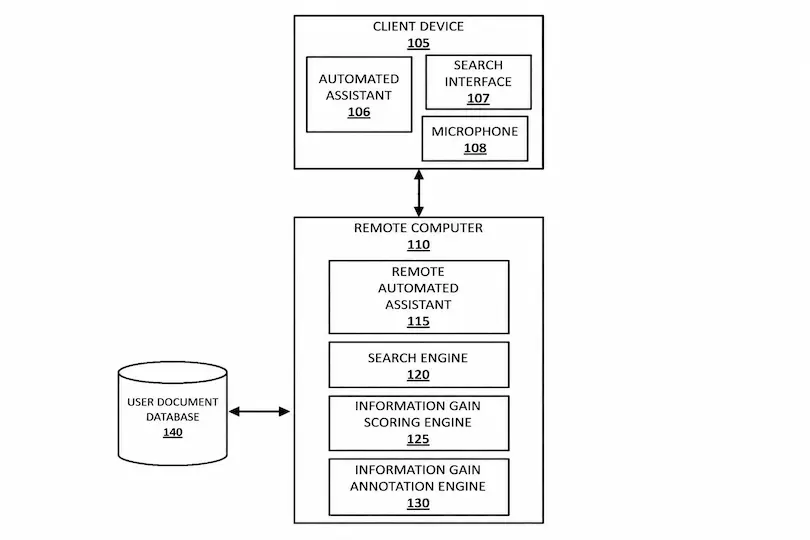
Simplified architecture from Google’s Contextual Estimation of Information Gain patent.
How to Implement Information Gain in Your Content Strategy?
Rewriting content has not worked for a long time. And if you only found out about this now, well, you probably missed the updates that Google has been implementing over the last period of time.
I remember the times when I started doing SEO in 2010, and we would simply take articles from the top results, rewrite them, add more keywords, place more links to the website, and often outrank even the articles from which we took the content.
Thank God those times are over, because it was unfair, unethical, and uninformative, we were not creating any additional value. Now I understand that all these changes are for the better. Of course, we want to reach the top with minimal effort, but we have to explain why exactly we deserve to be there.
After the emergence of AI assistants, search results have simply become flooded with a huge amount of material that is either rewritten or generated according to specific prompts. And Google had to do something about it. That is why it started valuing content that does not repeat existing information, but adds something new for users.
This is exactly where the concept of information gain appeared.
Information gain is the ability of a search engine to evaluate how much more useful, more original, and unique information a document contains compared to the content that already exists in search results.
Google does not disclose all the details of its ranking algorithms and patents. Patents, research, and numerous comments from company representatives show that search engines have already learned how to identify unique insights, original data, practical experience, and real expert knowledge.
Therefore, in practice, information gain is capable of giving users answers that competitors do not already provide.
Therefore, if your article already contains the same ideas that are already present on other websites, Google will have no reason to rank it, and you will hardly be able to get traffic from it.
Therefore, if your content strategy is built around taking articles that are already ranking at the top and simply rewriting them, adding more text, stop and think about how you can implement it differently.
There are many options. Think about which one you will choose.
Traditional Content vs Information Gain
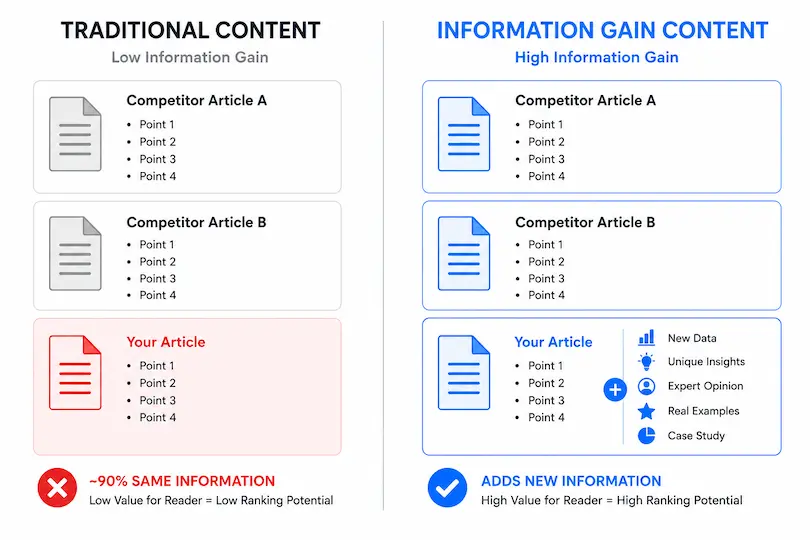
How to Implement Information Gain?
Adding Your Own Experience
If you are an expert in your niche, you will always have something to write about. Tell people what interesting things happened specifically to you.
In every article, I add a joke or a story from my life. And this article is no exception. I’ll tell you how we grew our traffic in a complex niche like online pharmacy.
Publish Unique Data
Most likely, you have some statistical information: your sales data, your client data, some observations, unique data. You can package all of this and present it nicely in the form of an infographic or as some kind of statistics, table, and so on.
There are many options. The most important thing is that you give this content some additional value.
Reveal More Details
Even if you see that certain strategies and mechanics have already been described in search results, but competitors have missed some specific details, you can use that. You can implement those details and gain more visibility.
This is called Passage Ranking, when Google can rank an individual fragment of your page. And instead of evaluating the entire document as a whole, Google uses the processing of individual paragraphs or sections to determine how well they match search queries.
If you have a very long article, you can win simply because of one paragraph where you describe an interesting mechanic or observation.
New Points of View
Yes, it is very difficult to swim against the current, especially if everyone in the niche has already agreed on something, and you want to challenge what many people consider normal.
A simple example is my article about LSI keywords on this site, where I clearly point out that some people misunderstand the term “LSI keywords”.
I name the article the way people search for it, but inside the article I write that it does not exist, that we are interpreting this term incorrectly.
Therefore, if you have an original point of view or some observations, and you can support them with facts, why not? You can confidently state them.
Naturally, you should not have contradictory data. If you publish knowingly incorrect information, then of course you will not rank either, because Google has completely different information in its Knowledge Graph.
But if you provide your own new point of view, that will be a good thing.
To summarize, after reading the article, your user should learn something new and original, exactly something that they cannot find on other websites.
What Does Google Value in Content?
First of all, Google values unique experience. This is one of the strongest signals in information gain. This is your practical experience.
Most articles explain a topic theoretically, but not everyone has real examples and practical information. For example, if you write the phrase that internal linking helps a lot with SEO rankings, it is much better to explain exactly how internal linking increases page indexing and improves page rankings.
A specific case: we did this, increased our internal linking, and achieved a certain ranking result. This will work much better.
Add New Data and Research
Here I want to tell one interesting story. At one point, I was the head of an online pharmacy, and my task was to implement a blog. I did not know this niche very well, so I took a very simple approach. I hired a person into my department for a couple of months who had worked in a real physical pharmacy.
That person knew medications very well and understood what people were asking about. Together with this employee, we conducted several small interviews. The employee prepared the data. We knew which medications people requested most often and what interested them the most when making a choice.
In this way, we created real information. We simply conducted interviews, recorded this person’s answers by voice, and then transcribed the audio into text format and turned it into articles.
This content was extremely expert because the person had worked in a real pharmacy for a very long time and knew the niche 100%.
So, we’ve grown our traffic from 250,000 users since I started working there to 1.5 million visitors per month. You’ll agree: we’ve done a pretty good job in content marketing.
Depth of Coverage
Many materials simply explain the basics or provide a summary of what something means, and do not always explain why it works. Even more importantly, they do not explain why it may not work, what mistakes can be made, and how to avoid them.
Because if you have experience in a particular niche, then most likely you have made mistakes and know how to avoid them.
Therefore, do not chase text volume, it is better to focus on depth. An article can be short but quite deep.
You do not need to aim for 5,000 words if you have nothing to write about. Write a 2,000-word article instead, but with useful conclusions and in-depth information.
Freshness, a Fresh Perspective
Google is interested in alternative points of view. If all the articles in a niche say the same thing, you can always add something unique from yourself, challenge certain ideas, and express your own perspective.
If you can do that, then try to show the limitations of popular advice in your materials. If established approaches do not work, criticize them constructively. Demonstrate how a problem can be solved in a non-standard way.
Explain that generally accepted recommendations do not always work. Sometimes it may be better to look for a shorter path instead of walking down a long well-trodden road.
This allows the user to look at the problem much more broadly.
How to Write a Modern Article That Aligns With Information Gain?
Start with competitors. Look at the SERP, see what is already ranking for the query, what topics competitors have covered, what they have missed, what examples they use, what questions they raised but only partially answered, and what important details your competitors overlooked.
This will be your opportunity for growth and gaining a competitive advantage.
Interview Experts
Most likely, the experts in your niche are busy doing something other than writing blog articles. They do not have time for that. Interview them.
It is much easier for a person to talk about a topic than to write an article. Writing articles is not that easy, and it is not something everyone can do.
Therefore, there is no need to torture people if they do not like typing or writing.
Analyze and create the structure of the article. What can you include? What additional facts can be added? What will be the meat of this article?
And adopt one simple rule: more meat and less water.
That way your content will be much more useful.
Create a small checklist. Ask yourself three simple questions.
Are you telling something new that competitors do not have?
If you have nothing to add, then the content will most likely be similar to existing materials, and you will have fewer chances to rank.
Can the reader find this information on a website that just appeared in the search results?
If yes, if they can find all of this from competitors, then the quality of your material also decreases compared to competitors.
Is the information supported by facts or personal experience?
If you talk about something abstractly, the user will notice it, and the search engine will too.
Tell your own stories and add more uniqueness to your content.
Article after we implemented Information Gain
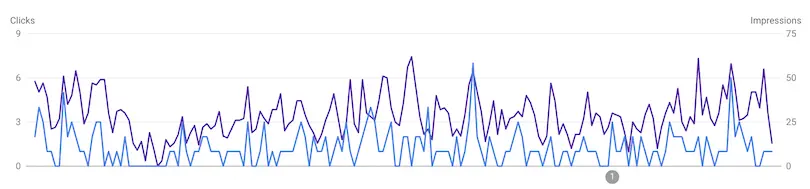
Create a Checklist for Your Article
I actually love checklists. I remember that at one job they told me: “You should not limit employees with checklists and instructions.” But a checklist is not a limitation at all.
A checklist does not explain HOW to do something. A checklist specifies WHAT exactly needs to be done. In simple terms, it helps you not miss anything when launching a project. And that is a very cool thing.
I have a checklist for articles on my website where I verify what should be included in an article. It is not because I want to control someone. It is so that I do not forget anything: so that I do not forget to use H2 headings, so that I do not forget to use the keyword in the Title.
Lists, quotes, tables, infographics — all of that is included in my checklist, so I do not forget anything.
Custom examples and analytical data should also be included in the checklist.
Data Visualization
Of course, an article is good to read, but it is even better to look at. Therefore, think about how you can enrich your article with content.
You can create screenshots if you are describing tools. You can make infographics. Personally, I use Canva, I like it very much and have been working with it for a long time.
You can create tables if you have a good database and can provide some statistical information.
If you have a designer or web designer in your company, they can visually display statistics for you, the way Statista.com does. It is very cool. This kind of information ranks well and is also very easy to consume visually.
If you do not have a graphic designer, modern AI assistants can create beautiful HTML layouts for your charts or dashboards, and you can add them to the page.
Hidden User Questions
It is impossible to write an article that leaves no questions unanswered. However, try to anticipate them.
You can create an FAQ section where you answer questions that users may have.
You can also add a comments section. Yes, it is risky. People will spam there, they will post some user-generated content that you most likely will not want to see.
But good comments may appear as well, so you will simply have some additional work processing those comments.
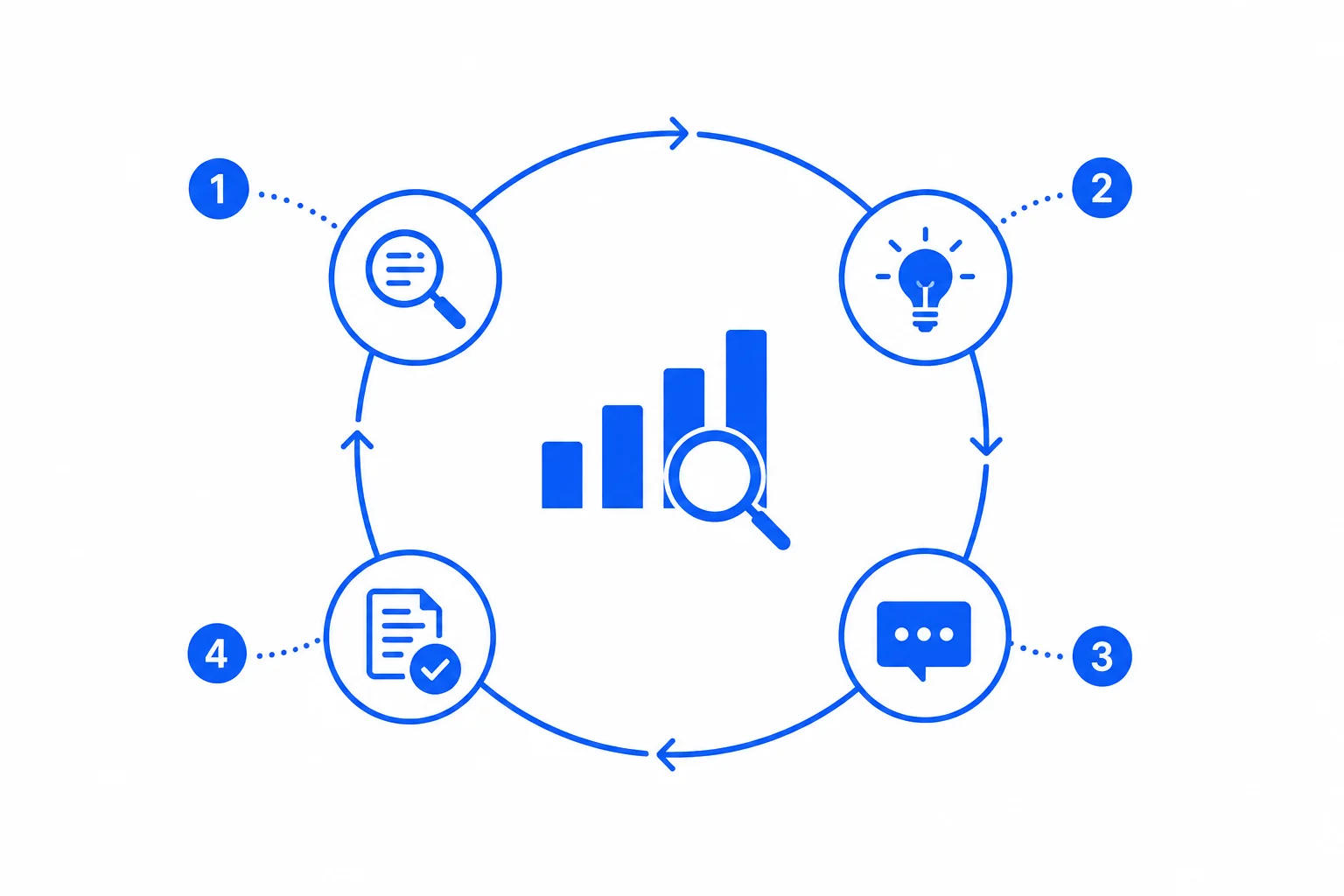
Information Gain and E-E-A-T
Information Gain is directly connected to the E-E-A-T concept, and together they form an inseparable connection.
If you have forgotten, let me remind you that E-E-A-T includes four components:
- Experience
- Expertise
- Authoritativeness
- Trustworthiness
Therefore, when you publish original research, you cover the expertise component.
When you share your own experience, you cover the experience component.
When you publish statistics and other websites begin linking to you, your authoritativeness grows.
When your claims are supported by evidence, trust in your resource increases.
In this way, you cover all four E-E-A-T components that contribute to the growth of Information Gain.
It looks like a perfect combination.
Therefore, websites that create new knowledge are much harder to displace from search results than websites that simply rewrite someone else’s content.
Conclusion
It may seem that Information Gain is about how creating content has become more difficult. In my opinion, it is not. It is more about not forgetting to actually create content.
It is easier for you to tell a story. Well, for me personally, it is definitely easier to tell a story than to formulate very complex definitions.
I remember that when I was studying at university, I could not formulate a definition for a certain term. Forget it, there is no need to do that. Just explain the topic and reveal its depth.
If you do not know where to start, start small. Take one of your old articles, update it, add your own experience, your original data, new details, or conclusions that you missed when writing it.
And something magical will happen — that article will start ranking better.
Therefore, do not focus on producing a large quantity of materials. Focus on depth.
That is all from me. Read my other articles on this website.