Generative Engine Optimization (GEO) is the process of structuring content in such a way that search engines that use artificial intelligence and LLM systems, such as Google AI, Perplexity, ChatGPT, and Gemini, can easily read and synthesize information in their answers and conversations.
For more than 20 years, search remained unchanged. Our goal was to get a page as high as possible in search engine results.
I even remember conversations between SEO specialists at various conferences saying that the niche was becoming boring to work in, that nothing was happening, that everyone had already learned the basics of SEO optimization and everyone was operating under equal conditions. In other words, it was very difficult to provide any additional value.
Well, congratulations, the rules have changed, and now we are starting to live by new rules. Now we won’t be bored. 😊

What Is GEO?
Generative Engine Optimization is the process of optimizing content for search engines and AI assistants such as ChatGPT, Claude, Google Gemini, AI Overview, Perplexity, Grok, and so on.
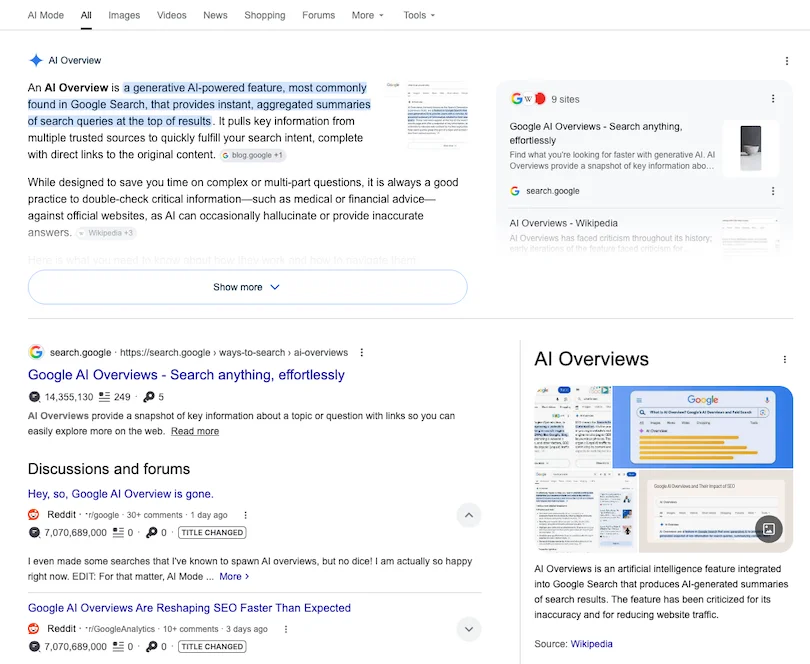
The main goal of GEO is for artificial intelligence to use your content when generating its answers.
Users receive a direct answer directly within the search engine or AI assistant interface, and instead of links they see a short summary generated by artificial intelligence based on multiple sources.
According to research by SparkToro, the share of searches performed without visiting websites continues to grow. More and more users receive the information they need directly within a search engine or chatbot. As a result, out of every 1,000 search queries, independent websites receive only 360 clicks. On mobile devices, this figure is even higher.
SEO vs GEO. What Has Changed?
Many people believe that GEO has become a complete replacement for SEO, but in reality this is not the case.
What we are talking about is a change in the search interface.
If previously the standard user journey looked like this:
- entering a query;
- receiving a list of links;
- visiting a website;
- getting an answer.
Now a completely different model is used:
- entering a query;
- receiving an answer;
- then a visit to sources may happen.
You have to admit that the difference is already significant.
How Do Generative Search Engines Choose Sources?
Yes, we already understand that we need to become a source, but how do we actually do that?
When users ask a question in ChatGPT, Gemini, or Perplexity, artificial intelligence does not look for the best match or the website that deserves the most trust.
Instead, the model tries to create the most complete answer possible based on different information.
Therefore, the role of a website is now changing.
If previously we needed to rank at the top for keywords, now we need to become a source that AI systems and AI assistants trust.
The exact algorithms of generative systems are, of course, not disclosed, but we can identify several factors that regularly appear among websites cited in AI answers.
Source Authority
Generative systems rely on resources with a strong reputation, and therefore they try to take data from well-known brands, industry media, various research sources, official sources, as well as websites of recognized experts.
Therefore, the higher the trust in the source, the greater the likelihood that it will be used in AI answers.
Completeness of Answers
Yes, of course, AI prefers materials that fully satisfy the user’s query.
Therefore, an article titled “What Is GEO” with examples, definitions, advantages and disadvantages, and step-by-step recommendations will have a much greater chance of appearing in an answer than a short note or glossary containing only 500–700 words.
Structured Content
Generative models find it very easy to use materials that have a clear structure.
This may include:
- H2 and H3 headings;
- bullet lists;
- tables;
- FAQ sections;
- instructions;
- quotes.
Therefore, the easier it is to extract information from a page, the easier it is to appear in generative system answers.
In this way, you create content blocks on your website that can later be used by AI generative systems.
Mentions on Other Resources
Generative systems also evaluate not only the content of your website but your overall presence in the information ecosystem.
If your brand is actively mentioned in research, reviews, professional communities, or industry publications, this also increases the likelihood of appearing in answers.
And GEO operates at the intersection of classic SEO, PR, and content marketing within a single system.
Ranking Factors in GEO
E-E-A-T and Trust in the Source
Of course, one of the main signals remains the concept of E-E-A-T — Experience, Expertise, Authoritativeness, and Trustworthiness.
Therefore, if content is created by an expert in a particular niche, contains real examples, and is published on an authoritative resource, the probability of it being used increases significantly.
That is why you need to create authors on your website. Not invent them, but add real authors, create author pages, indicate their professional experience, links to social networks or LinkedIn, show their real case studies, expert comments, and brand citations.
Algorithmic systems also need to understand which companies are considered authoritative within their niche.
Useful signals may include media publications, rankings, research, and expert interviews.
Unique Data
Publish unique data, do not simply retell publicly available information.
You can conduct your own research, show internal statistics, customer surveys, and experiment results.
In this way, you will obtain unique data that none of your competitors have.
Freshness of Information
Of course, generative systems want to show the freshest answers possible.
This is especially important for niches such as finance, medicine, marketing, technology, and legislation.
Here we use the concept of YMYL (Your Money Your Life).
For these niches, this becomes especially important.
Semantic Completeness
The better you connect materials together, the higher your topical authority, and the more in-depth materials you have covering a topic, the greater the probability of appearing in generative answers.
Therefore, detailed guides and topical resources will receive an advantage over simple and superficial publications.
Content Optimization for GEO
I’ll give you a few tips to help increase your chances of appearing in the answers.
While the algorithms that underlie generative systems remain proprietary and don’t always provide transparent data, practical testing reveals a clear set of optimization rules.
Implementing the following content standards will significantly increase your chances of getting mentioned in AI-generated publications.
Using the “Answer → Details” Structure
Previously, we created content according to the following model:
When I started working in SEO in 2010, our task was to provide an introduction, history, context, and only then the answer. We inserted questions exactly as users typed them and used those questions to create exact keyword matches.
Now the approach has completely changed.
Provide the answer directly on the first screen and only then move on to details and explanations.
Content That Can Be Quoted
Create content that can easily appear in answers.
Look at how much space AI system answers occupy.
Short definitions work very well.
You can highlight quotes, short conclusions, lists of advantages and disadvantages, comparison tables, fact blocks, and so on.
Therefore, instead of a long paragraph, it is better to use a couple of specific sentences and format them as quotes or highlight them in some way so that the content has a chance of appearing in an answer.
Statistics and Specific Data
You can use research results, survey data, and industry statistics to support your experience and show facts and figures to generative systems.
Tables
Tables are also a very convenient format for analysis, and such blocks are an important source for generative answers.
FAQ
FAQ sections are also a great example of how people interact with AI assistants.
Therefore, you can place relevant queries there.
For example:
Can GEO replace SEO?
And we provide the answer that no, GEO and SEO solve different tasks, and most likely they will exist in parallel.
Which systems use GEO?
Here we can write that ChatGPT, Google AI Overview, Gemini, Perplexity, Google Cloud, and Grok will use additional intents and increase the likelihood of appearing in AI-generated answers.
How to Measure GEO Performance?
Previously, everything was simple. We could see rankings, see traffic, and understand the effectiveness of the work done on our website.
Now, one of the challenges of GEO is that there are no standard metrics like in classic SEO, where we had rankings, organic traffic, CTR, and impressions.
In GEO, the situation is much more complicated.
A user may simply see a mention of your brand in an answer and visit your website or make a purchase without even clicking on links.
Therefore, traditional SEO metrics no longer show the full picture.
Generative Engine Visibility
Therefore, one of the key indicators becomes brand visibility in generative systems.
And now we answer the question: how often is my brand mentioned in answers for queries related to my niche?
If a user asks:
- what are the best keyword research tools;
- how to find competitor search queries;
- what alternatives to Ahrefs exist;
then I should periodically check whether my website appears in such answers or not.
If not, then visibility remains low regardless of the quality of organic traffic.
If yes, then I am doing everything correctly and need to continue my content strategy.
Brand Mentions
It is also useful to check how AI systems respond to queries related to our market.
In my case these are:
- best SEO tools;
- keyword research services;
- keyword clustering tools;
- Ahrefs and SEMrush alternatives.
And in my case it is important to track:
- whether my brand is mentioned;
- in what context it is mentioned;
- how detailed the product description is;
- which competitors appear alongside it.
Therefore, over time you will be able to track the dynamics of your generative visibility.
GEO Checklist
If you are just starting to work with GEO, check your content using the following steps:
- create detailed expert materials;
- add direct answers in the first paragraph of the article;
- use lists, quotes, tables, and fact blocks;
- use research, statistics, and unique data;
- strengthen E-E-A-T through authors, case studies, and expert materials;
- work on brand mentions outside your own website;
- check how ChatGPT, Grok, Perplexity, DeepSeek, Gemini, and other systems describe your product;
- track generative visibility together with traditional SEO metrics.
And the main conclusion is simple.
The winners in the era of generative search will not be the websites stuffed with large numbers of keywords, but the brands that create genuinely useful and trustworthy information that will be cited in search engine answers.
GEO and LLMO. What Is the Difference?
As generative search continues to evolve, another term has appeared — LLMO, Large Language Model Optimization.
And it may seem that GEO and LLMO are the same thing, although they solve slightly different tasks.
Let’s break down the differences.
GEO is more focused on systems that generate answers in real time.
These may include Google AI Overview, Perplexity, Gemini Search, Bing Copilot, and other AI search platforms.
Therefore, the goal of GEO is to increase the probability that your website will be used as a source when generating such answers.
LLMO is focused on the language models themselves.
And the task is to ensure that your brand is represented in the data on which future generations of models will be trained.
To simplify it, GEO answers the question: will AI cite my website today?
And LLMO answers the question: will AI know about my brand tomorrow?
Therefore, models that acquire knowledge use sources such as Common Crawl, Wikipedia, scientific publications, industry media, and documentation.
For long-term generative visibility, it is important not only to optimize your website but also to work on your brand’s presence in the broader information ecosystem.
This is exactly where classic SEO, GEO, PR, and digital branding begin to intersect.
Technical GEO
We are also interested in how AI bots access our website, and therefore it is not enough to simply publish content. A website must be accessible to systems that collect and analyze information.
Therefore, let’s create a table showing how generative systems use bots to crawl pages.
Main AI Bots
| Bot | Purpose |
|---|---|
| GPTBot | Data collection for OpenAI models |
| ClaudeBot | Data collection for Anthropic models |
| PerplexityBot | Content indexing for Perplexity |
| Google-Extended | Use of content in Gemini and Google AI products |
| Bytespider | Data collection for the ByteDance ecosystem |
| AmazonBot | Used by Amazon AI services |
Therefore, you need to understand which bots use your data, and you should know that blocking one bot does not mean completely blocking all other bots.
Access Control Through robots.txt
You can control access for individual AI bots through the standard robots.txt file.
For example, for GPTBot you can write:
User-agent: GPTBot
Disallow: /
or
User-agent: GPTBot
Allow: /
In this way, you can manage access permissions and either allow or block bots.
Using the same approach, you can manage other bots as well.
Should You Block Bots?
Well, of course, you generally should not.
We do not gain any benefit from complete blocking.
However, there may be exceptions.
For example:
- paid databases;
- private research;
- content with high commercial value.
In such cases, you may choose to block bots from accessing your website.
Website Speed in GEO
Page loading speed has long been considered an important SEO factor, and now in generative search it has become even more important.
If your website is slow or requires complex JavaScript execution to display content, the system may simply move on to another source and choose it instead.
Therefore, check that your website does not rely on:
- heavy frameworks;
- content that appears only after script execution;
- a slow server;
- access errors;
- long redirect chains.
These types of issues should be avoided.
Conclusion
Generative Search Optimization is not just a temporary trend or another renaming of SEO.
We need to understand that the method of obtaining information itself has changed.
Previously, a user selected from a list of websites and read the source, but now they receive an answer first and then, if they want to explore the topic further, they visit the source.
And this completely changes the rules of the game for businesses, website owners, marketers, and SEO specialists.
Achieving high search rankings is no longer enough, and brand authority, citations, content quality, and the ability to become a trusted source of information for generative systems are becoming increasingly important.
Therefore, the conclusion is simple: in the era of generative search, the winners are not the websites with the largest number of keywords, but the brands that create useful and trustworthy information.
The future has already arrived, so do not fall behind it and use the information I have provided to optimize your website, and also read other articles on my website.