Keyword Difficulty (KD) is a metric used to assess SEO potential; it indicates how difficult a keyword is to rank for.
In other words, it shows how difficult it will be for us to achieve high rankings for a given search query on Google and other search engines.
- What Is Keyword Difficulty?
- Why Is Keyword Difficulty So Important for SEO?
- The Most Common Mistake Beginners Make
- How Is Keyword Difficulty Calculated?
- What Factors Influence Keyword Difficulty?
- How Does KeywordStat Calculate Keyword Difficulty?
- What Do These Numbers Actually Mean?
- Keyword Difficulty: 0–20 (Low)
- Keyword Difficulty: 21–50 (Medium)
- Keyword Difficulty: 51–70 (High)
- Keyword Difficulty: 71–100 (Very High)
- Finding Low-Competition Keywords in KeywordStat
- Keyword Difficulty vs Search Volume
- Search Intent
- Intent Mismatch
- What Is More Importan: Keyword Difficulty or Search Intent?
- Why You Should Not Rely Only on Keyword Difficulty
- Keyword Difficulty Is an Opportunity Filter
- How AI Overviews Changes the Meaning of Keyword Difficulty
- Advanced Keyword Difficulty Concepts
- Quick Checklist Before Choosing a Keyword
- Conclusion
What Is Keyword Difficulty?
It is an SEO metric that shows how difficult it is to rank in the top search results for a specific keyword. The higher the Keyword Difficulty score, the stronger the competition in the search results. The lower the KD value, the easier it is for us to reach top positions.
Keyword Difficulty helps us evaluate the level of competition for a keyword before creating content. Instead of spending time and budget targeting highly competitive keywords, we can focus on keywords that have a more realistic chance of bringing traffic.
However, it is important to understand that Keyword Difficulty shows the level of competition in the search results, but it does not account for all Google ranking factors. Therefore, when choosing keywords, KD should also be considered alongside Search Volume, Search Intent, and overall traffic potential.
Why Is Keyword Difficulty So Important for SEO?
Because creating high-quality content requires time, resources, and budget. If we incorrectly evaluate the competition in advance, we can end up creating great articles that simply have no chance of ranking.
If you have a young website, you definitely should not target extremely competitive keywords. You can use the Avalanche SEO technique, which I have written about on this website. Read that article if you are not yet familiar with what it is.
The Most Common Mistake Beginners Make
The most common mistake beginners make is choosing keywords based solely on search volume.
And we see a keyword. Let’s take the following examples:
- The keyword generator has a search volume of 18.1 thousand and a KD of 43.
- The free keyword generator for Etsy has a search volume of 420 and a KD of 24.
Or let’s take an example from another niche.
- Running shoes — search volume 740, KD 78.
- Running shoes for beginners — search volume 540, Keyword Difficulty 32.
As you can clearly see, the most reasonable strategy is to work with low-competition keywords that allow us to gain traffic faster, achieve rankings faster, and attract organic traffic to our website.
Therefore, Keyword Difficulty helps evaluate the level of competition before creating content, find keywords with realistic ranking potential in search engines, avoid extremely competitive queries, allocate content and link-building budgets more efficiently, and discover new opportunities for traffic growth.
How Is Keyword Difficulty Calculated?
Some marketers and specialists think that Keyword Difficulty is an official Google metric, but that is completely untrue. Google does not have such a metric.
This metric is used by various keyword research and analysis tools, and it is calculated differently by each platform. Every service uses its own methodology.
That is why you can enter the same keyword into different tools and receive different Keyword Difficulty scores, and that is completely normal. It does not mean that one service is wrong. It simply means that each service uses its own evaluation model.
Yes, there may be situations where most services show similar data while another service shows completely different values. This often happens because many services buy keyword databases, search volume data, and Keyword Difficulty data from each other. Very often, multiple services are using the same underlying database. As a result, their metrics will be similar, while another service may show different numbers.
What Factors Influence Keyword Difficulty?
Although, as I already mentioned, methodologies differ, most SEO tools use similar signals.
Backlink Quality
First and foremost, backlink quality remains one of the most important ranking factors. If the pages ranking in the top 10 have thousands of high-quality backlinks from other websites, especially editorial content links and dofollow links, competing against them will be much more difficult.
For example, for keywords such as keyword research tool, best SEO tools, or CRM software, the search results are already dominated by authoritative domains that have thousands of referring domains. In such cases, Keyword Difficulty will be very high.
Number of Referring Domains
For Google, the number of unique websites linking to a page is often more important than the total number of backlinks.
Let’s look at an example:
- Page A has 10,000 backlinks from 20 websites.
- Page B has 1,000 backlinks from 300 different websites.
Which page will be more authoritative?
Yes, of course, Page B, because it has a larger number of referring domains.
That is why SEO tools analyze not only the total number of backlinks but also the number of unique referring domains.
Website Authority
Competing against small blogs will be much easier than competing against major brands.
For example, keywords such as running shoes, credit cards, and web hosting are extremely difficult to rank for. The top positions are occupied by companies and authoritative media websites that have been building their websites for years. They have invested huge budgets into content, link building, and domain trust.
Very often, these websites win simply because of their domain authority, while your website is still new and cannot compete on those pages.
Therefore, the stronger the websites ranking in the top 10, the higher the keyword difficulty score will be.
It should be mentioned here that Google officially states that it evaluates individual pages, and a page on a weaker domain can rank higher than a page on a large website if it has 2–3 highly relevant backlinks pointing to it that pass clean PageRank.
Strength of Individual Pages
It is important to remember that Google ranks not only websites but also individual pages.
Sometimes a strong domain publishes a weak article that does not properly answer the user’s query. They assume that because they have a powerful domain, they do not need to invest as much in content marketing and therefore make mistakes.
In such situations, a relatively small and less authoritative website can cover the topic better, optimize the page more effectively, and, thanks to high-quality content, still reach the top of the search results.
That is why modern Keyword Difficulty algorithms analyze not only the domain itself but also the specific pages ranking in the search results.
Overall SERP Competition
Tools also evaluate the overall strength of Google’s first page.
For example, the keyword research example may contain many small blogs and educational resources in the search results, while the keyword research tool is likely dominated by large SEO platforms with strong backlink profiles and high brand recognition.
Therefore, in the second case, the difficulty score will be much higher, and ranking for that keyword will be significantly more challenging.
How do you do this step by step?
If you want to look at the top 10, you open the search results and check if there are any large giant sites, like Amazon or Wikipedia, or other reputable brands.
If the results include weaker blogs or forums like Reddit or Quora, check to see if your competitors’ tags are optimized for that keyword.
How Does KeywordStat Calculate Keyword Difficulty?
We do not fully disclose all of our formulas and algorithms, but I can explain the general principles.
Like other leading SEO platforms, we analyze the link profile of the top 10 pages in search results, unique referring domains, and domain authority.
KeywordStat goes even further to reflect the realities of search. Our proprietary KD algorithm applies a mathematical weight based on PageRank distribution and explicitly reduces the difficulty score if search results are dominated by AI-generated reviews or zero-click snippets.
This ensures you receive a calculation based on real traffic potential, not simply backlink metrics.
What Do These Numbers Actually Mean?
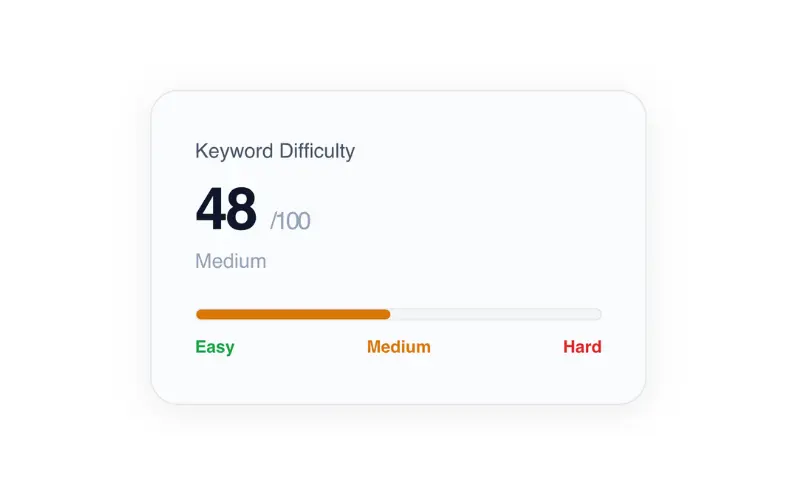
By itself, the Keyword Difficulty metric says very little without context. For example, a value of 30 or 40 may seem high for a new website, but quite achievable for a website that already has a strong backlink profile and authority in the search results.
So let me create a simple table for you to help you understand the general difficulty levels.
Here is the Keyword Difficulty table.
| KD | Difficulty Level | What It Means |
|---|---|---|
| 0–20 | Easy | Low competition, often possible to rank through high-quality content and good SEO optimization. |
| 21–50 | Medium | Moderate competition, usually requires strong content, quality on-page optimization, and some quality backlinks. |
| 51–70 | Hard | High competition, requires strong website authority, a solid backlink profile, and powerful backlinks. |
| 71–100 | Very Hard | Very high competition. Search results are usually dominated by market leaders and major brands with strong trust and authority. |
Always remember that these are general guidelines, not strict rules, because difficulty levels can have different meanings across different industries.
These difficulty scores may also change over time. There are priority keywords for which databases are updated much more frequently. There are less competitive keywords whose data may not be refreshed for several months. Therefore, always keep this in mind and do not blindly trust the numbers.
I still recommend opening the actual SERP and verifying whether the numbers match reality. Look at the websites ranking in the top 10, examine how many keywords they target in their content, and review the number of backlinks they have.
Now let’s take a closer look at what these numbers actually mean.
Keyword Difficulty: 0–20 (Low)
This is the most attractive zone for new websites because competition is still relatively low, and the search results often contain small blogs, forums, niche websites, and local projects.
When you look at the search results, you understand who you can realistically outrank.
What kind of keywords are these? Classic examples include running shoes for beginners, budget travel tips for students, health break for 3 days for running, keyword research for bloggers, and so on.
In many cases, a quality article can achieve strong rankings even without serious link building.
When I start working on a website, these are exactly the kinds of keywords I look for because they help me attract quality traffic.
However, remember that a low KD does not always mean success. If the query has a low Search Volume or Google displays AI Overviews, the actual traffic may be much lower than expected.
In other words, you may reach the top positions and still receive almost no traffic.
Keyword Difficulty: 21–50 (Medium)
This is the zone where you can find high-quality SEO opportunities. Competition is already noticeable, but it remains achievable for growing websites.
I always combine low KD keywords with medium KD keywords because we do not want to rank only for low-value keywords. We want to generate traffic for the website.
Examples may include Email marketing software, meal planning apps, and Search Volume Checker.
To reach the top positions for these keywords, we need high-quality content. You can even look at how I write articles. They are quite large, comprehensive, heavily interlinked, have strong internal optimization, and include some incoming backlinks, because ranking without backlinks is quite difficult.
You do not necessarily need backlinks pointing directly to the article itself. You may simply have a well-developed domain with a strong backlink profile and a few links pointing to important pages. That is usually enough to achieve a good balance between ranking difficulty and traffic potential.
Keyword Difficulty: 51–70 (High)
Yes, this is already a completely different story. Strong players begin to dominate. The top 10 search results are usually filled with authoritative websites that have large numbers of backlinks and very high brand recognition.
For a young website, ranking here becomes much more difficult.
That is why you should only move into this range after successfully passing through the earlier stages.
Examples of such keywords include running shoes, CRM software, web hosting for WordPress, keyword research, and keyword research tool.
Ranking for these keywords requires a strong domain, a highly developed content hub, ongoing link building from authoritative websites, and a high level of topical expertise.
That is why new websites should not focus heavily on these keywords when they are just getting started.
Be patient. You will get there, but not all at once.
Keyword Difficulty: 71–100 (Very High)
These are the most competitive keywords in search results.
Here you will find major brands, international companies, and market leaders.
It’s also important to remember the cost per click in Google Ads contextual advertising and organic search results. Therefore, the more expensive the on-demand advertising, the more aggressively large brands build their SEO promotion and thus protect their organic positions.
Examples include insurance, credit cards, hotels, loans, SEO agency, and similar keywords.
Even high-quality content will not guarantee strong rankings without an authoritative website, strong trust signals, and a powerful backlink profile.
A high KD does not always mean that these keywords should be ignored.
We can still create pages targeting these keywords as long-term investments. But you should understand that you are unlikely to receive meaningful traffic from them unless you are competing in the top tier.
However, these highly competitive keywords can serve as the center of a large topical cluster.
For example, one keyword that interests me is keyword research. It has a high difficulty score, and I have a page targeting that keyword.
But that page can rank for dozens of related keywords: keyword research, keyword research process, keyword research example, keyword research techniques, and many others.
As a result, the total traffic generated by the entire cluster may significantly exceed the search volume of the primary keyword itself.
That is why we can create content around a highly competitive keyword while actually targeting medium-difficulty keywords.
This can also be a very effective strategy.
Finding Low-Competition Keywords in KeywordStat
When we created KeywordStat, we immediately focused on making keyword research as simple as possible for users.
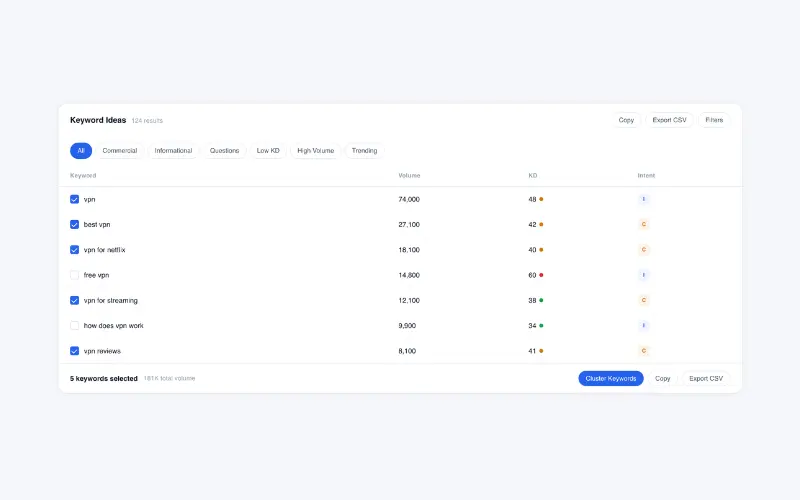
When you enter a primary keyword, you receive many other related keywords, and you have filtering and sorting options based on KD. You can simply select keywords with a low KD while also considering Search Volume and Search Intent.
Therefore, filter keywords by KD and check the ones that fit your goals. Also pay attention to the Volume metric, and you can click Update Metrics to see which keywords have a low KD.
You should also evaluate search intent because KD does not guarantee successful rankings. You need to understand what your users are actually expecting.
If the keyword is informational, the user wants an explanation or a guide.
If the keyword is commercial, then you will most likely need to create a landing page that explains the features and conditions of using the tool because the user is already close to making a decision.
Therefore, do not look for individual keywords. Look for topical clusters.
This is one of the most important SEO concepts of recent years because many specialists try to find the perfect keyword, while in practice you should be finding entire groups of related queries.
As a result, a single article can receive traffic not from one keyword but from an entire keyword cluster.
Keyword Difficulty vs Search Volume
Which metric is more important: Search Volume or Keyword Difficulty?
We know that the most common mistake in SEO is choosing keywords based only on search volume.
The logic seems obvious: people search for queries, and the more often they do it, the more traffic that keyword can potentially bring.
But we should always work with a combination of metrics.
High Search Volume shows demand, but it does not guarantee traffic or rankings.
That is why experienced SEO specialists always analyze Search Volume together with Keyword Difficulty.
Let’s imagine two keywords:
- One keyword is Riding Shoes. It has a Search Volume of 90,000 and a KD of 85.
- And the keyword Riding Shoes for Beginners has a search volume of 3,500 and a KD of 22.
Of course, the number 90,000 looks more attractive, but logic suggests that we will get results much faster with the keyword Riding Shoes for Beginners.
That is why the second keyword may turn out to be the better SEO opportunity.
Low KD Does Not Guarantee a Good Choice
You should not go too far in the opposite direction and choose keywords solely because they have a low KD.
Very often, SEO specialists start looking only for the easiest keywords, but then another imbalance appears.
You end up with no hub pages. Instead, you only have pages targeting low-competition, low-volume keywords. And this looks strange because when you describe a niche, you are only describing its edges while having no strong core at the center.
This can also be a missed opportunity because you have not written about the most important topics.
Balancing Search Volume and Keyword Difficulty
Like everything else in life, we need to find balance. That is why the best opportunities are often somewhere in the middle.
You can choose keywords that have real demand, remain relatively achievable to rank for, allow you to gain traffic faster, and help build the topical authority of your website.
At the same time, we also need to think about topical authority. This means covering the entire niche rather than simply chasing easy keywords.
You have to admit, it would look strange otherwise.
Traffic Potential
Another mistake is evaluating a topic based only on the search volume of a single keyword.
We need to understand that every keyword may have additional long-tail variations and include many related keywords.
A single page can rank for these additional queries as well.
We should evaluate traffic potential across all related keywords.
The combined traffic from these keywords may be several times higher than the Search Volume shown for a single keyword.
This is called Traffic Potential.
Therefore, we should evaluate not only an individual keyword but the potential of the entire topic.
Search Intent
A low KD does not guarantee rankings because a low KD can still be a poor SEO opportunity if you ignore Search Intent.
Search Intent is the goal behind a user’s search query.
In other words, we are answering the question: what does the user actually want when they enter this query into Google?
Obviously, they should find that answer on your page.
Therefore, if you do not offer the products or services they are looking for, if you intentionally distort the meaning of the query, or if you use a competitor’s keyword simply to attract additional traffic, you will not get results.
Even if you temporarily receive traffic, users will land on the page and fail to find the answer they were expecting. As a result, you will generate negative user signals.
Your page will eventually lose its rankings and stop receiving traffic.
I have a separate article about Search Intent. You can read it, but let’s briefly review the main types of intent.
Informational Intent
This is when users want information, instructions, or explanations.
Commercial Intent
This is when users are comparing options and preparing to make a decision. They are not ready to buy yet, but they are much closer to a purchase within the marketing funnel.
Transactional Intent
This is when the user is already ready to take action. They enter queries that help them make a purchasing decision and are at the final stage of the marketing funnel.
That is why commercial and transactional keywords are directly connected to money.
A large number of companies compete for these queries, and they usually have a higher Keyword Difficulty score.
The closer the user is to making a purchase, the higher the competition tends to be.
Search Intent Examples
| Keyword | Intent |
|---|---|
| How to choose running shoes | Informational |
| Best running shoes | Commercial |
| Buy running shoes online | Transactional |
Intent Mismatch
That is why one of the biggest and most expensive mistakes in SEO is intent mismatch.
It is a common reason for unsuccessful SEO campaigns.
You find a keyword with good Search Volume and low KD, and it seems like a great opportunity.
But after looking at the search results, you notice that Google is showing service pages or commercial landing pages, while you want to write an article explaining how to do something.
Okay, that’s fine. You may even manage to rank, but your chances of success will be minimal because the user wants to make a purchase while you are only providing information.
Of course, you can write an article about the topic. But if we understand that the intent is commercial, then you need to show where the product can be found or at least provide a link to a store where the product is available.
You have to admit, this already looks less attractive than it did at first.
What Is More Importan: Keyword Difficulty or Search Intent?
If we had to choose only one factor, then, of course, Search Intent would be more important than Keyword Difficulty. A high-KD keyword can still deliver excellent results, but if your page type does not match user expectations or what Google is already showing in the search results, then none of that matters.
On the other hand, a low-competition keyword can be almost useless for SEO if your content does not match the search intent at all.
That is why, before choosing a keyword, you should analyze the current Google search results and review the pages that are already ranking in the top 10.
Are they articles, guides, or reviews? Are they category pages or product pages? Are they commercial landing pages or service pages?
What user questions are they answering, and how thoroughly is the topic covered?
You should also pay attention to additional SERP features such as AI Overviews, Featured Snippets, People Also Ask, video results, and other search features.
These elements help us understand which format Google considers most relevant for a specific query.
This does not mean that you should directly copy your competitors. On the contrary, your goal is to create the most useful, complete, and high-quality resource possible.
Therefore, if articles are ranking for a keyword, it will be much more difficult to rank a product page. And vice versa.
That is why all the answers are already in the search results.
Why You Should Not Rely Only on Keyword Difficulty
Although Keyword Difficulty is one of the most useful SEO metrics, many specialists make the mistake of making decisions based exclusively on KD.
But KD only helps us understand how strong the websites ranking in the top 10 are. At the same time, it does not take into account many factors that can influence your actual chances of success.
Keyword Difficulty Does Not Account for Topical Authority
Today, one of the most important factors in modern SEO is Topical Authority.
This term refers to the level of expertise a website has within a specific subject area.
However, the KD metric does not take this into account.
Imagine two websites:
- The first website publishes a large amount of content about SEO: keyword research, keyword difficulty, search volume, keyword clustering, search intent, and so on. Yes, this is exactly what I do on the KeywordStat website.
- The second website writes a little bit about everything: marketing, business, finance, SEO, and occasionally publishes an article about keywords.
Even if these websites have similar backlink profiles, or even if the first project has a weaker backlink profile, as in my case because it is a new project, the first website will often have an advantage for SEO-related keywords because it has stronger expertise.
As a result, a keyword with a low or medium KD may be completely achievable for a specialized website but almost impossible for a general marketing blog.
That is why ranking difficulty does not depend solely on KD. It also depends on the specific website.
Branded Keywords Are Harder Than They Appear
A similar situation exists with branded keywords.
This is another limitation of Keyword Difficulty.
For example, keywords such as Ahrefs Pricing, Semrush Login, or Nike Running Shoes may not appear highly competitive because brands do not always build large numbers of backlinks specifically to those pages.
As a result, you may not see a high difficulty score.
However, Google understands user intent very well.
When a user searches for Ahrefs Pricing, Semrush, or Nike, Google understands that the user wants to visit the company’s official website.
Even if I create an Ahrefs Pricing page on the KeywordStat website, first of all, it would mislead users, which is why I would never do it.
Second, Google understands that this is a different website and will prioritize the official brand website.
Yes, there are industries where companies need to invest in Brand Protection because branded traffic is intercepted by intermediary websites designed to redirect users elsewhere.
But this is more the exception than the rule.
Usually, it is related to regulatory differences between countries or the specifics of a particular industry.
Keyword Difficulty Does Not Fully Measure Content Quality
When we discussed how Keyword Difficulty is calculated, we saw that most tools analyze backlinks, domain authority, and page strength.
But evaluating content quality with a mathematical formula is extremely difficult.
A page may rank well today but later become outdated or contain only superficial information.
Over time, such a page may start losing rankings.
And it is very difficult to include this in a mathematical model.
Google uses many additional signals: content freshness, proprietary knowledge systems, user behavior signals, and many other factors.
If users simply do not find a page interesting, they leave it and move to competitors.
This is a signal that the content does not meet audience expectations.
Keyword Difficulty Is an Opportunity Filter
Always remember this.
It is simply a guideline for your work, not a prediction of results.
It is an additional way to validate a hypothesis.
This metric answers only one question: how strong are the websites already ranking in the search results?
But it cannot guarantee top rankings, future traffic volume, or the speed at which rankings will grow.
Therefore, to make good SEO decisions, you need to take a comprehensive approach and consider multiple factors:
- Search Volume.
- Search Intent.
- Topical Authority.
- Content Quality.
- Business Value.
- Search Results Structure.
- The Authority Level of Your Website.
That is why the best opportunities are not found through KD alone but at the intersection of many different factors.
How AI Overviews Changes the Meaning of Keyword Difficulty
I have been working in SEO since 2010, and we were used to a fairly simple model for evaluating keywords.
High Search Volume, low KD, and high-quality content.
When all three conditions were met, the keyword was considered a good opportunity and an excellent source of traffic.
And honestly, I worked this way for years. I had successful affiliate projects, and it seemed like we had found a gold mine. The evolution of search has changed this logic.
Today, it is no longer enough to rank in Google’s top 10.
We need to understand whether our page will actually receive clicks after it appears in the search results because many specialists still do not analyze the structure of the search results themselves.
What Are AI Overviews?
AI Overviews are AI-generated answers created by Google that appear directly in the search results.
Instead of a list of links, users receive a ready-made summary of a topic directly on the search results page.
Moreover, Google may display this AI-generated answer even before the organic search results.
And this completely changes the way people consume information.
Previously, we entered a query, saw a list of websites, visited them, and found the answer.
Now everything is different.
We enter a query, receive the answer directly in the search results, and only visit websites if we want to explore the topic in more detail.
Unfortunately, for website owners, the reality is that we can lose traffic even when our own content helps answer users’ questions.
Very often, users receive the information immediately and no longer visit websites from the search results.
It is also worth mentioning the concept of informational gain because, in order to appear as a source in AI Overviews, an article should not simply copy what is already ranking in the top 10.
You need unique expert quotes, original research, new data, practical experience, or original insights.
It is precisely when you enrich an article with this type of content that it gains additional value for users and has a greater chance of being included in AI Overviews.
The Zero-Click Search Problem
Zero-Click Search is a situation where a user gets the answer directly in Google and does not visit any website.
This happens for queries such as term definitions, currency exchange rates, forecasts, birth dates, calculators, and many other types of searches.
The user receives the answer directly in the search results.
And even if you rank in the first position, you may receive no traffic at all or significantly less traffic than expected.
Content Quality Is More Important Than Ever
We have already discussed that modern Keyword Difficulty models are primarily built around factors such as backlink quality, the number of referring domains, and website authority.
However, AI systems analyze much more than backlink profiles.
Content quality, completeness of the answer, expertise, content structure, and the ability to satisfy user needs are becoming increasingly important.
As a result, in many cases, a high-quality article can appear in AI Overviews faster than an authoritative page with a large number of backlinks.
This does not mean that backlinks no longer matter.
It simply means that the rules of the game have changed a little.
Advanced Keyword Difficulty Concepts
I want to tell you about several additional methods that can help you work with keyword difficulty more effectively.
Keyword Golden Ratio (KGR)
The first concept is the Keyword Golden Ratio (KGR).
This is a method for finding ultra-low-competition keywords for new websites.
The concept was developed to identify keywords that can generate traffic even without a strong backlink profile.
When I first started working in affiliate marketing and learned about the KGR concept, this is exactly what we did.
We created content around these low-competition topics and generated good traffic because we found keywords that large brands simply ignored.
The KGR formula looks like this:
KGR = (Allintitle Results) / (Monthly Search Volume)
Number of Google pages returned by the operator allintitle:keyword divided by Search Volume.
Note: When checking Google, type it exactly as allintitle:your keyword without spaces after the colon and without quotation marks.
Typically, the method focuses on keywords with a search volume of up to 200–300 searches per month.
How Are the Results Interpreted?
- KGR below 0.25 — excellent opportunity.
- KGR between 0.25 and 1 — medium competition.
- KGR above 1 — high competition.
For example, keywords such as keyword research tools for bloggers, local keyword research template, and keyword clustering example for e-commerce may have very low Search Volume but still allow new websites to achieve rankings quickly.
KGR does not replace Keyword Difficulty.
It is simply an additional method for discovering hidden SEO opportunities.
Avoid the KGR trap: Don’t write a separate 300-word article for each KGR keyword. You’ll fall into the cannibalization trap. Instead, cluster closely related KGR phrases into a single, comprehensive article to satisfy Google’s intent-matching algorithms.
Warning About KGR Pitfalls
Finding keywords that match KGR can take hours, and the search volume they generate is typically very small. More importantly, in 2026, the KGR formula faces a serious technical limitation. Current search algorithms rely on vector search and semantic entities rather than exact title matches.
Google easily ranks exhaustive pages even if their titles don’t contain the exact phrase. Therefore, consider KGR solely as a small historical baseline for moving beyond the initial testing phase. In the modern age of artificial intelligence, never build a long-term content strategy based solely on KGR.
Search Volatility
Keyword difficulty can change over time.
Keyword Difficulty only reflects the state of the search results at the moment the analysis is performed.
Google constantly updates search results, while SEO tool databases are updated much more slowly and do not always keep up with changes in the SERPs.
As a result, search results may change significantly within a few weeks, while in other cases the top 10 rankings remain almost unchanged for years.
This is called Search Volatility.
For example, for keywords such as Google Core Update, best AI tools, and ChatGPT alternatives, the leaders in the search results will change much faster than for keywords such as keyword research, marathon training plan, or email marketing guide.
Why? Because some industries evolve much faster than others.
That is why Keyword Difficulty should not be viewed as an exact snapshot of current competition.
It is simply a guideline for estimating keyword difficulty.
Keyword Difficulty in Different Countries
Another important consideration is that Keyword Difficulty can vary significantly depending on the country.
Even if you are targeting English-language keywords, the same query may have a different competition level in the United States, the United Kingdom, Australia, Canada, or India.
This happens because competition differs from one country to another.
For example, the keyword running shoes may have extremely high competition in the United States due to the presence of major brands and international online retailers.
In other countries, competition may be significantly lower.
Therefore, without geographic context, the difficulty score can be misleading.
Always analyze Keyword Difficulty within the context of a specific country.
Keyword Clustering
In modern SEO, the principle of “one page, one keyword” is becoming less effective.
Google evaluates topics rather than individual search queries.
That is why keyword clusters are becoming much more important than individual keywords.
For example, the keyword research may have a Search Volume of 27,000 and a KD of 74.
At first glance, this keyword looks extremely difficult.
However, there are many related keywords surrounding it that you can also include within your content.
The combined search volume of these related keywords may be significantly higher than the Search Volume of the primary keyword itself.
Therefore, when planning content, it is important to consider not only the Keyword Difficulty of an individual keyword but also the entire topical cluster.
Very often, the traffic potential of the entire cluster is much more important than the KD score of a single keyword.
Quick Checklist Before Choosing a Keyword
Before adding keywords to your content plan, make sure you have checked these simple things:
- Search Volume.
- Keyword Difficulty.
- Search Intent.
- Traffic Potential.
- The presence of AI Overviews or other SERP features.
- The topical authority of your website.
- The business value of the keyword.
- The potential of the topical cluster.
This approach will help you find keywords that not only look attractive inside a tool but also deliver real business value, traffic, and sales.
Conclusion
Let’s remember that there is no universal definition of a good Keyword Difficulty score.
It depends on the age of the website, the level of competition within the niche, and the current authority of the domain.
Always evaluate Keyword Difficulty together with Search Volume, Search Intent, and Traffic Potential.
We should remember that Google does not use an official Keyword Difficulty metric and does not use KD as a ranking factor.
This metric was created by SEO tools to help you better understand keyword competition.
That is why every service uses its own methodology for calculating KD, and the numbers may differ from one tool to another.
You will notice that different tools display different Keyword Difficulty values, and that is completely normal.
Also remember that a high KD score does not mean ranking is impossible.
Sometimes you can generate traffic from highly competitive keywords through the development of topical authority, publishing high-quality content, growing your backlink profile, building content clusters, and strengthening your Topical Authority.
Remember that Search Volume shows the level of demand, while Keyword Difficulty shows the level of competition.
Therefore, when selecting keywords, you need to consider both metrics at the same time.
If you want to quickly find low-competition keywords and build an effective content strategy, use our Keyword Stat service.
Simply enter a keyword and get all the data you need for your SEO strategy. That’s all from me. Thank you for reading this article. Be sure to read the other articles on my website.