Keyword trends show how search demand changes over time. Some keywords explode for two weeks and disappear.
Others quietly bring traffic and sales for years. If you ignore trends during keyword research, you end up publishing content nobody searches for anymore, or chasing hype that never converts into actual business.

- Why Keyword Trends Matter in SEO
- Trending Keywords Are Often Misleading
- Trend-Based Fakeouts
- Seasonal Keyword Trends Quietly Control Entire Niches
- Google Trends Keywords: Useful, But Not Enough Alone
- How to spot valuable trends before they peak?
- Rising Search Trends Usually Start Small
- Evergreen vs Trending Keywords
- Classification of trends
- The 70/30 Content Strategy Rule
- How to distinguish growth from decline?
- How can you tell a developing trend from a fading one?
- Keyword Trends Change Faster Than Most Content Teams
Why Keyword Trends Matter in SEO
A lot of SEO beginners still treat keyword research like a static Excel sheet. They export keywords, sort them by volume, publish pages and expect rankings to stay stable forever. Search behavior does not work like that.
People constantly change the way they search. New products appear, industries shift, Google autocomplete changes phrasing, YouTube creators introduce new terms, social platforms suddenly push weird keyword combinations into mainstream searches. Same user intent, different wording. Rankings disappear faster than most site owners expect.
I have seen websites lose massive amounts of traffic because they spent months targeting keywords that were already dying when the content was published. Painful mistake.
Trending Keywords Are Often Misleading
Everybody loves trending keywords because huge traffic graphs look exciting in reports. Big spike, big impressions, big promises. Then the project owner checks revenue and realizes the traffic brought almost nothing useful.
That happens constantly.
A keyword can trend simply because people are curious for a few days. Another trend appears because users want free templates, free tools or answers with zero buying intent. Traffic comes. Money does not. I worked with projects where one “hot” keyword generated thousands of visits and almost zero conversions because users searched for completely different expectations than the product actually offered.
Most keyword tools do not explain this properly. They show growth numbers and colorful charts, but they rarely help people understand whether the trend has business value or is just temporary noise.
Trend-Based Fakeouts
Remember how brands like Clubhouse and Threads by Meta exploded? I remember Clubhouse invites being sold on various classifieds sites. SEOs even created landing pages to ride the hype and see explosive traffic growth.
So what really happened?
Almost no one remembers Clubhouse anymore. Although I have a friend who’s a marketer who wrote on his channel that Clubhouse was the future, that he saw great potential in this platform. I wonder how his opinion has changed now.
Remember how the hype around Clubhouse quickly evaporated? And all traffic dropped to zero. But most importantly, those visitors to the sites that wrote about Clubhouse had zero interest in the brand. They were looking for an answer to a fast-moving tech trend.
And those companies that created this content and tried to drive traffic have already realized that the return on investment was zero. There may have been traffic, but the money is gone. And the investment proved short-lived and costly.
Meanwhile, the Threads social network experienced a decline in its first month, but then successfully integrated into the Instagram ecosystem, and now the network is very active with a huge, engaged audience.
It’s gotten to the point where screenshots from threads are being published on Facebook and Instagram.
Seasonal Keyword Trends Quietly Control Entire Niches
Seasonality destroys weak SEO strategies every year.
Travel searches rise before holidays. Fitness keywords spike in January. Educational queries explode before exam periods. Ecommerce stores suddenly panic before Black Friday because competitors prepared landing pages three months earlier while everyone else was still discussing “content strategy” inside meetings nobody wanted to attend anyway.
The funny part is that many companies still publish seasonal content too late. Google needs time to crawl and trust pages. If you launch Christmas pages in December, you already lost a huge part of the traffic window.
Monthly search averages hide this problem badly. A keyword showing 20,000 monthly searches may actually receive almost all of that traffic during one short seasonal period while staying nearly dead the rest of the year.
Let’s see what this looks like in real life. Let’s take a classic example from e-commerce: “Christmas gift ideas.” If we enter this keyword into a standard SEO tool, it will show us a very high search volume.
But what’s the harsh reality? This query is only searched in November and December. That’s when traffic and search volume skyrocket, and then for the rest of the year, there’s virtually no search for this query.
And we could give many more examples like this.
Google Trends Keywords: Useful, But Not Enough Alone
Google Trends measures popularity and allows you to see trends by queries and broad categories. But you need to know how to use it.
The tool divides entities into search queries: Search term and Topic. Synonyms and related concepts are grouped here.
I recommend understanding this and not confusing relative popularity with absolute demand.
The Google Trends graph shows interest in a topic on a scale from 0 to 100 relative to its peak, not an actual number of monthly searches.
Increasing popularity doesn’t guarantee high traffic for your article if the topic itself is very narrow.
A keyword can show explosive growth on the chart due to semantic variations, but at the same time, its actual search demand remains very low.
Conversely, a high-yield transactional keyword can appear completely unchanged in Google Trends, yet still generate high-converting revenue without being noticed.
Those are some observations.
The smarter approach combines trend movement with real keyword databases, SERP analysis and intent evaluation. This is partly why I built KeywordStat the way I did. I got tired of staring at bloated keyword exports where 30% of the “trending opportunities” were garbage phrases, duplicated queries or temporary spikes with no business value behind them.
Most beginners never see this problem because the charts look impressive enough to sell the illusion.
How to spot valuable trends before they peak?
While big brands are bogged down in endless approvals, you can spot fast-growing trends in just a few steps.
Check primary demand platforms
People start discussing a topic long before they even search for it on Google. Therefore, you can study active communities on Reddit, Quora, and TikTok trends. If new terms are constantly being discussed, they’re likely to see significant search volume soon.
Track momentum in Google Search Console
Check the Performance report in Google Search Console and look for new, low-volume queries you’ve never seen before. These may be tiny tails of queries, but they could be the first signs of an emerging trend.
Look for spikes in Google Trends
Don’t limit yourself to just the general popularity graph. Also look at related queries, top queries, and trending queries. This will allow you to filter out historical baseline traffic and pinpoint aggressive and sudden spikes in demand.
Check search intent
Before writing an article, check your Google search query. If the first page is filled with news feeds, TikTok videos, and other news content, this means the “Question Deserve Freshness” (QDF) algorithm has been activated.
There’s no need to write a traditional guide yet. But if you’re a media site or blog and are willing to create expert content in a couple of hours (this strategy is called “newsjacking”), this is your chance to rocket to the top three with fresh content while your main competitors are still coordinating their search queries. Google prioritizes verified media outlets in the “Top Stories” section of Google News.
Rising Search Trends Usually Start Small
By the time everybody starts talking about a keyword trend publicly, the easy traffic is often gone already.
Real opportunities usually start with short and long-tail search queries, unusual modifiers, new autocomplete suggestions, and subtle changes to search patterns. Most people completely ignore them because their volume seems “too small” to pay attention.
Frankly, this is a huge advantage for smaller sites looking to grow faster, while large brands continue to waste months on approvals, spreadsheets, and presentations that no one even remembers two weeks later. Small signals matter.
Evergreen vs Trending Keywords
Evergreen keywords keep bringing traffic for years. Trending keywords move aggressively, spike fast and often disappear just as quickly.
Both matter. The mistake starts when websites depend entirely on one type.
Projects focused solely on perennial queries tend to become slow and painfully competitive. This happens because everyone is constantly targeting the same stable search queries. Meanwhile, projects that chase trends exclusively descend into chaos.
The healthiest SEO strategies usually mix both approaches together. Evergreen pages create stability. Trend content creates momentum, fresh traffic and visibility while competitors are still sleeping.
And honestly, most “SEO experts” online oversell trends badly. Not every rising keyword deserves content. Some trends are already dead before your article draft is even finished.
Classification of trends
Not all trends are created equal. And if you build a strategy without understanding their nature, you’ll waste your resources.
Let’s divide trends into four categories.
Macrotrends
With a life cycle of years, represent global changes in society and technology. For example, the emergence of remote work, generative AI, and so on.
A fundamental content hub is created for them, regularly updated because the niche is growing and more and more information is becoming available.
Microtrends
With a life cycle of months, represent outbreaks around specific products or phenomena. For example, a new iPhone, Pop-it, toys, and so on.
They require maximum speed, so you need to write articles in the first few days, generate traffic, and after six months, you can forget about the page because no one is looking for it.
Seasonal cycles
With a life cycle of several weeks. This is the annual predictability of demand: Christmas gifts, exam preparation, Black Friday.
Content for these is prepared 2-3 months before the demand starts, because it needs to be indexed and ranked, preferably before the event, not after.
However, you can maintain optimized landing pages forever simply by updating their content year after year, as URL weight and old backlinks cannot be lost. Major brands often do this.
Event spikes
With a life cycle of a couple of days. These include memes, scandals, and breaking news.
These spikes last only a few days and are primarily suitable for social media or news feeds. Using SEO for them is unwise. By the time Google indexes the page, the trend may already be dead.
But if you’re a popular media outlet, you can quickly get traffic.
The 70/30 Content Strategy Rule
There’s a 70/30 strategy that helps balance predictability and highly profitable growth.
So stop treating keyword research as a once-a-year task. Instead, divide your content operations into several areas.
70% of resources are the evergreen core.
You can focus on stable, high-intent keywords that will drive traffic and conversions month after month. This is the main financial component of your SEO.
30% of resources are trend sprints.
Allocate a certain portion of your budget and time to finding and writing such content. When your tracking tools or Google Search Console detect the next breakthrough trend, your team should be flexible enough to quickly respond and implement this content.
This hybrid approach will help you maintain a safe level of traffic by attracting it to your evergreen core, while simultaneously keeping your finger on the pulse by publishing new, high-volume content even before your competitors finish their internal presentations.

How to distinguish growth from decline?
When you look at a keyword chart mid-cycle, an upward trend can be misleading. It could be the beginning of a long-term microtrend or, conversely, the peak of a short-term hype followed by a collapse.
To avoid wasting budget on fading trends, Year-over-Year (YoY) and Moving Average analytical methods are used.
Year-over-Year (YoY) Analysis
You can mistake an annual seasonal spike for the emergence of a new, powerful trend. If a search query for a particular software starts growing in October, it doesn’t mean the niche has made a breakthrough. Companies may simply be closing budgets before the end of the year and launching advertising campaigns.
How to check YoY?
Compare the current search volume with the same month last year and calculate the percentage change.
If traffic has grown by 40% compared to the previous month, but the YoY is zero or negative, then this is typical seasonality. It’s too late to invest in such content because the trend is fading.
If YoY is growing steadily month over month—by 10%, 15%, or 30%—then the trend is truly developing and has long-term potential.
Moving Average
If you have weekly or monthly query traffic data for the past year, a simple traffic graph won’t reveal the underlying dynamics. Small fluctuations will obscure the true direction of movement.
To refine this data, use the moving average method. This is a method for analyzing data series by averaging them over a fixed period.
I recommend using a combination of two lines.
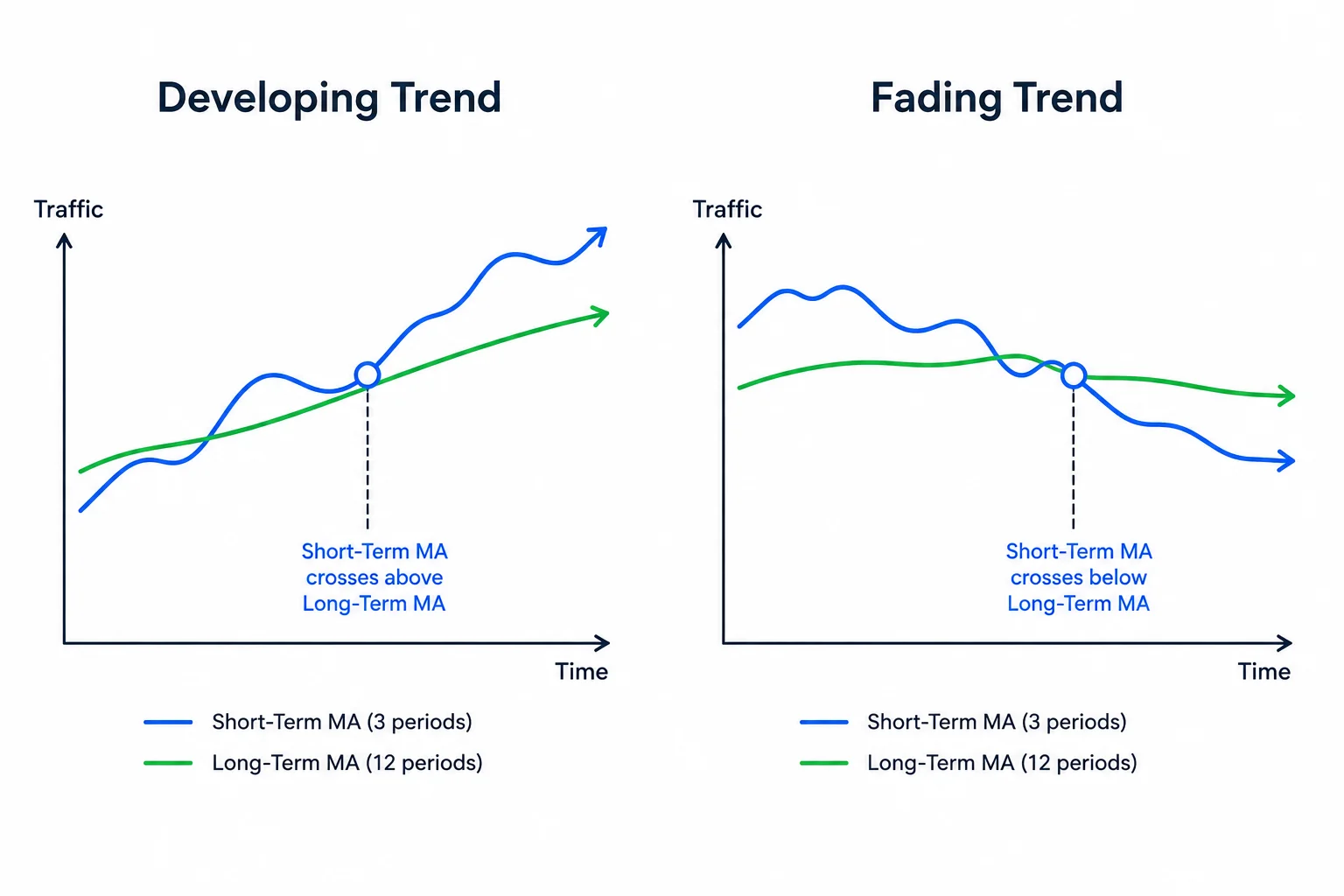
Short-Term Moving Average
Short-Term Moving Average (SMA) is the average value over the last three periods, for example, three weeks. It quickly responds to recent changes.
Long-Term Moving Average
The slow moving average (Long-Term MA) is the average value over the last 12 periods, for example, 12 weeks. It shows a stable historical baseline.
How can you tell a developing trend from a fading one?
Two moving averages generate precise mathematical signals.
Developing Trend (Action Signal) – The fast moving average crosses the slow moving average from below. Short-term momentum has become stronger than the historical background.
Demand is accelerating sharply. Therefore, content must be released immediately.
Declining Trend (Trap) – The fast moving average crosses the slow moving average from above. The traffic graph may still appear high.
But the rate of demand growth has already slowed. The market is oversaturated, and interest is waning. Investments in such content will likely not pay off.
Keyword Trends Change Faster Than Most Content Teams
Large companies love complicated processes. Endless approvals. Endless revisions. Endless discussions about wording.
Meanwhile smaller sites publish faster, react faster and steal rankings first.
I have watched tiny niche websites outrank giant brands simply because they adapted to changing search behavior in days instead of months. Google rewards relevance aggressively now. Slow content operations bleed traffic quietly while managers blame algorithms, AI, backlinks, competitors, basically everything except the obvious problem sitting directly in front of them.
Search behavior changes constantly.
If your keyword strategy still looks exactly the same as it did two years ago, there is a very good chance you are already losing traffic and do not fully realize how much money quietly slipped away because of it.