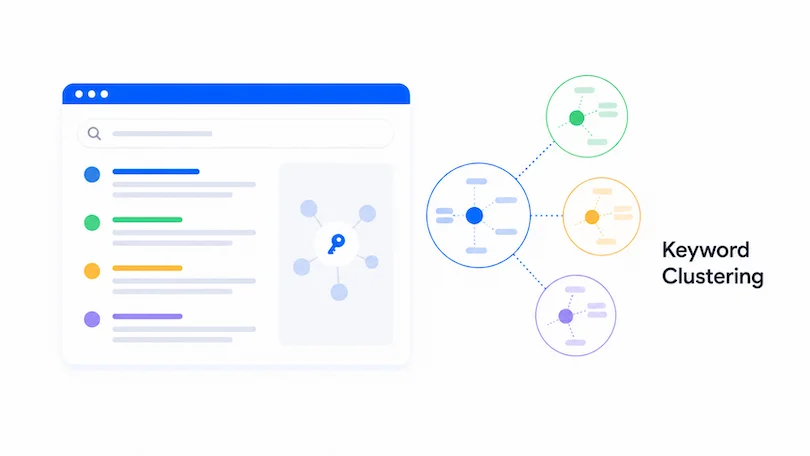
Keyword clustering is the process of organizing a list of keywords into groups that correspond to page types.
Instead of writing a separate article for each keyword, you group related terms into a single topical cluster and place those keywords on the same page.
This allows you to avoid keyword cannibalization and improve the overall organic visibility of your project.
- What Is Keyword Clustering?
- Keyword Clustering
- Types and Methods of Clustering
- Types of SERP Clustering
- Soft vs Hard Clustering. Which One Should You Choose?
- Methods of Performing Clustering
- Clustering by Search Intent
- Step-by-Step Clustering Algorithm
- Keyword Clustering Tools
- Using Clustering Results
- Common Keyword Clustering Mistakes
- Conclusion
What Is Keyword Clustering?
Imagine that you have completed keyword research and collected a large number of keywords. What should you do next?
Of course, you should not create a separate page for every query because many keywords mean the same thing, are synonyms, are simply word variations, or are the same terms with long-tail modifiers.
Therefore, most often, a group of these keywords shares the same search intent, and Google ranks them using the same pages.
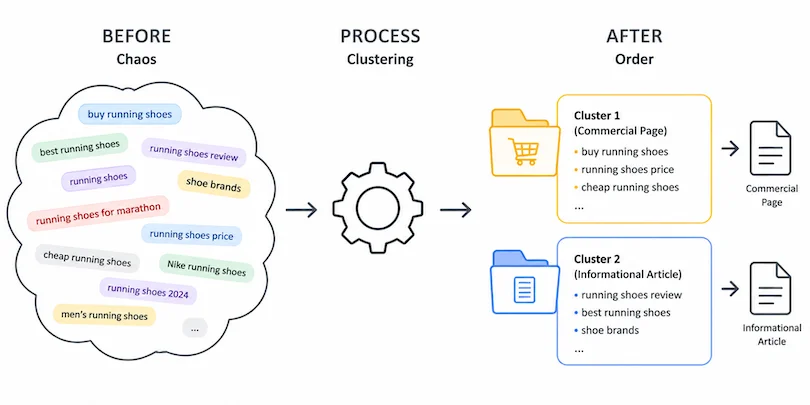
Keyword clustering is the process of grouping such search queries into topical clusters based on their meaning, intent, and similarity in search results.
Clustering helps us determine which queries should be placed on the same page, which queries should be separated into different URLs, what the overall structure of the website should look like, and which topics should be combined into a single content block.
For example, the queries “keyword clustering”, “what is keyword clustering”, and “keyword clustering guide” are most often part of the same cluster and should be promoted on a single page, such as this one.
Why Has Query Clustering Become So Important Today?
Previously, specialists could manually create multiple pages for multiple queries, and many projects contained a huge number of keywords and a large number of potential pages, which allowed them to gain traffic.
I remember that several years ago we created multiple pages, and one of my projects, which unfortunately I cannot name because of NDA restrictions, had three different pages ranking in Google’s top 10.
In other words, I created a guide, an article, and a landing page, and all three reached the top rankings.
It was a medium-competition keyword, not the easiest one.
So situations like that did happen, but that was a long time ago, and I think it is good that Google fixed this issue.
Today, you will hardly ever see something like that in search results.
That is why, if you are doing parasite SEO and want to create content on third-party platforms to rank for high-volume keywords, for example by creating a page on Trustpilot, publishing on Medium, writing an article on LinkedIn, or using other platforms, then before creating such a page, simply open the search results and check them.
If a similar page already exists in the top 10 results, then creating another page will most likely not produce any results because of cannibalization.
Google generally will not show multiple pages from the same domain for the same query.
Keyword Clustering
Clustering is not just a way to bring order to your semantic core and keyword list. It directly affects keyword mapping, content quality, and the ability of pages to achieve high rankings and participate in AI Overviews.
Improving Content Relevance
Modern search engines have long stopped evaluating individual words and instead focus on a page’s ability to fully satisfy user needs.
Therefore, queries such as “keyword clustering”, “what is keyword clustering”, and “keyword clustering guide” will most often belong to a single page.
Creating the Right Website Structure
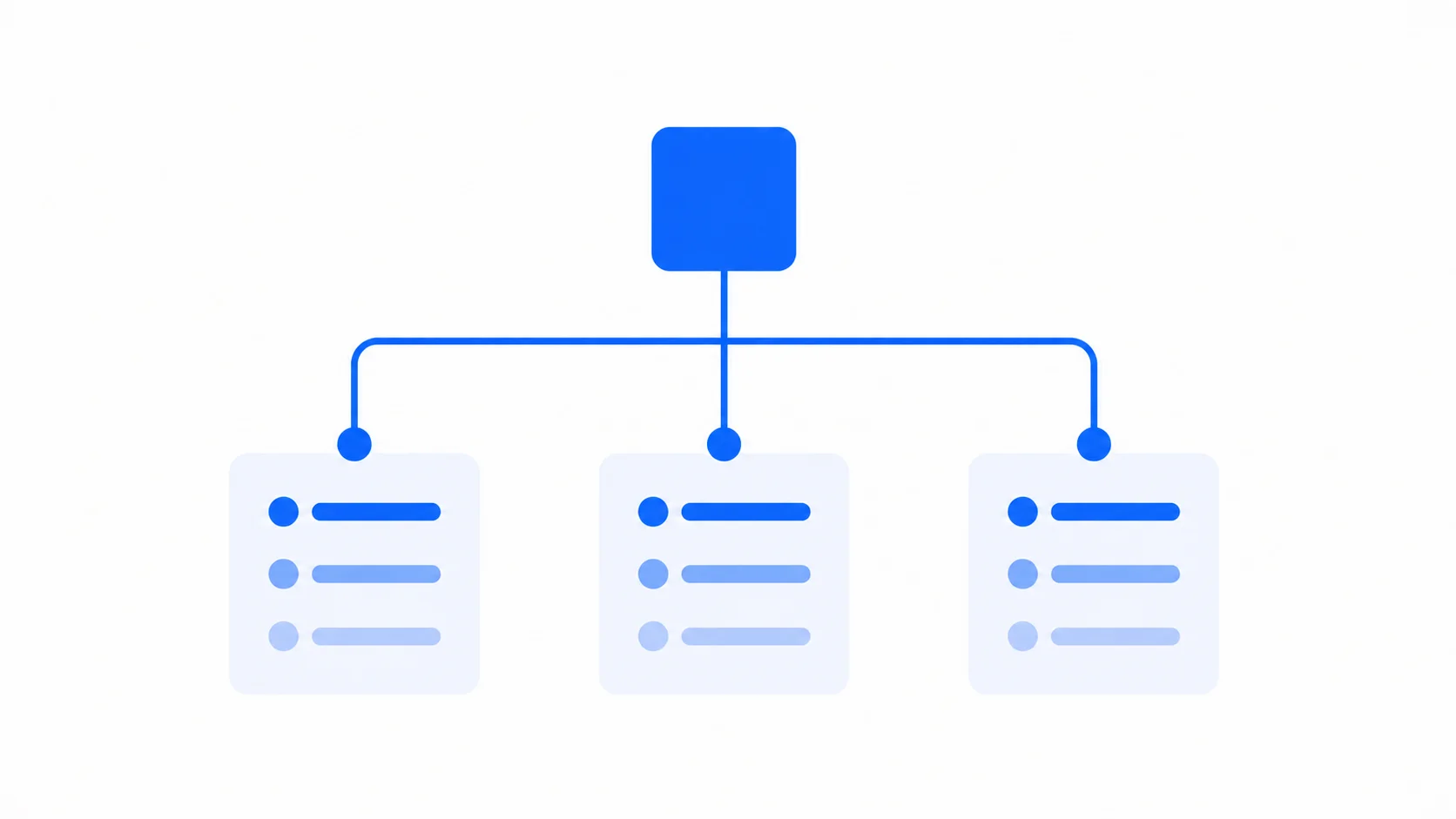
Topical clusters practically become the foundation of your website architecture.
After grouping queries, it becomes clear which pages need to be created, which topics should be combined, which sections or articles are needed on the website, which ones should be removed, and how content hierarchy should be organized overall.
For example, for the KeywordStat blog, these could be articles such as “keyword research”, “keyword clustering”, “keyword mapping”, “search intent”, “SEO”, and a structure like this already looks logical both for users and for search engines.
You take topical authority into account, cover all the topics within your niche, and fully satisfy the user’s content needs.
Internal Linking
After clustering, it becomes easier to build relationships between pages.
If previously we used internal linking mainly to pass link equity, now we are also showing Google our entities.
The Foundation of Keyword Mapping
Keyword clustering and keyword mapping are closely connected.
If clustering answers the question of which queries belong to the same topic, then keyword mapping answers a different question: which page should this cluster be assigned to?
Therefore, clustering is a preliminary step before building a website structure and developing a content strategy.
Types and Methods of Clustering
There is no single correct way to group keywords, which is why SEO tools, specialists, and marketers use different clustering methods.
Let me explain what types of clustering exist.
We can identify three main technological approaches for determining how closely keywords are related to each other.
Lemma-Based Clustering (Morphological Type)
In this approach, queries are grouped based on the presence of the same word roots, stems, or synonyms.
For example, the queries “buy a phone” and “buy a smartphone” may end up in the same semantic group.
Meanwhile, “phone repair” and “cheap phone” may belong to a different group.
Search Result-Based Clustering (SERP Clustering)
This is the most popular approach in SEO.
In this method, the algorithm analyzes the top 10 search results in Google or other search engines and determines how many competitor URLs overlap for each query.
If a significant number of pages overlap, the queries belong to the same cluster.
If not, they most likely belong to different clusters.
Hybrid Neural Network NLP Approach
This approach uses Natural Language Processing (NLP) and word embeddings.
It combines semantic similarity based on meaning with analysis of actual search results.
Types of SERP Clustering
Let’s use the standard clustering approach and look at soft, hard, and middle clustering, and examine how they differ.
Soft Clustering
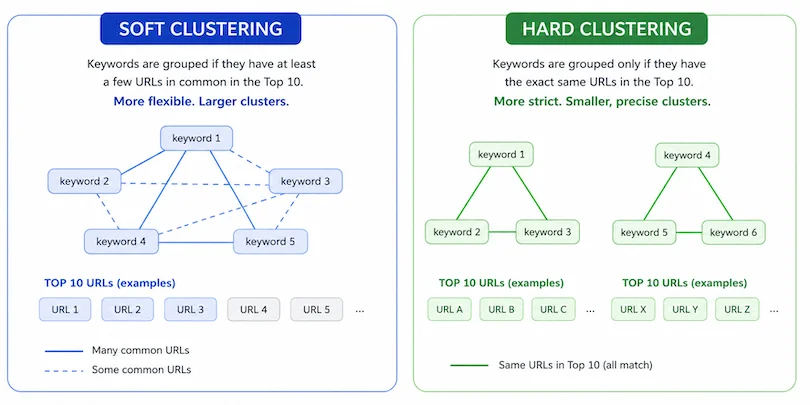
Soft clustering is a clustering method where queries are grouped together if they share several common URLs in search results.
For example, queries such as Keyword Clustering, Keyword Clustering Tool, and Keyword Clustering Software.
If you open Google’s top 10 results, you will regularly see the same pages ranking for these queries. The algorithm will consider them part of the same cluster.
The advantages of soft clustering are that it creates larger content groups, helps avoid unnecessary fragmentation, and works well for informational websites and blogs.
Its disadvantages include the fact that queries with slightly different intents may sometimes end up in the same cluster.
Hard Clustering
Hard clustering uses stricter rules for combining queries into a group.
All keywords within the group must have a high level of search result overlap with each other.
In other words, if we open the SERP, more than 50% of the pages should match.
As a result, these clusters become more precise but also narrower.
The advantage of hard clustering is high accuracy and a minimal risk of combining different intents.
It works well for competitive niches and commercial projects.
The disadvantage is that it often produces too many separate clusters and pages.
Middle Clustering
Middle clustering is a moderate clustering approach where stable micro-groups are created through strong relationships, but can later be expanded with related queries based on frequency markers.
This can be an optimal balance for most commercial and mixed projects because it helps avoid unnecessary expansion of the website structure.
Table
| Clustering Type | How the Algorithm Works | Best Used For |
|---|---|---|
| Soft | One high-volume marker query is selected, and all other dependent queries are compared only against it. | Informational websites, blogs, and broad topics. Allows the creation of large, comprehensive articles. |
| Hard | All keywords within the group must overlap not only with the marker query but also with each other. | Commercial websites, highly competitive niches, e-commerce stores, and service websites. |
| Middle | A grouping method positioned between strict (Hard) and flexible (Soft) clustering. Stable micro-groups are created using a strict approach and then expanded with related queries based on marker frequency. | An optimal balance for commercial and mixed projects. |
Soft vs Hard Clustering. Which One Should You Choose?
So, which type of clustering should you choose?
Of course, there is no universal answer, although logic suggests that middle clustering can be a good compromise.
Let me give you a table showing how I would recommend clustering keywords. But this is only my recommendation, the final decision is yours.
| Project Type | Recommended Approach |
|---|---|
| Blog | Soft clustering |
| Content website | Soft clustering |
| SaaS | Soft or middle clustering |
| E-commerce | Hard clustering |
| Highly competitive niche | Hard clustering |
If you do not know where to start, I recommend using soft clustering first and then manually reviewing the most important groups.
Methods of Performing Clustering
Of course, everything depends on the size of your semantic core, the number of keywords, and the resources available.
I would divide the work into three main approaches.
Manual Method
In this approach, a specialist analyzes each query individually.
If you are working with 300, 500, or even 1,000 keywords, this can be a good option.
You will achieve maximum accuracy, but it will require significant resources.
Automated Method
You can use various SEO tools.
The process may take anywhere from a few minutes to a couple of hours, and you only need to configure parameters such as:
- region;
- SERP depth;
- clustering type.
Hybrid Method
This is the most professional approach.
First, software performs a rough automatic grouping, and then an SEO specialist manually reviews and adjusts the structure.
Clustering by Search Intent
Even perfect SERP overlap does not always reflect the actual user need.
That is why SEO specialists perform additional intent analysis.
Typically, we distinguish the following intent types:
- Informational intent — the user wants information.
- Commercial intent — the user is comparing options before making a purchase.
- Transactional intent — the user is ready to take action.
- Navigational intent — the user is looking for a specific brand or website.
Intent identification is even more important than the keywords themselves because when we understand that queries share the same entity but have different user intentions, we know that separate pages must be created.
Therefore, modern clustering methods combine SERP analysis and intent analysis rather than relying solely on keyword similarity.
Because visually, keywords may look similar while their actual meaning can be completely different.
Step-by-Step Clustering Algorithm
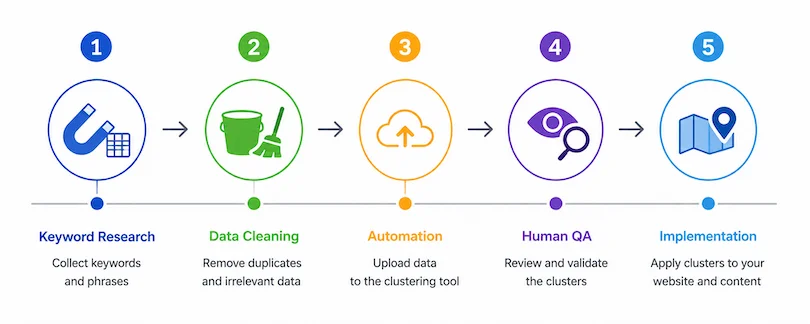
To get accurate keyword groups, I would recommend using the following stages.
Keyword Collection
At the first stage, our task is to find the largest possible list of queries related to the topic.
These can be your main keywords, niche terms, expert terminology, and other topic-related phrases.
And this is very important. Why?
Because even keyword tools rarely suggest all of them.
I have worked in niches where a keyword had multiple meanings, but industry experts understood exactly what it referred to. You can even create your own list of such terms within your niche.
Send me a message on LinkedIn later and tell me about interesting keywords you have encountered in your niche because I have seen many of them over the years and, honestly, very little surprises me anymore.
Still, you can start with brainstorming and specialized SEO tools.
Among the popular ones, I can mention:
- KeywordStat;
- Ahrefs;
- SEMrush;
- SE Ranking;
- Serpstat.
You can also use Google Search Console, but as you know, this is only possible for your own website.
Therefore, if your website is already live, you can refine the structure later when you receive real data from Google Search Console.
Semantic Cleanup
Before clustering, you need to remove everything that may distort the results.
This includes duplicates, typos, irrelevant queries, competitor brand queries, and queries from unrelated topics.
For example, if we are working on the topic of Keyword Research or something similar, queries related to advertising, SMM, or web design should not be included in the clustering process.
Therefore, proper keyword cleanup significantly improves the accuracy of further grouping.
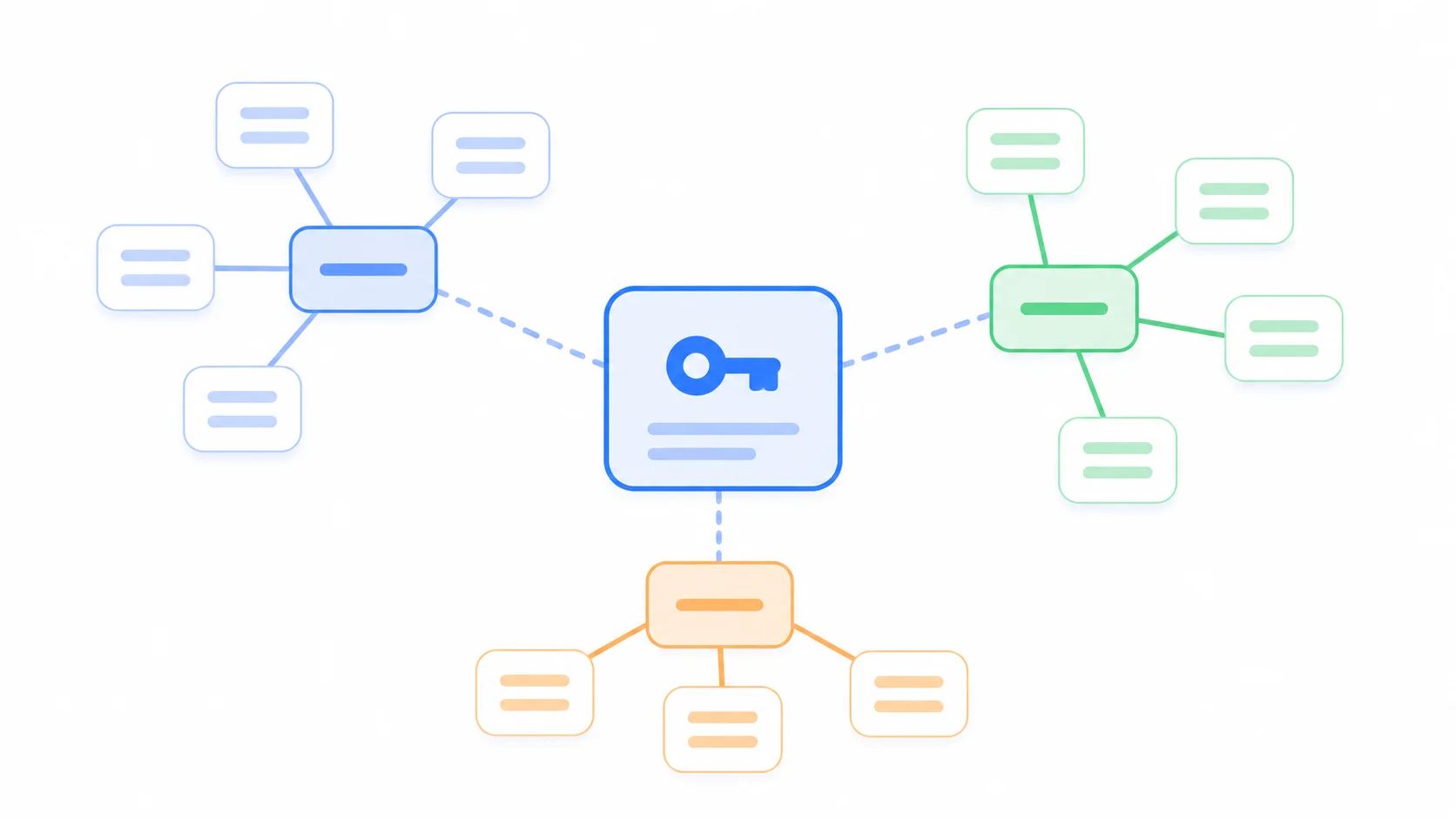
Clustering Tool
As I mentioned before, I recommend starting with a clustering tool and moving directly to automated query grouping.
Most modern services use one of two approaches:
- SERP-based clustering — analysis of search result overlap;
- AI-based clustering — analysis of query intent and meaning.
The first approach is the classic one and is generally considered more accurate because it relies on real Google search results.
The second approach allows you to work with larger datasets but requires additional verification.
Clustering Parameters
Before launching the process, select your settings.
Typically, you specify the search engine, country or region, and SERP depth — top 10, top 20, or top 30. Going deeper probably does not make much sense.
You also select the clustering type. The most popular options are hard and soft clustering.
For example, results for the United States, the United Kingdom, and Australia can differ significantly even for identical English-language queries.
Therefore, always perform clustering for your target market unless you have a worldwide product.
Manual Cluster Review
Regardless of which tool you choose, I would not rely on it 100% because tools can make mistakes or fail to properly understand certain queries.
Human review should never be completely eliminated.
Check how different intents are grouped, how similar queries are separated, and how clusters are created overall.
Pay special attention to clusters with high commercial potential because mistakes there can be the most expensive.
Creating Target Pages
Once clustering has been completed, each cluster should receive its place within the future or existing website structure.
Example table:
| Cluster | Future Page |
|---|---|
| Keyword Clustering | Article |
| Keyword Mapping | Article |
| Keyword Research Tools | Commercial comparison |
| Keyword Research Software | Product page |
Comments.
Your clustering process turns into keyword mapping.
You understand what type of page it is, what purpose it serves, and therefore what type of content needs to be prepared.
This includes not only writing content but also preparing visual materials, adding interactive elements, and thinking through what the user will actually do on each page.
Updating Clusters
Clustering is not a one-time task because search results constantly change, new queries appear, and user behavior evolves.
That is why larger projects typically review clusters every few months, update them, supplement them with data from Google Search Console, and account for products or services that have appeared or disappeared.
This should also be taken into consideration.
Results
After completing all these stages, you will have more than just a list of keywords.
You will have a structured system of topics and pages for your project.
This system becomes the foundation for content planning, website architecture, internal linking, keyword mapping, and building topical authority.
That is why I believe modern SEO is almost impossible without high-quality clustering, and you should devote sufficient attention to it.
Keyword Clustering Tools
Clustering can be performed manually or with the help of specialized tools, so the choice of tool depends on the number of keywords, your budget, and the level of grouping accuracy you need.
When we created KeywordStat, I immediately thought that keyword clustering should be one of the first features we built because I was not satisfied with the tools that existed at the time.
So I decided that we would definitely create keyword clustering functionality.
KeywordStat
KeywordStat helps you not only discover new keywords but also group those queries into topical clusters.
The focus is on making the process simple and fast, allowing you to essentially download a ready-made spreadsheet with an already clustered structure.
The tool is designed for small teams and relatively small keyword datasets, but it is fast and reliable like a Swiss watch.
Therefore, for most SEO specialists, this tool will be very useful and effective.
SE Ranking
SE Ranking offers a built-in clustering tool based on SERP analysis.
It identifies URL overlap in search results.
It is a comprehensive platform that includes a clustering module based on SERP data.
It is better suited for larger SEO agencies, content projects, and enterprise websites.
Semrush
SEMrush is also a multifunctional SEO platform that includes a clustering module.
It allows you to work with large keyword datasets and automatically distribute them into topical groups.
This tool is useful for planning content hubs and topical clusters.
I’m not a big fan of Semrush, as it was originally a russian-founded company. Even though Adobe acquired it in 2026, it still leaves a bad taste in my mouth.
Ahrefs
This is a top-tier tool for SEO specialists that is primarily focused on backlink analysis.
However, Ahrefs also allows you to research keywords and cluster them.
Thanks to its “Clustering by Parent Topic” feature, Ahrefs is ideal for identifying state clustering results.
It sequentially groups keyword strings into logical subtopics, helping you visualize the input content needed to create topic-specific tasks without relying on external databases.
Clustering With AI
Modern AI assistants can also perform basic keyword clustering.
For example, Claude or ChatGPT can identify intent, perform preliminary query grouping, discover topical relationships, and prepare a website structure.
However, you need to understand the limitations of this approach.
AI analyzes the meaning of queries but does not see real search results.
Therefore, after AI-based clustering, you still need to manually review and refine the clusters.
Python and Data Science
Many teams use custom Python-based solutions for their projects.
This approach relies on popular libraries.
It allows large numbers of queries to be processed and enables the creation of custom keyword grouping models.
However, you need a technical team to build and maintain the process.
Therefore, this type of clustering is suitable only for enterprise projects or large SEO teams.
Which Tool Should You Choose?
I think the answer depends on many factors: the size of your team, the amount of semantic data, and your goals.
Ideally, you should use SERP-based clustering.
If your budget is limited, you can even perform clustering with an AI tool.
In practice, SEO specialists usually use a combined approach.
- semantic collection;
- SERP clustering;
- intent validation with AI;
- manual review of important clusters.
I believe this workflow provides the best balance between speed, cost, and the quality of target keyword grouping.
Using Clustering Results
Okay, we have completed keyword clustering, but clustering itself will not generate traffic.
We need to do something with the file we have produced.
The next stage after clustering is building the website structure.
Clusters should determine which pages will exist on your website.
After clustering, you understand which topics are primary, which materials should be supporting content, which pages need to be added, and which should be removed.
From Clustering to Keyword Mapping
After grouping queries, I recommend assigning each cluster to a specific URL.
For example:
| Cluster | URL |
|---|---|
| Keyword Clustering | /keyword-clustering/ |
| Search Intent | /search-intent/ |
Within each cluster, you will also maintain a list of the keywords that belong to it.
This process is called keyword mapping and answers the question: which page should rank for this topic?
At this stage, we also design the internal linking structure because clusters help us build logical relationships between pages.
Such a structure improves navigation for users and helps search engines understand topical relationships within the website.
You can not only identify which pages should link to each other but also define the anchor texts that will be used for internal linking.
Building Topic Clusters
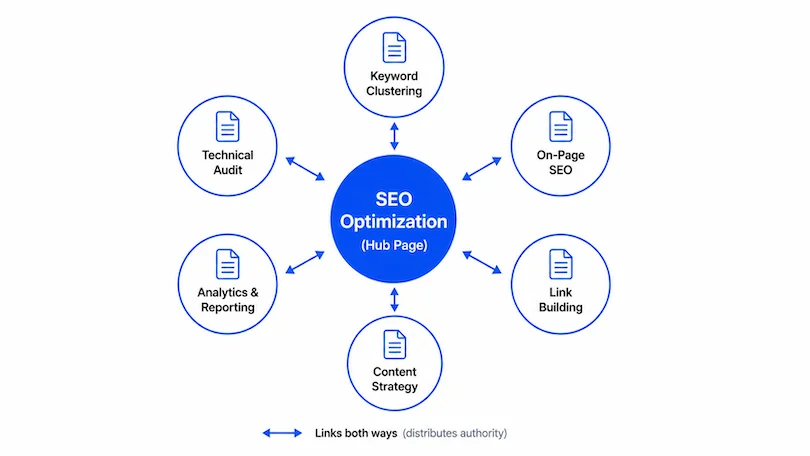
Modern SEO frequently uses a model called hub and spoke.
In this model, there is one central page (the hub) and multiple supporting pages (the spokes).
For example:
- Hub: Keyword Research
- Spokes: Keyword Clustering, Keyword Mapping, Search Intent, Long-Tail Keywords, and Keyword Difficulty
Each supporting article strengthens the parent topic and helps build topical authority.
These pages become the foundation of your future content plan.
Common Keyword Clustering Mistakes
Even if you use excellent clustering tools, incorrect grouping can lead to structural issues, keyword cannibalization, and ultimately traffic loss.
Over-Splitting the Semantic Core
It is tempting to create as many pages as possible to target different keywords and gain more traffic.
However, if those pages satisfy the same intent, they should usually be combined into a single page.
Excessive fragmentation can lead to diluted authority, keyword cannibalization, and the creation of thin content.
In most cases, one high-quality piece of content performs better than several small and nearly identical pages.
Ignoring Search Intent
If queries are grouped solely based on keyword similarity, mistakes can occur.
For example:
These queries share the same topic but have completely different intents.
The first is commercial, while the second is informational.
Combining them into a single cluster would be a mistake.
As a result, the page may perform poorly for both keyword groups.
Blind Reliance on Automated Clustering
Even the best tools make mistakes.
They may merge unrelated queries, create overly broad clusters, or separate queries that should belong together.
Therefore, always manually review your most valuable and commercially important clusters.
Remember that automation speeds up the process but does not replace expert judgment.
Ignoring SERP Differences
Search results can vary significantly by country and region.
The same query may require one page in one market and multiple pages in another.
This is completely normal.
Always validate clustering for your target market.
Use a VPN or SERP simulation tools if you are working outside the target country.
Conclusion
Keyword clustering is one of the fundamental processes of modern SEO.
It transforms a chaotic list of keywords into a clear website structure, helps prevent cannibalization, improves content relevance, and creates a logical page architecture.
Modern search engines focus less on individual keywords and increasingly evaluate search intent, topical relevance, and the completeness of the answer provided to users.
That is why clustering should always be part of your SEO workflow.
Proper clustering is the stage that comes before content creation, website architecture planning, and keyword mapping.
And remember, clustering is not about grouping similar words.
Its purpose is to determine which queries should rank together and which page is best suited to satisfy the user’s needs.
Always focus on the user’s needs, and your decisions will become much easier.
That concludes this article, thank you for reading.
If you found it useful, share it with your colleagues and explore other resources available on this website.