Topical authority is the perceived expertise and trustworthiness of a website within a specific topic.
Topical authority is Google’s way of measuring your website’s depth of expertise. It is the shift from ranking individual pages based on keywords to ranking entire domains based on topical coverage.
- Topical Authority Meaning
- How Does Topical Relevance Work?
- Why Topical Authority Is No Longer Optional
- From Keywords to Entities
- Build Your Cluster Architecture Through Keyword Analysis
- Practical Cluster Checklist
- Build a High-Performance Internal Linking Topology
- The Force Multiplier: Bringing External Links Into Your Hub
- The Myth of "Topical Authority"
- How to Measure Real Topical Authority with Google Search Console
- Key Takeaways: Your Blueprint for Building Topical Authority
- Stop Guessing. Start Clustering.
Topical Authority Meaning

When Google views your site as a niche authority, it stops relying heavily on your backlink profile.
Instead, it ranks your content because your domain covers the subject more comprehensively, accurately, and deeply than anyone else.This is exactly why lean, laser-focused websites can outrank legacy media giants with massive domain ratings. A structured ecosystem of tightly connected pages creates a topical moat that is incredibly difficult for competitors to breach.
How Does Topical Relevance Work?
Search engines compare your website’s content against a much broader topical ecosystem. For example, if your website focuses on keyword intelligence platforms, Google expects to see exhaustive coverage around search volume metrics, automated keyword clustering, search intent classification, SERP volatility analysis, long-tail variations, and competitor keyword gaps.
If you leave large portions of these areas uncovered, it can appear unusual. After all, if you are truly an expert in your niche, you should be able to explain virtually every important concept, process, or situation that your audience may encounter.
This is exactly why young websites with relatively weak backlink profiles can sometimes achieve high rankings and outperform older, more authoritative domains. If your topical relevance is significantly broader and deeper than that of your competitors, you always have an opportunity to rank above them in search results.
It is common for a single page to rank highly in Google. However, when an entire website is built as a connected ecosystem around a specific topic, pushing that site out of the top search results becomes much more difficult.
Why Topical Authority Is No Longer Optional
I’ve been working in SEO since 2010. Back then, scaling a blog followed the same repetitive formula:
- Open a keyword research tool.
- Filter for high search volume and low competition.
- Rewrite the top competitor’s article.
- Build a few backlinks from forums.
We often outranked the original sources.
Looking back, we weren’t creating any real value—we were simply polluting the search index with lightly rewritten duplicates.
Fast forward to today, and many marketing teams are still stuck in 2010.
They treat blogs like digital junk drawers. They target random high-volume keywords, publishing an article about “email marketing metrics” on Monday and “Instagram caption ideas” on Wednesday simply because a keyword tool said the query was easy.
When the next Google Core Update rolls out, these fragmented websites lose 80% of their organic traffic overnight.
Why?
Because search engines don’t see a complete topical map—they see a chaotic collection of disconnected keywords.
From Keywords to Entities
Google’s modern ranking systems—powered by Hummingbird, RankBrain, and MUM—don’t read text the way humans do.
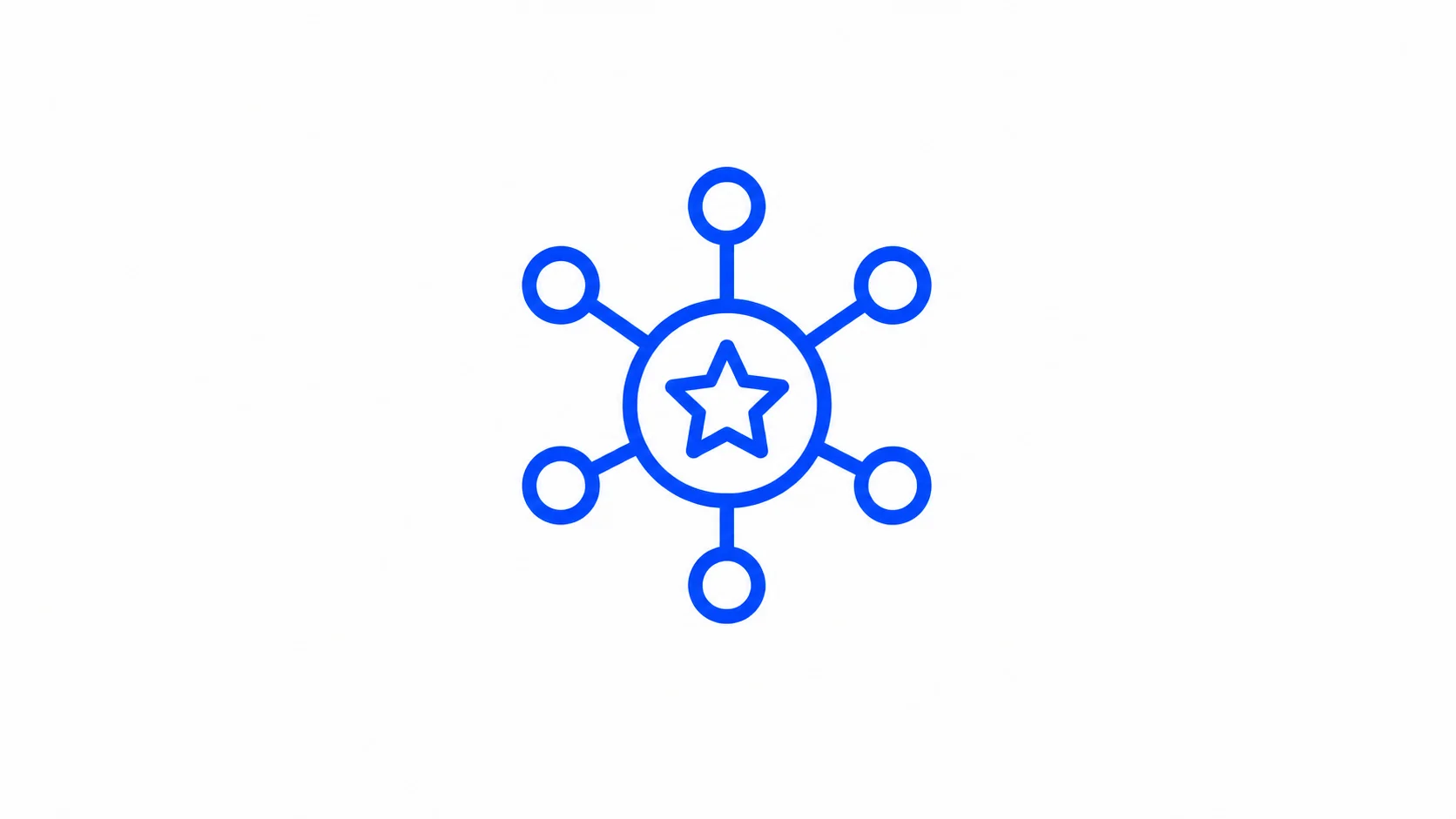
If my website is dedicated to keyword research tools, then according to Google’s Knowledge Graph, my domain should systematically cover the entire topical ecosystem.
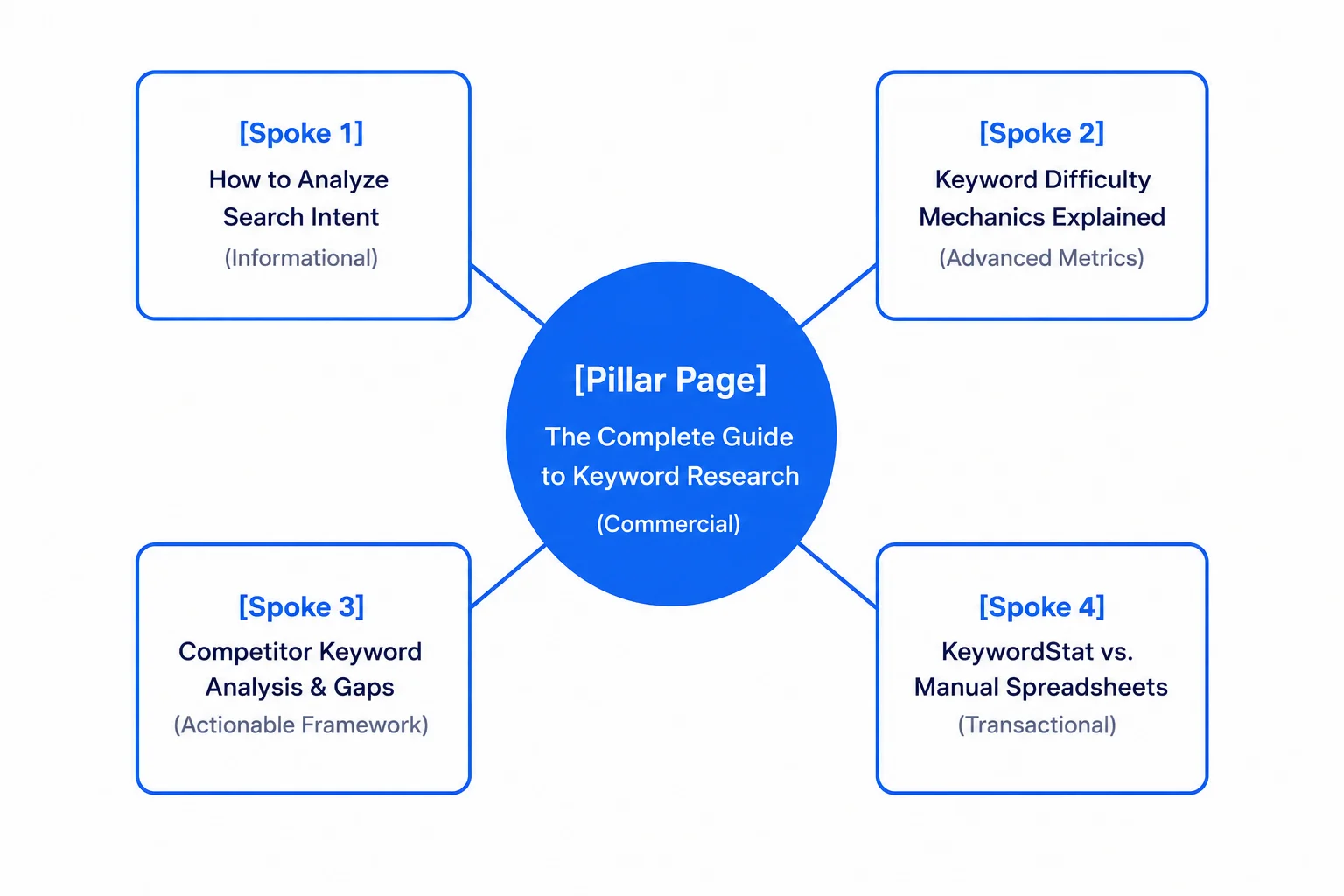
For example, the cornerstone page should be “The Complete Guide to Keyword Research.” To establish genuine topical authority in this field, Google expects me to build deeply interconnected content clusters such as:
- Keyword Intent: covering informational and commercial intent, as well as strategies for optimizing content for transactional search queries.
- Competitor Keyword Analysis: identifying keyword gaps, outranking high-DR competitors, and reverse-engineering the SEO strategies of leading domains.
- Advanced Keyword Metrics: explaining how search volume fluctuates, how proprietary keyword difficulty scores work in practice, and how historical search trends can be analyzed.
Build Your Cluster Architecture Through Keyword Analysis
Once you’ve identified your core topic, the next step is to build the supporting infrastructure: your cluster pages.
The biggest mistake SEO teams make is creating content copies. They look at the top three pages ranking in Google, rewrite them, and expect to rank.
In Google’s information-driven search era, that approach is obsolete.
Your cluster pages must provide unique perspectives, original data, or practical workflows that cannot be found anywhere else on the web.
To build cluster pages that genuinely make a difference, we use a systematic three-step workflow.
Map Semantically Related Entities (Not Just Synonyms)
Don’t simply look for variations of your primary keyword.
Google evaluates the density of industry-specific entities and terminology to verify your expertise.
If your cluster page is about keyword difficulty, Google’s NLP models expect to encounter related concepts such as SERP volatility, link equity, CTR bias, and search intent shifts.
Group Keywords Using Automatic Clustering
Manually grouping hundreds of long-tail keywords into individual articles is one of the fastest ways to create keyword cannibalization.
This is where automation becomes essential.
With KeywordStat, you can eliminate days of spreadsheet work.
After entering your primary topic, the platform automatically collects SERP data, analyzes ranking overlaps, and groups thousands of search queries into logical intent-based clusters with a single click.
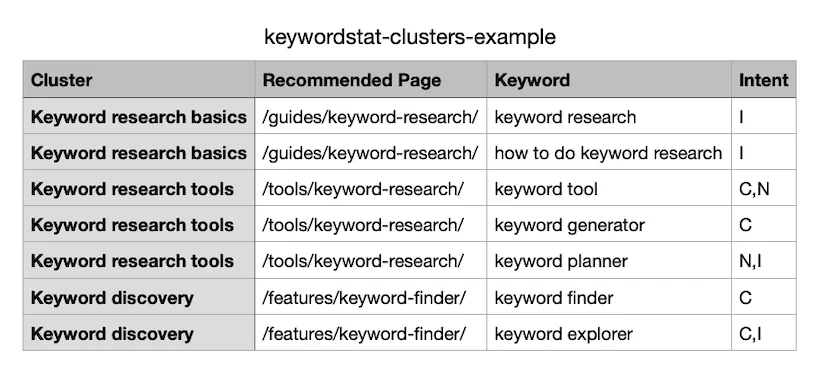
This screen demonstrates exactly how the platform identifies which keywords belong on the same cluster page and which keywords require completely separate URLs to rank effectively.
Build a Clear Internal Linking Structure
Before writing a single line of content, plan your internal linking architecture.
Your cluster pages shouldn’t simply link back to the cornerstone page using generic anchor text such as “click here.”
Instead, your anchor text should use clear, descriptive entity-based terminology.
Practical Cluster Checklist
Opening Paragraph: Begin every cluster article with a direct, no-fluff answer to the user’s question, supported by a unique metric or original data point.
Zero-Overlap Rule: Ensure every cluster page targets a distinct search intent. If two pages begin solving the same user problem, merge them immediately to prevent keyword cannibalization.
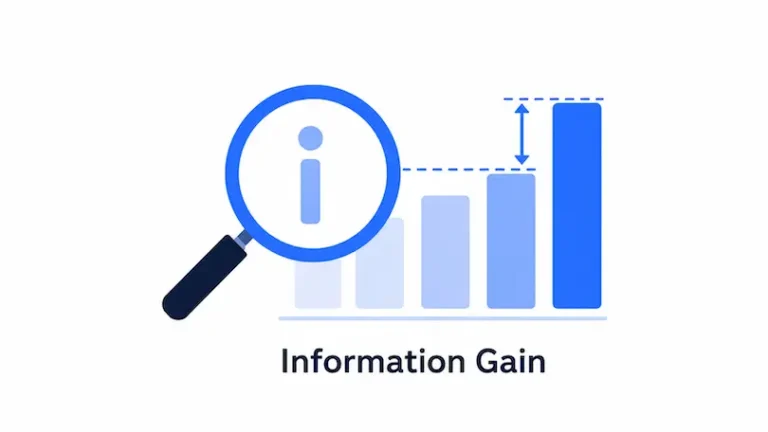
Proprietary Terminology: Introduce custom frameworks or product-specific terminology (for example, how KeywordStat handles data filtering) to maximize your Information Gain.
Build a High-Performance Internal Linking Topology
Internal links are the neural network of topical authority.
Without them, Google may discover your cluster pages through your sitemap.xml, but it won’t fully understand how those pages relate to one another.
Basic internal linking isn’t enough.
You need a strict hub-and-spoke architecture.
Whenever you create internal links, follow these three non-negotiable rules:
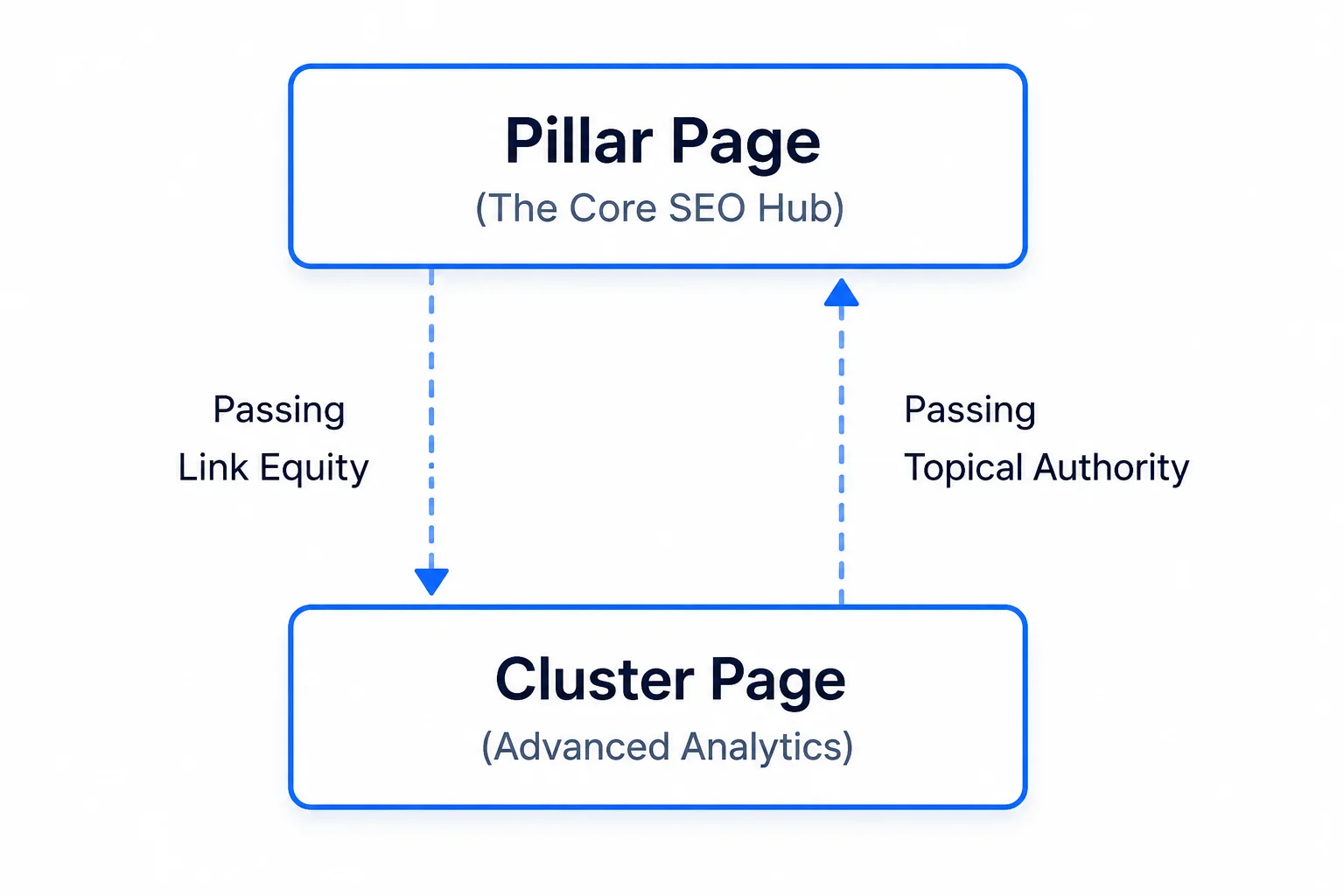
The Two-Way Traffic Protocol
Your cornerstone page should link to every cluster page using contextual, descriptive anchor text.
In return, every cluster page should link back to the main hub page.
This tells Google’s crawler:
“This collection of pages represents our complete, self-contained knowledge base on this topic.”
Cross-Link Related Cluster Pages
If Cluster Page A (for example, “How to Analyze Search Intent”) naturally supports or expands on Cluster Page B (for example, “How to Build Keyword Clusters”), link them together.
Don’t create links simply for the sake of adding more links.
Create links that guide users naturally through the topic.
When users continue exploring your website instead of returning to the search results, Google receives a strong quality signal.
Absolute Anchor Text Precision
Never rely on automated plugins that scatter internal links across unrelated pages.
Never use generic anchor text such as “Read more” or “Click here.”
If you’re linking to a guide about keyword difficulty, your anchor text should be something like “understanding keyword difficulty mechanics” or “analyzing competition metrics in search results.”
The Force Multiplier: Bringing External Links Into Your Hub
While internal links demonstrate your expertise, external validation reinforces it.
When authoritative, high-DR websites in the SEO industry link to your cluster pages, they provide a powerful vote of confidence for your entire domain.
If you’ve built a tightly connected hub-and-spoke architecture, a single high-quality backlink pointing to one cluster page can pass link equity through your internal linking structure, strengthening the rankings of the entire cluster.
To be honest, I certainly wouldn’t turn down a contextual backlink from Backlinko or Search Engine Journal. Oh come on, I’m just kidding. 😉
The Myth of “Topical Authority”
If you open any third-party SEO platform, you’ll often find a proprietary metric labeled “Topical Authority.”
Let’s be completely honest: this metric does not exist within Google’s ecosystem.
You won’t find it in Google Search Console, the Google API documentation, or the Search Quality Evaluator Guidelines.
It’s simply an algorithmic estimate created by SEO tools to approximate your search visibility relative to your competitors.
While it can serve as a rough directional indicator, treating it as your primary KPI is a waste of time.
Google intentionally keeps its real evaluation of your domain’s expertise hidden for two very specific reasons.
Context Changes Dynamically
Topical authority is not a single static score that applies to an entire website.
A domain may have tremendous authority in keyword research tools while having virtually no authority in technical server optimization.
A single universal score simply cannot capture that level of nuance.
Spam Prevention
If Google displayed a definitive “Topical Authority Score: 78/100” inside Search Console, SEO professionals would immediately begin gaming the metric instead of creating genuinely useful content.
How to Measure Real Topical Authority with Google Search Console
Since Google doesn’t provide a topical authority score, you need to evaluate the underlying search signals.
Stop obsessing over third-party dashboards.
Instead, open Google Search Console and monitor these three real indicators of topical authority.
Impression Velocity for Long-Tail Clusters
When you publish a new cluster page, monitor its impressions—not clicks—during the first 14 days.
If your domain has topical authority, Google will immediately begin testing that page across dozens of long-tail search queries, creating a rapid increase in impression velocity.
If impressions remain close to zero, your domain likely lacks sufficient authority for that particular topic.
The “Rising Tide” Effect
Whenever you publish a new, in-depth article within an existing topic cluster, monitor the performance of your older articles in the same cluster.
If Google rewards the new content, you’ll often see rankings and traffic improve across older cluster pages at the same time.
True topical authority behaves like a rising tide—it lifts every closely related URL.
Head Keyword Impressions
Track your rankings for broad, highly competitive head terms such as “keyword metrics” or “keyword analysis.”
As you continue expanding and strengthening your topical clusters, your average ranking for these competitive head keywords should steadily improve—even if you haven’t built a single new backlink to that specific page.
Key Takeaways: Your Blueprint for Building Topical Authority
Building topical authority isn’t about publishing more content—it’s about creating an impenetrable knowledge ecosystem.
As you expand your organic presence, keep these core principles at the center of your strategy:
- Think in books, not blog posts. Treat every new piece of content as a deeply integrated chapter of a larger book, ensuring there are no gaps in your topical coverage.
- Protect against keyword cannibalization. Never allow your cluster pages to compete for the same search query. Every URL should cover a distinct, highly specific aspect of the topic.
- Create assets, not just content. Fill your clusters with original data, proprietary workflows, and interactive elements that naturally attract backlinks over time.
- Let data do the heavy lifting. Manual keyword mapping is a relic of the past. Use intelligent clustering engines to eliminate human error and accurately map relationships between your entities.
Stop Guessing. Start Clustering.
The old strategy of chasing fragmented, high-volume keywords is officially obsolete.
To survive—and outperform—Google’s modern entity-based algorithms, your topical map must be comprehensive, structured, and fully automated.
Don’t waste weeks digging through spreadsheets trying to determine which long-tail keywords are related.
Get started with KeywordStat today and dominate your niche using next-generation entity clustering.