AI Overviews are AI-generated summaries that appear at the top of search results. Instead of a simple list of links, the search engine analyzes multiple sources and provides a direct answer to your query.
This answer includes links to sources that allow users to verify the information and explore it on the original website, the source of the data.
- What Did Search Engine Results Look Like Before?
- What Is AI Overview?
- How Is AI Overview Different From Featured Snippets?
- How Do AI Overviews Work?
- How to Optimize Your Content for AI Overview?
- AI Overviews in E-commerce
- What Do the Experts Say?
- How to Prevent Your Content From Being Used in AI Overview?
- The Future of Search
What Did Search Engine Results Look Like Before?
Google and other search engines used to work according to a simple model. A user entered a query, received a list of websites in the top 10, and clicked on the links.
But today, the answer often appears directly in the search results. Google uses AI together with Google and displays generated reports and answers above the traditional search results.
Therefore, the user receives a brief explanation, recommendations, and links to sources before they even see the classic list of websites.
Therefore, for website owners this means serious changes to the rules of the game because many queries are already starting to turn into zero-click searches, and the usual SEO metrics no longer have the same value.
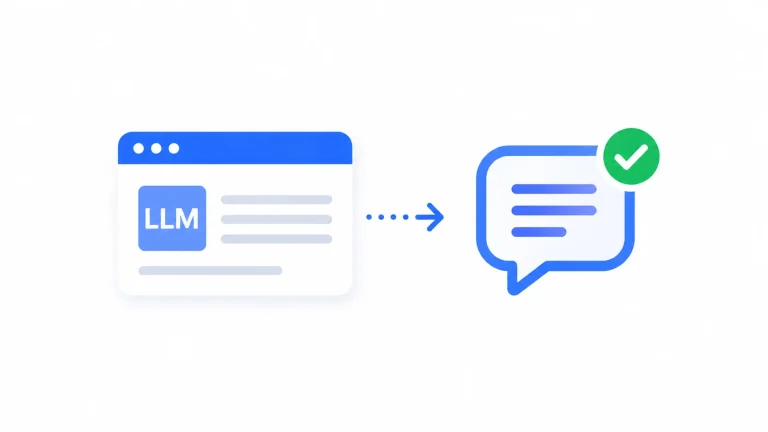
Optimization for AI Overviews is part of a global trend of optimizing not for link ranking algorithms, but for language models (LLM) and a fundamental paradigm shift towards GEO (Generative Engine Optimization).
What Is AI Overview?
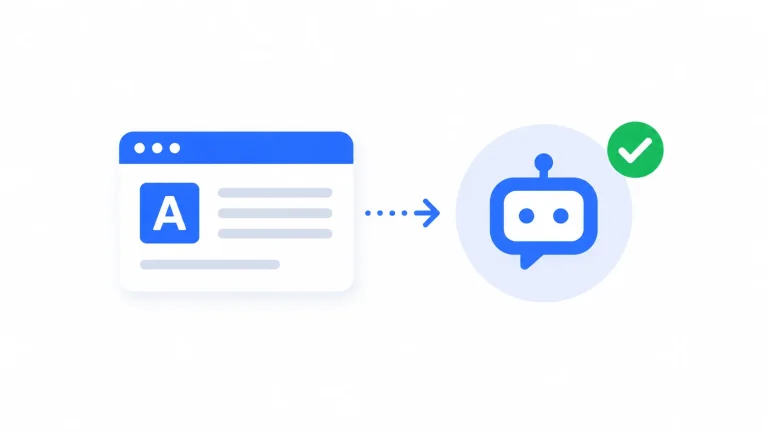
AI Overview is an answer block created by artificial intelligence and displayed directly in search results, and instead of a set of links, the user receives a ready-made answer that is compiled from several sources at the same time.
What Does AI Overview Look Like?
What does AI Overview look like on desktop?
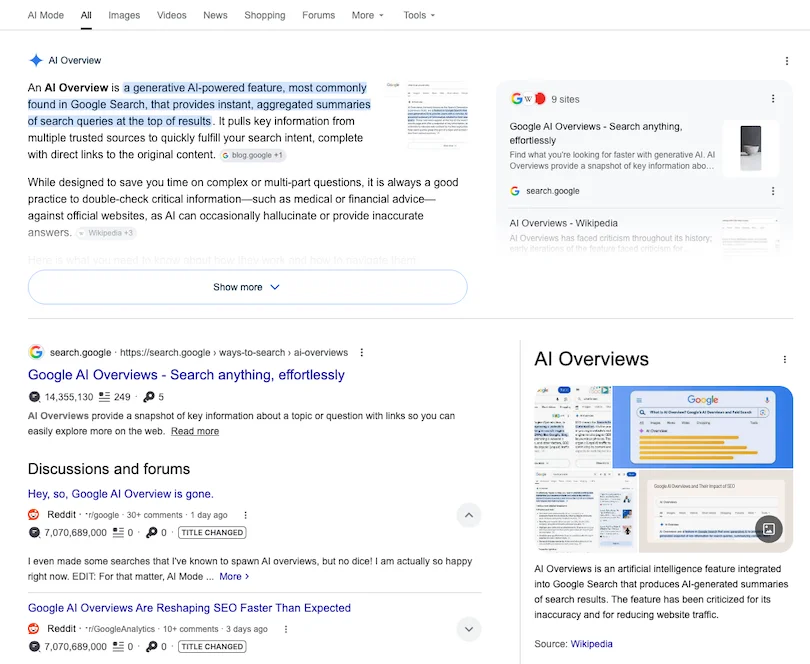
Caption for the screenshot: AI summary, links to sources, expandable blocks, traditional search results below.
What does AI Overview look like on mobile?
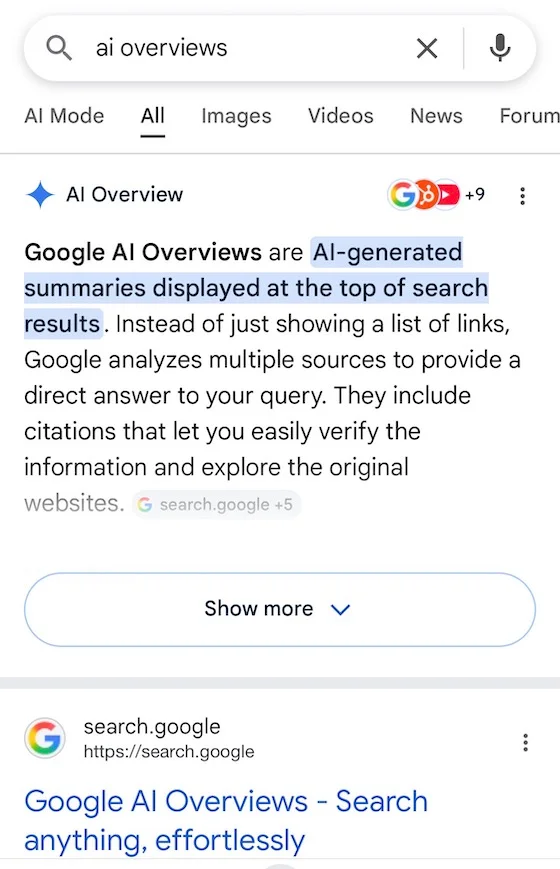
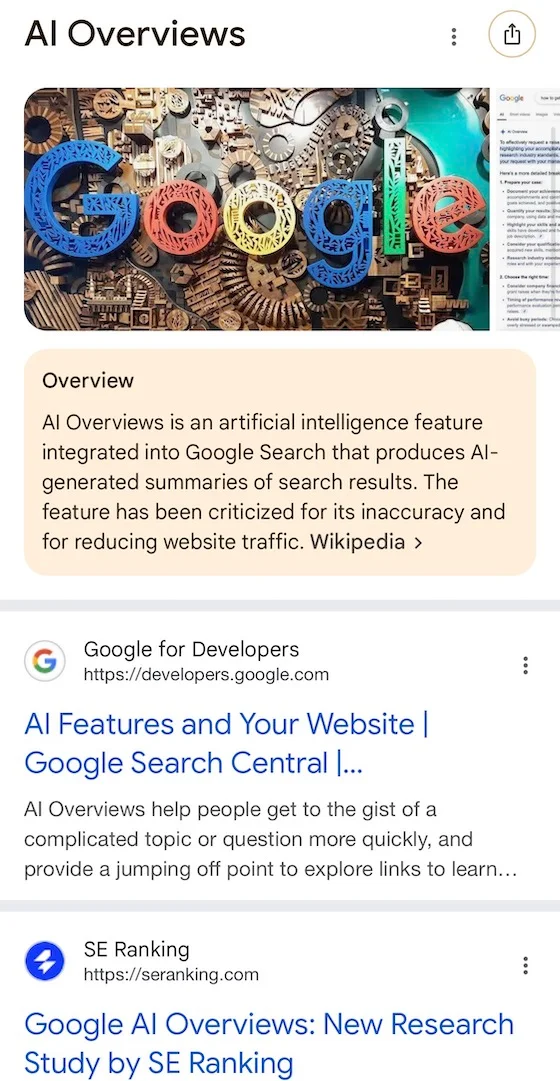
Caption for the screenshot: AI summary, cards, source, additional questions, organic search results.
How Is AI Overview Different From Featured Snippets?
| Featured Snippet | AI Overview |
|---|---|
| One source | Multiple sources |
| Text citation | Answer generation |
| Simple answers | Complex answers |
| Limited format | Dynamic format |
How Do AI Overviews Work?
AI Overviews are most commonly shown for informational queries, comparison queries, “how to” queries, research queries, or some kind of multi-step queries.
For example:
- How to start a blog
- Best keyword tool for small business
- PPC vs SEO
- How AI changed search
Where Does Google Get This Information?
Google does not use a single source of data. The Gemini system analyzes multiple pages and creates one final answer based on several documents at the same time.
Therefore, several factors are taken into account when selecting sources:
- document relevance;
- website authority;
- freshness of information;
- content quality;
- compliance with E-E-E-A-T principles.
How Do AI Overviews Change SEO?
Previously, a user simply had to visit a website to get an answer. Now they receive the answer directly in the search results.
As a result, we get fewer clicks, less organic traffic, and lower CTR even at the highest rankings.
So What Happens to CTR?
A website may still rank in first position in the organic search results while at the same time receiving fewer visits.
And the reason for this is very simple. The user already sees the answer before viewing the search results and will not always visit the website.
Therefore, the new reality of SEO looks like this.
Previously, the question was: what position does the page rank in?
Now we have to ask: is this page participating in AI Overview answers?
How to Optimize Your Content for AI Overview?
Now we are getting to the most interesting part.
Forget about simply placing keywords on your website and so on. You need to provide answers to user queries.
Give the Answer in the First Paragraphs
Use the simple inverted pyramid principle. First give a short answer, then a definition, then an expanded answer, and only after that, expand into specific details and conclusions.
This structure is understandable for AI as well.
Lists, tables, FAQs, step-by-step instructions, and comparison blocks work very well in content.
Although first of all you should still think about the user.
Create Original Data
Artificial intelligence usually retells publicly available information. It is very difficult for it to replace research, statistics, case studies, and your own experiments, so always create original data.
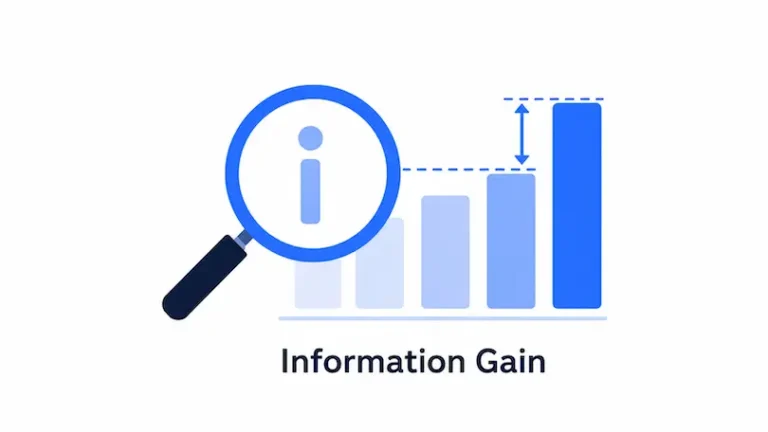
And read my article “Informational Gain” This is a metric that Google actively uses to evaluate how original and unique the information on your website pages is compared to what already exists on the internet.
Work on E-E-A-T
This is one of the most important factors.
Google really likes when an author has real experience, expertise, authority, and trustworthiness as a source.
Therefore, indicate your real work experience and support your information with real examples.
Optimize for Conversational Queries
Move away from queries like SEO tools, move away from standard keywords.
I remember when I first started working in SEO in 2010, our task was to fill an article with as many keywords as possible.
Now users search differently. They very often enter queries by voice.
And for example, instead of SEO tools, a user will more often ask: “what is the best SEO tool for small business with a limited budget”.
Such queries are becoming more and more popular with the development of AI Search, so make sure that your content is optimized for these conversational queries.
AI Overviews in E-commerce
Online stores and e-commerce brands also need to understand how AI-powered Views work because for commercial queries they work a little differently than for informational ones.
And AI search results for e-commerce are divided into two different formats, and they also need to be optimized differently.
Format 1. Text Blocks: Selection, Comparison, Guides
This format is triggered when the user is in the middle of the funnel, at the research stage before a purchase. They are not yet searching for a specific product but are asking which laptop for a beginner they should choose, or what are the best noise-canceling headphones, or which mountain bike is suitable for a beginner.
What Does It Look Like?
Google generates text summaries with selection criteria and lists of recommended models. On the right side or inside the text there will be links and images leading to articles, reviews, or large marketplaces.
What Is the Optimization Strategy for Text Blocks?
For e-commerce models, the concept of informational gain is critically important. I already wrote about it today and in another article.
Google will not choose your website as a source if you simply copy technical specifications from the manufacturer’s website.
You need to contribute something of your own and provide more useful information.
What Can We Do?
Create commercial content hubs.
Write deep and honest buyer guides based on your own experience.
Implement Expert Experience and E-E-A-T
Google will look for phrases such as: “We tested this model in rainy weather” or “This computer, this laptop worked for this many hours without charging, and its performance was as follows.”
You can add real photos of your team with the product to show that you have at least held the product in your hands.
Create Comparisons
You can use clear comparison tables that compare product advantages, disadvantages, and price categories.
LLM systems love extracting data from table tags.
Optimize FAQ Blocks on Product Pages
Back in April 2023, Google (source: https://developers.google.com) began limiting the visibility of FAQ results, and in August 2023, announced that they would remain only for well-known, authoritative government and medical websites.
Also at that time, HowTo rich results were no longer shown on mobile devices, and were later completely discontinued.
Following an official Google update in May 2026, rich snippets for frequently asked questions (FAQs) were completely removed from search results for all websites.
While these blocks are no longer visible to users, LLM systems still rely heavily on structured FAQ markup to efficiently crawl, parse, and extract understandable question and answer nodes for AI reviews. Google also states that FAQ markup will continue to help improve understanding of page content. Here’s some information on the matter.
Format 2. Product Results: Direct Purchase
This format is triggered for transactional queries, already at the bottom of the funnel when the user is ready to buy a product.
For example:
- medium-firm orthopedic mattress;
- evening suit.
What Does It Look Like?
AI Overview turns into a long dynamic storefront and groups products by categories, displaying carousels, cards with prices, real ratings and stars, key characteristics, benefits, and a direct Buy button.
What Is the Optimization Strategy for Product Results?
In this case, classic content marketing will no longer work.
AI Overview product results are based on Google Shopping Graph technology. This is Google’s database that processes billions of products in real time and displays them through Merchant Center.
Creating a perfect Google Merchant Center will be your main weapon.
Your product feed must be updated continuously. Product names, prices, availability, and delivery conditions must be accurate at the moment of purchase.
If AI sees that there is a price discrepancy between the feed and the website, the product card will simply disappear from Google AI Overviews.
Product SEO Optimization
This includes title and description in the feed, so forget about creative product names.
AI will search for parameters such as brand, product type, material, color, size, and specifications.
Structured Data
Schema.org Product and Review. On every product page, implement extended structured markup.
LLMs should be able to easily read the price, currency, availability, and reviews.
Work With Reviews
AI Overview product results often generate summaries stating that, for example, buyers praise a product for certain characteristics.
AI will scan reviews on your website and on third-party platforms: Google Maps, Trustpilot, and others.
Therefore, your task is to encourage users to write detailed reviews that mention specific product characteristics.
What Do the Experts Say?
I would like to give you a couple of quotes from well-known experts so that we know where we are heading with AI Overview.
Cyrus Shepard, former Head of SEO at Moz and founder of Zyppy, wrote on his LinkedIn:
“That almost all independent studies confirm that the appearance of AI Overview blocks reduces the click-through rate of traditional rankings by 50–60%. Therefore, if your brand is not simply ranking lower down the page but is included inside AI citations, your CTR may grow compared to those whom artificial intelligence ignored. Yes, this will not fully compensate for the overall loss of organic traffic caused by the zero-click policy, but right now citation links inside AI are your lifeline.”
Sundar Pichai, CEO of Alphabet and Google, in an interview with The Verge:
“We are building AI Overview in a way that directs traffic to the widest possible range of web resources. With artificial intelligence, users begin searching for more complex things and dive deeper into topics, and explore a broader variety of content. Across the entire ecosystem, we do not see an overall decline in outbound clicks to websites.”
Kevin Indig, former Head of SEO at Shopify, G2, and one of the leading analysts of AI transformation, He wrote in his Growth Memo blog:
“Our large-scale study of user behavior shows that AI Overview really cuts traffic by around 30–50%, depending on the device. An interesting behavioral pattern has emerged. Users do not blindly trust artificial intelligence, especially in complex fields such as medicine or finance. They use AI as a brief summary, but then visit sources and verify the information. At the same time, younger generations check links and click on Reddit and YouTube, while older users prefer traditional trusted websites.”
How to Prevent Your Content From Being Used in AI Overview?
If you are interested in this question and for some reason want your content not to participate in AI Overview, this is possible.
Google supports a number of directives for managing snippets, and the most well-known are no-snippet, max-snippet, data-nosnippet, and so on.
However, completely preventing the use of content usually leads to reduced visibility of your page in search results, so you should not block participation in AI Overview without a serious reason.
The Future of Search
AI Overview is only the first stage of the transformation of traditional search, but it is already clear that Google and other search engines are gradually moving from a system of links to a system of answers.
This does not mean the complete death of SEO, so if you are already preparing to go work at a factory and update your resume: wait a little longer. 😀
It means a change in the rules. Websites that publish superficial content without any added unique value will naturally receive less and less traffic.
But websites that truly demonstrate expertise and collect original data will maintain visibility even in the era of AI search.
Conclusion
Google AI Overview changes the way users interact with search, but it does not eliminate the need to create high-quality content.
Therefore, the main task of SEO is no longer blindly searching for keywords and striving to achieve high rankings.
It is important to become a source of information that Google, other search engines, and LLM systems will use when generating artificial intelligence answers.
Therefore, the winners of the new era will not be the websites that optimize keywords the best, but those that learn to provide the best answers to user queries.
I hope this article was useful to you.
Therefore, read other articles on my blog and share links to the materials on this website with your colleagues and friends.