LLM Optimization is the process of optimizing a website to make it understandable, authoritative, and accessible to most large language models.
Such as ChatGPT, Google AI Overview, Gemini, Claude, Grok, Perplexity, and others, so that the content on the website can be used to generate answers.
- How Do You Get ChatGPT, Claude, and Gemini to Recommend Your Brand?
- How Is LLM Optimization Different from SEO and AEO?
- GEO or LLMO: What's the Difference?
- Why Do ChatGPT and Other LLMs Recommend Some Products While Ignoring Others?
- Which Language Models Should You Optimize For?
- ChatGPT (OpenAI)
- Gemini (Google)
- Claude (Anthropic)
- Perplexity AI
- LLaMA (Meta AI)
- Grok (xAI)
- General Principles of LLM Optimization
- Building an LLM Optimization Strategy
- Define Your Product Category
- Create a Product Page
- Publish Original Research
- Build Brand Authority
- Engage with Expert Communities
- Reviews and Reputation
- Create Content That Is Easy to Cite
- Develop a Consistent Brand Voice
- Build Your Brand—Not Just Your Website
- Build Your Own Information Ecosystem
- How to Check Whether Your Website or Brand Is Optimized
- What Else Can You Use?
- Testing Product Recommendations
- Check the Sources
- LLM Optimization Checklist
- Conclusion
How Do You Get ChatGPT, Claude, and Gemini to Recommend Your Brand?
More and more users no longer open Google or compare dozens of websites. Instead, they ask AI systems directly: Which AI tool is better, Gemini or ChatGPT? Which service should I use for keyword research? Can you recommend the best AI writer for SEO?
In their responses, ChatGPT, Claude, Gemini, and Perplexity don’t display a list of links. Instead, they recommend a few products and briefly explain why they are worth using or considering.
This creates a new question for many companies: Why do AI systems recommend some brands while never mentioning others?
This is called LLM optimization – a discipline aimed at increasing the likelihood that large language models will use information about your product and recommend it in their responses.
If traditional SEO answers the question, how do you get into search results?, then AI optimization answers a different one: how do you get AI systems to recommend your website or brand?
This is a significant and fundamental difference because, in traditional search, the user chooses which link to click. In AI search, that choice is made by the language model.
That’s why it’s no longer enough to optimize only the pages of your website. You also need to optimize your brand’s overall presence. This is exactly why AI optimization is becoming a new channel for acquiring traffic.
Every recommendation made by ChatGPT or Gemini is essentially the digital equivalent of a personal recommendation. If a user asks which service is best for keyword research, they expect to receive a curated list of trusted solutions—not just a directory of tools with descriptions and features. As a result, AI systems provide a complete answer about the recommended product.
How Is LLM Optimization Different from SEO and AEO?
These disciplines are closely connected, but they solve completely different problems. Let’s take a look at the comparison below.
| SEO | AEO | LLM Optimization |
|---|---|---|
| Helps achieve higher search rankings | Helps content appear in AI-generated answers | Helps your brand become an AI recommendation |
| Main goal is traffic | Main goal is content citations | Main goal is brand mentions |
| Page optimization | Answer optimization | Optimization of your brand’s digital reputation and knowledge presence |
| Works primarily with the website | Works with content | Works with the entire brand ecosystem |
None of these disciplines compete with one another. Instead, they complement a unified strategy for your brand’s digital presence in the age of artificial intelligence.
GEO or LLMO: What’s the Difference?
When AI-powered search first emerged, marketers quickly adopted two new terms: GEO (Generative Engine Optimization) and LLMO (Large Language Model Optimization).
So, what’s the difference between them?
GEO (Generative Engine Optimization) focuses on AI-powered search engines such as Perplexity, Google AI Overviews, and SearchGPT. The primary goal of GEO is to ensure that the RAG (Search + AI) algorithm, which retrieves information from the web in real time, finds your website, considers it authoritative, and includes a link to it in the generated answer.
LLMO (Large Language Model Optimization) takes a broader approach. It focuses on your brand’s presence within the language model itself. The goal of LLMO is to build strong associations (embeddings) in the neural network’s “memory.”
If ChatGPT or Claude were to lose access to the internet, and a user asked, “Can you recommend the best keyword research tool?”, the model should still mention your brand based on the knowledge it acquired during training.
Why Do ChatGPT and Other LLMs Recommend Some Products While Ignoring Others?
This is one of the most common questions among SaaS founders and marketers.
Recommendations are influenced by many different factors. Large language models analyze the amount of information available about different sources to determine which companies are mentioned most often, how authoritative they are, and how users evaluate them.
Which Language Models Should You Optimize For?
When we talk about LLM optimization, many people immediately think of ChatGPT because it is one of the largest players in the market.
However, there are many other large language models, and each of them has its own characteristics. So let’s take a closer look at each of them.
ChatGPT (OpenAI)
ChatGPT is one of the most popular AI assistants in the world. It was originally introduced as a text generation model, but today it has evolved into one of the most advanced ecosystems for complex reasoning, programming, and in-depth analysis.
It collects brand information from global archives like Common Crawl, as well as authoritative review databases and real-time web search powered by Bing.
Thanks to deep integration with Apple Intelligence, the ChatGPT ecosystem processes search contexts synthesized by Applebot, making your brand’s technical documentation Apple-compliant.
Make your content as specific as possible: eliminate fluff and answer user questions directly. As an additional step, you can create an llms.txt file in the root of your site—this is an unofficial but increasingly popular format.
Gemini (Google)
Gemini is deeply integrated into Google’s ecosystem and is becoming part of the traditional search experience. Developed by DeepMind, it is a multimodal system that excels at analyzing images, videos, code, and performing fast web searches.
Gemini gathers information about companies from authoritative text databases, encyclopedias, and official documentation. It also retrieves brand information directly from Google Search, Google Maps, Google Business, and major business directories.
Optimizing your brand for Gemini requires excellent traditional SEO, a verified presence in Google Maps, flawless mobile optimization, and the implementation of JSON-LD structured data.
Claude (Anthropic)
Claude is positioned as a language model focused on accuracy, safety, and deep information analysis.
Created by former OpenAI employees, Claude is widely used for in-depth text analysis, long-form content creation, working with large documents, and software development.
The ClaudeBot and Claude Search Bot crawlers collect information about brands from authoritative text databases, scientific publications, Wikipedia, and live search results based on user queries.
Give Anthropic bots access in the standard robots.txt file and focus on deep content analysis without any marketing fluff. The llms.txt file can serve as an auxiliary tool for the AI to quickly navigate your site.
Perplexity AI
Perplexity combines the capabilities of a large language model with real-time web search. Nearly every response includes citations to the sources used, making Perplexity fundamentally different from traditional AI assistants.
The PerplexityBot crawler indexes the web to build its search database, while Perplexity-User visits websites directly in response to user queries. It is widely used for instant web search, in-depth market research, and fact-checking.
To optimize your website for Perplexity, allow these user agents in your robots.txt file, structure your content into short, information-rich chunks, and implement Schema.org markup to help AI extract facts more efficiently.
LLaMA (Meta AI)
LLaMA is an open-source language model designed for deploying local AI assistants on private infrastructure.
It is trained on internet snapshots and large statistical datasets. Information about brands is primarily gathered from established sources such as Wikipedia, Crunchbase, and major news publications.
To optimize your brand for Meta AI, focus on traditional digital PR, register your business in authoritative directories, maintain a presence in wiki-based platforms, and strengthen your overall online reputation.
Grok (xAI)
Developed by xAI in late 2023, the Grok model is trained on the Colossus supercomputer and is known for its witty humor. The latest versions of the model are strong in programming, mathematics, and data analytics.
By integrating with social network X (Twitter), the AI instantly learns about world events, and for classic web search, it relies on data from partners such as Bing and Wikipedia.
For Grok to recommend your product, simply specifying a user agent in robots.txt is not enough. You need an active presence and brand mentions on social network X itself, as well as clean technical markup of your website using JSON-LD, which allows search crawlers to gather facts about your company.
General Principles of LLM Optimization
Despite the differences between these language models, several common optimization principles can be identified.
All modern LLMs strive to use well-known and trustworthy brands, rely on information from multiple independent sources, give preference to expert and up-to-date content, consider a company’s online reputation, and avoid recommending products that lack reliable information in order to minimize errors.
For this reason, LLM optimization should not be built around a single platform. Instead, it should focus on creating a strong digital presence for your brand.
Building an LLM Optimization Strategy
LLMs evaluate the entire digital ecosystem of a brand: what people say about it, who recommends it, how consistently the project is presented, and whether the available information can be trusted.
Let’s go through the key elements required to build an effective optimization strategy for your brand.
Define Your Product Category
The primary goal of AI systems is to understand what your product actually is. This may seem obvious to you, but many companies describe the same product in different ways.
You may find descriptions such as SEO platform, marketing toolkit, keyword software, content suite, or SEO assistant. While this looks perfectly natural to a human reader, a language model may interpret these as entirely different product categories.
That’s why it’s better to choose one primary description and use it as consistently as possible.
For example, KeywordStat is a keyword research, analysis, and clustering platform. This description should be repeated consistently across your homepage, blog, documentation, press releases, YouTube channel, social media profiles, product descriptions, and every other brand touchpoint.
Create a Product Page
To help an LLM clearly understand what your product is, it’s recommended to create an About Us page that explains it in detail.
A strong product-focused About Us page should include a brief product description, the problem your service solves, its core features, the target audience, its advantages over competing solutions, and real-world use cases.
This page becomes the primary source of information about your brand because it represents the first and most authoritative source—the brand describing itself.
Publish Original Research
Don’t limit yourself to publishing only how-to articles, tutorials, and guides. Most companies create educational content, but far fewer publish original research.
Today, original research has become especially important because it serves as a source of citations. This new and original information—now commonly referred to as Information Gain—creates unique value that simply cannot be obtained from other sources.
Build Brand Authority
Language models trust established brands that are mentioned by independent sources. That’s why you need to build your brand’s presence beyond your own website.
This includes major media outlets, professional blogs, industry directories, product reviews, founder interviews, third-party research, social media, YouTube, Medium, customer reviews, and more.
Every independent mention strengthens your brand’s digital authority, making it increasingly important for LLM optimization.
Engage with Expert Communities
LLMs analyze not only websites but also discussions across online communities. Platforms where users naturally recommend tools, brands, and products to one another are particularly valuable.
These include Reddit, Quora, Hacker News, Stack Overflow for technical products, as well as other specialized forums.
Instead of posting promotional messages, participate in discussions, help users solve problems, and share your expertise. It’s also important that different people contribute different opinions rather than creating a discussion where you ask and answer your own question.
Reviews and Reputation
Reviews have long since stopped being just a conversion optimization tool. Today, they have become an important part of LLM optimization.
When many independent users consistently describe the same product strengths, language models begin to recognize those characteristics as stable attributes of the brand and incorporate them into their answers.
That’s why reviews on independent platforms where users share real experiences are so valuable. Examples include Trustpilot, Sitejabber (now Smart Customer), ProvenExpert, and similar review websites.
Create Content That Is Easy to Cite
Create content that is easy to quote and reference. Include clear definitions, comparison tables, lists of benefits, step-by-step instructions, question-and-answer sections, practical worksheets, and checklists.
AI systems rarely use long, unstructured paragraphs. They find it much easier to extract well-organized fragments, increasing the likelihood that your content will be selected by a language model.
Develop a Consistent Brand Voice
Every company has its own terminology.
If your product helps users perform keyword research, consistently use the same terminology, such as keyword research, keyword clustering, search intent analysis, keyword difficulty, and keyword analysis.
When these phrases appear consistently across all of your content, language models build a stronger association between your brand and your area of expertise.
The language you use to present your brand should also remain consistent across every platform where you publish content.
Build Your Brand—Not Just Your Website
Almost every SEO specialist focuses primarily on their own domain. I’m probably no different.😉
They check rankings, monitor traffic, track impressions, and spend a significant amount of time in Google Search Console.
Today, however, language models analyze a company’s entire digital footprint.
That’s why it’s important to build and maintain a YouTube channel, publish product documentation, create a GitHub page for technical products, launch podcasts, prepare presentations, publish original research, maintain active social media profiles, and provide information about your company’s founders and their conference presentations.
Each additional touchpoint strengthens trust in your brand because language models build logical connections across all of this information.
Build Your Own Information Ecosystem
Successful companies have stopped creating isolated pages—they build entire ecosystems of informational content.
For example, since I’m developing an SEO platform, I created a Learning Center where I explain the most important SEO concepts and keyword-related topics.
You can also add a blog, documentation, research, a glossary of terms, a template library, customer case studies, competitor comparisons, free tools, and much more to your website.
Such an ecosystem demonstrates that your company has deep expertise in its field rather than simply offering a single product.
How to Check Whether Your Website or Brand Is Optimized
Unlike traditional SEO, LLM optimization does not yet have a universal metric—similar to Domain Rating—that shows how well your website is optimized for large language models.
Many platforms already measure citations, showing how often your brand is mentioned for different queries. However, these metrics do not provide an overall score indicating how well your website is optimized for LLMs.
I came across several resources that can help evaluate this.
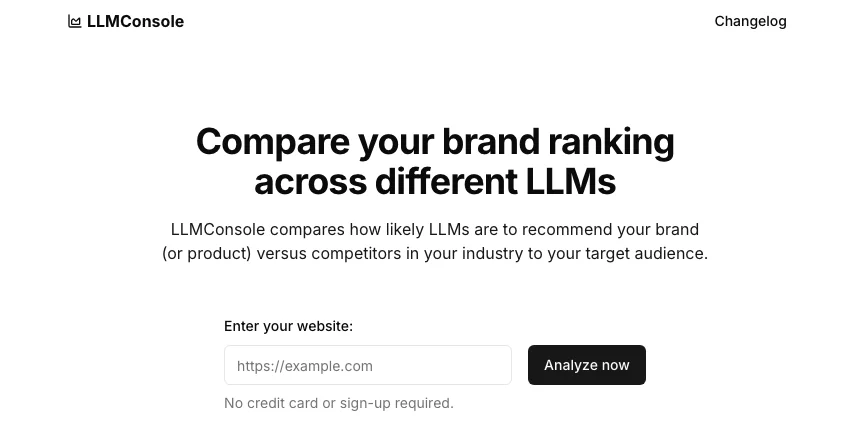
For example, LLM Console measures how well a website is optimized across the most popular LLM platforms.
Orchestrik provides a list of recommendations that you should implement to improve your website’s optimization.
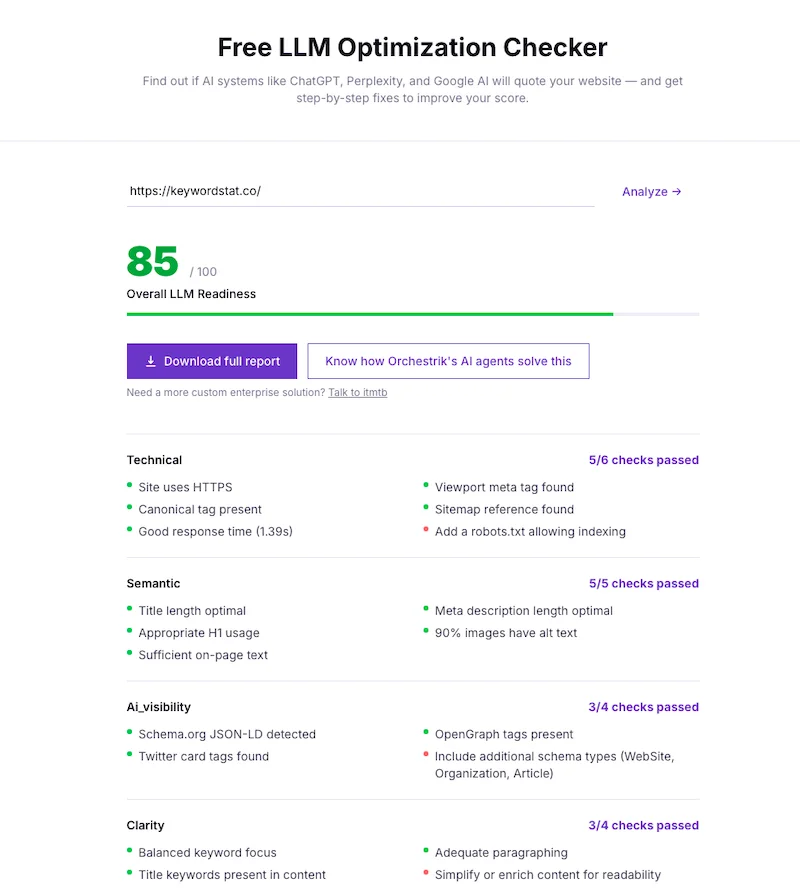
When I was building KeywordStat, I followed exactly the same approach. I visited several popular LLM Optimization Check services and also asked different language models directly how I could improve my website’s visibility and optimization for LLM systems.
As a result, I received a list of recommendations, which I then implemented on my website.
What Else Can You Use?
The simplest approach is to ask AI directly.
For example, that’s exactly what I did when we first launched KeywordStat.
I opened all the major AI platforms and asked: “There’s a website called KeywordStat. What does it do? What is it used for? Can it be trusted?” and similar questions.
The language model describes the website because it already has some information about it. It explains what the brand is, and you can then ask follow-up questions such as who is behind the brand, whether it can be trusted, and so on.
This allows you to understand exactly what needs to be optimized.
Testing Product Recommendations
You don’t have to ask only about your website or brand. Instead, you can ask questions such as “What is the best keyword clustering tool?” and see whether, for example, my service KeywordStat is recommended.
Or ask: “What is the best keyword research tool?” and check whether your product appears among the recommended options.
Of course, you can also ask: “What do you think about this brand?” However, if the LLM doesn’t recommend it in the first place, it most likely hasn’t yet included it in its knowledge base.
If the AI only recommends your competitors, you should analyze the reasons why.
You can also perform a reverse analysis. For example, ask: “Why is this particular service better suited for these tasks?” Then examine how the language model describes your competitor’s brand to identify what’s missing from your own product.
Check the Sources
You can also examine which sources ChatGPT or Perplexity cite in their responses.
Look at the websites they reference most frequently and the publications they rely on. These may be platforms where your brand should also establish a presence.
This can increase the likelihood of your brand being recommended by AI systems.
LLM Optimization Checklist
Before launching your product or optimizing your brand, make sure it meets the core requirements of LLM optimization:
- Your brand has a clear and consistent positioning.
- Your product is clearly described on your official website.
- You have dedicated landing pages describing your product.
- Your company regularly publishes expert content.
- Your brand is mentioned in independent reviews and publications.
- Your company has profiles on authoritative platforms, directories, and social media.
- Users leave genuine reviews about your product.
- You consistently use the same terminology to describe your product.
- Your company is developing as an industry expert, not just as a product vendor.
- There is a real person behind the brand who is responsible for creating both the product and the content published on the website.
Conclusion
Large language models have already become a new way for users to discover information about products.
In the past, companies competed for rankings in Google’s search results. Today, they are beginning to compete for a place among the recommendations generated by leading LLMs such as GPT, Gemini, Claude, Perplexity, and other AI assistants.
This transformation is changing the very concept of search optimization. Building a high-quality website or publishing SEO articles is no longer enough.
If you want AI systems to recommend your product, you need to build a strong digital presence for your brand, earn users’ trust, and become an authoritative source of information within your industry.