The SEO Avalanche Technique is an SEO methodology based on gradually increasing a website’s authority by targeting low-competition keywords and then, as you build the authority of the website, smoothly transitioning to highly competitive and high-volume search queries.
This technique is based on accumulating small wins for a new website, attracting traffic, and demonstrating relevance and authority to search engines.
- What Is the SEO Avalanche Technique?
- What Is KGR (Keyword Golden Ratio)?
- Why Does the SEO Avalanche Technique Work?
- Principles of the Content Pyramid
- How to Properly Organize Internal Linking on a Website?
- Choosing Anchor Texts for SEO Avalanche
- Why Does Internal Linking Accelerate the Avalanche Effect?
- Who Is the SEO Avalanche Strategy For?
- Who Is the SEO Avalanche Strategy Not Suitable For?
- Conclusion
What Is the SEO Avalanche Technique?
When we have a young website and publish quality content, but it does not grow in the search results, the problem is not the quality of the content. The problem is that the website is competing at a level it is not yet ready for.
Even a young and promising athlete cannot compete in the Olympics until they have gone through national championships and won competitions in their own country.
The same applies to SEO. Our website cannot compete in the major leagues if we created it only yesterday.
That is not how it works in any niche, and not only in SEO. Therefore, every victory creates the foundation for the next victory.
First, the website gets a few visitors per day, then a few dozen, then hundreds, and so on.
And like a snowball, the traffic keeps growing. That is exactly why this technique is called the SEO Avalanche Technique.

You need to publish content targeting keywords that match the current level of your website and gradually increase the difficulty of the queries, using the traffic you gain as the foundation for the next stage of growth.
How to Quickly Evaluate Keyword Difficulty for Your SEO Avalanche Strategy?
The foundation of your SEO Avalanche strategy is selecting the right low-volume keywords. To avoid spending hours analyzing every keyword manually, use KeywordStat.
Our tool allows you to instantly check Keyword Difficulty metrics so you can immediately filter out the “hard” keywords that your new website is not yet ready to rank for and focus on the low-hanging fruits instead.
The foundation of your SEO Avalanche strategy is selecting the right low-volume keywords that carry real Traffic Potential. To avoid spending hours analyzing every keyword manually, use KeywordStat.
The Core Idea of the Method Is Very Simple
I first became familiar with the SEO Avalanche Technique in 2020 on BuilderSociety.com, where the well-known English-speaking SEO expert Chris Carter published a topic and formulated the concept of traffic levels.
A friend of mine sent me this article and asked, “Do you know anything about this?”
It seemed quite logical to me because I already had similar thoughts myself.
The only thing Chris Carter explained more clearly was that he created a certain scale. Your level and the amount of traffic your website can receive.
These figures can be disputed, they are not backed by anything, but there is some logic behind them.
I am not saying that you should target exactly this amount of traffic, but as a framework for understanding, this approach can be useful.
If we simplify it, the scale is very large. I will provide a link to it.
If we simplify it even further, we can conditionally define a basic level as anywhere from zero to ten clicks per day.
For a new website, you should target specific long-tail keywords.
There is also a reference to the KGR golden ratio of keywords.
What Is KGR (Keyword Golden Ratio)?
KGR, or the Keyword Golden Ratio, is the number of search results containing the target keyword in the title divided by the monthly search volume.
How Does It Work?
Essentially, it involves finding keywords based on two factors:
- Popularity: how many people search for this query?
- Competition: how many websites are already talking about it?
The formula KGR is:
KGR = (Allintitle Results) / (Monthly Search Volume)
- KGR < 0.25 — excellent, fast path to top rankings.
- KGR 0.25 – 1.0 — medium competition.
- KGR > 1.0 — high competition, skip at the beginning.
Current reality: While the KGR formula was considered the gold standard for years, modern search algorithms have evolved beyond exact title match. Today, Google uses vector search and semantic entities, meaning a page can easily rank highly in search results for a keyword even if its title doesn’t contain the exact phrase.
KGR shouldn’t be used in isolation. Instead of spending hours manually checking allintitle: commands, modern SEOs rely on algorithmic keyword difficulty (KD) metrics based on tools like KeywordStat. KD analyzes the actual backlink profile and topical authority of pages ranking high in search results, providing a much more accurate picture of your ranking chances. However, finding a low-difficulty keyword is only half the battle. To ensure the entire topic is worth your time, you must also evaluate its Traffic Potential—the total organic volume your page can realistically capture across all long-tail variations.
Content Scaling
When we expand content to increase our content base, group related keywords into content clusters, and use internal links to direct crawlers and users through our website.
Moving to the Next Level — The Avalanche Effect
This is why the method is called Avalanche SEO.
Just like a snowball rolling downhill, our traffic grows, and that snowball keeps getting bigger.
And as traffic grows to the next level, for example 10 or 20 clicks per day, we already have some website authority in the eyes of both our audience and search engines, and our traffic can continue to increase.
Yes, of course, it’s worth saying that when you choose keywords with low search volume, from 10 to 100, you should always check the search results for AI Overviews and special SERP features such as Featured Snippets. Because if Google provides a comprehensive answer directly on the search results page, the CTR and overall number of clicks will be minimal, since the user already gets the answer right there on the page.
A simplified version of daily organic traffic levels:
| Tier | Traffic (Daily/Monthly) |
|---|---|
| Level 0 | 0 – 10 |
| Level 10 | 10 – 20 |
| Level 20 | 20 – 50 |
| Level 50 | 50 – 100 |
| Level 100 | 100 – 200 |
| Level 200 | 200 – 500 |
| Level 500 | 500 – 1,000 |
| Level 1,000 | 1,000 – 1,500 |
| Level 1,500 | 1,500 – 2,000 |
| Level 2,000 | 2,000 – 3,000 |
| Level 3,000 | 3,000 – 4,000 |
| Level 4,000 | 4,000 – 5,000 |
| Level 5,000 | 5,000 – 7,500 |
| Level 7,500 | 7,500 – 10,000 |
| Level 10,000 | 10,000 – 12,500 |
| Level 12,500 | 12,500 – 15,000 |
| Level 15,000 | 15,000 – 25,000 |
| Level 25,000 | 25,000+ |
Always remember that these traffic levels are only an approximate strategic framework, not strict Google algorithms or fixed thresholds. Google evaluates your overall topical authority and user engagement, not some rigid daily visitor count. These are all just guidelines. Therefore, use these traffic levels simply as a roadmap to help you choose which keywords to target.
Why Does the SEO Avalanche Technique Work?
At first glance, this technique seems too simple, and you may even start doubting whether it actually works.
Sometimes people think, why spend time and money targeting low-volume keywords when you can simply write one large article and include all the necessary keywords in it.
But that is not how it works.
The answer lies in the fact that modern search engines evaluate websites as a whole.
The Concept of Domain Power
Google does not use the official term Domain Power, but in practice every domain has a certain level of strength, trust, authority, and credibility.
Modern search engines analyze a large number of factors:
- domain history;
- the number of links pointing to the domain;
- content quality;
- topical expertise;
- behavioral signals;
- the internal structure of the website;
- user engagement;
- and much more.
Based on these signals, the search engine forms an understanding of whether our website deserves high rankings in the search results or not.
Let’s look at the following example.
Imagine two websites.
The first website is 2 months old, has 10 pages, and receives 20 visitors per month.
The second website is 5 years old, has 500 pages, and receives 50,000 visitors per month.
Now let’s imagine that both websites publish an article on exactly the same topic.
Which website do you think has a higher chance of reaching the top rankings?
I think the answer is obvious.
The second website is larger, the domain is older, and most likely it has accumulated more backlinks over time.
And naturally, it has also accumulated more behavioral signals.
This means the problem is not the quality of the article. The problem is that the first website does not have enough trust from search engines.
This is where temptation appears.
What if we simply write an article that is twice as long as our competitor’s and, because of that, cover more keywords, more keyword occurrences, and add several less competitive terms?
Partly, this sounds logical, but in practice, unfortunately, it does not work that way.
For Google, it does not really matter how long your article is.
The most important thing is that when a user enters a specific query, the search engine determines the user’s intent and ranks your website for that query.
It then determines whether the user satisfied their need on your website or not. It is really that simple.
Principles of the Content Pyramid
In the Avalanche SEO technique, pages are usually distributed across several levels.
At the lowest level are low-volume articles targeting narrow queries with minimal competition.
At the middle level are broader topical materials and guides.
At the top of our pyramid are the most important pages of the website.
These are commercial landing pages, service pages, category pages, important reviews, and other materials that generate the main revenue.
Therefore, each lower-level page should pass part of its authority to pages at a higher level.
In this way, link equity is passed from weaker pages to stronger pages.
How to Properly Organize Internal Linking on a Website?
When creating a new piece of content, you should ask yourself a simple question: which page should receive additional authority from this article?
What are we going to mention in our article?
After that, when you structure the content, you can plan in advance how you will add relevant internal links to other materials on the website.
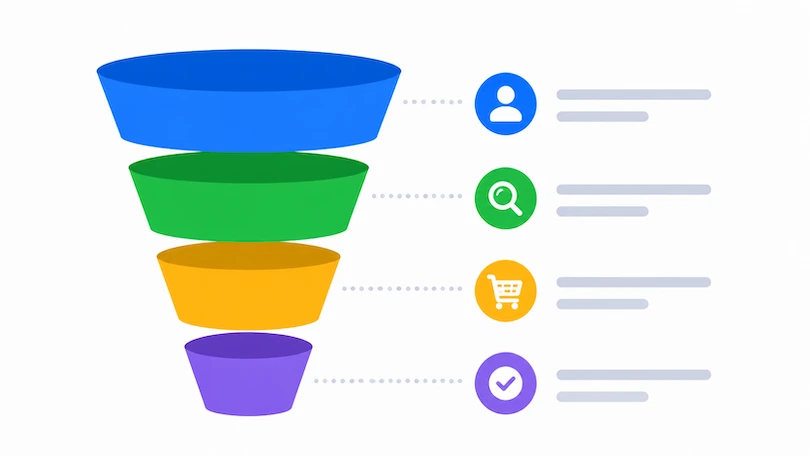
Let’s look at the example of the See, Think, Do, Care (STDC) strategy. This is an audience engagement framework from Google and :contentReference[oaicite:0]{index=0} that divides the customer journey into 4 stages.
If this is an informational article, for example an article about how to choose a CRM system, it can link to:
- a general CRM systems overview, the See stage.
- a CRM comparison page — this is already a commercial keyword, the Think stage.
- a commercial product page — this is already a transactional keyword, the Do stage.
- a CRM implementation guide — this is support content, the Care stage.
This is the classic See, Think, Do, Care strategy.
See — we look.
Think — we think.
Do — we do.
Care — this is our care for the user after they have completed an action.
You can use this simple strategy when building your content.
This approach will help you create not only topical materials, but also strengthen the pages that have the highest commercial value, while moving cold users into warmer users within the marketing funnel.
Choosing Anchor Texts for SEO Avalanche
Also, when you create internal links, you should think about which anchor texts you will use in your internal linking.
This will help diversify your internal anchor profile so that it does not become over-optimized.
Yes, Google may also take anchor text over-optimization into account not only from external websites but also within your own website.
Therefore, you need to choose your words carefully.
Use a simple rule: in the anchor text, use the keyword that best describes what will happen to the user when they move to the next page.
Why Does Internal Linking Accelerate the Avalanche Effect?
Every new article within the SEO Avalanche strategy creates an additional entry point from search engines.
Therefore, if you create a piece of content that receives traffic and ranks well, part of its authority will flow through internal links to other pages of the website.
In this way, you will strengthen your important pages with this link equity.
And ultimately, like an athlete, these pages will become better trained.
That is why new publications will start getting indexed faster, and rankings will grow more easily.
At some point, you will notice that the time between publishing a new article and seeing it rank at the top of the search results becomes shorter and shorter.
And eventually, it may seem to you that SEO is no longer a difficult task and that websites grow by themselves.
But all of this happened because you did the groundwork correctly earlier.
And now you are already on the right Avalanche SEO track, continuing to move forward precisely because you worked well during the previous stages.
Who Is the SEO Avalanche Strategy For?
I have praised this strategy so much that it may seem like it has no disadvantages at all.
However, despite its effectiveness, Avalanche SEO cannot be considered a universal strategy for every project.
Sometimes, when a website develops gradually, this method delivers the best results.
But there are cases where you have limited resources and are not prepared to invest time in creating high-quality content.
Let’s look at who SEO Avalanche is suitable for and who it is not suitable for.
Informational Websites and Content Projects
This strategy works especially well when you can publish a large number of articles targeting low-volume queries, have strong topical coverage, and operate in a broad niche that allows you to do so.
These can include:
- niche blogs;
- educational projects;
- thematic portals;
- media websites;
- and other content-driven projects.
Startups Without a Large Budget
If you do not have a sufficient marketing budget, this strategy can become a real lifeline.
If you do not have the money to invest in expensive link building and promote commercial landing pages for highly competitive commercial keywords, then the Avalanche SEO strategy can be an excellent alternative.
You promote your blog, create informational pages targeting less competitive queries, and in this way gradually strengthen your commercial pages.
Who Is the SEO Avalanche Strategy Not Suitable For?
Let’s look at the different options.
SaaS and Affiliate Marketing Projects in Competitive Niches
Many marketers believe that competitive SaaS and affiliate marketing niches are growing too quickly for a gradual strategy like SEO avalanche. They believe that they need to target highly targeted, frequently used commercial keywords from the start to demonstrate an immediate ROI.
In reality, for newcomers without a huge link building budget, the opposite is true. If a young SaaS platform tries to target broad queries like “Best project management software,” it will be instantly crushed by established giants. For such projects, avalanche is a necessity, not an option. It’s essential to start by dominating ultra-specific, long-tail keywords that solve problems (e.g., “project management tool with automatic time tracking for overseas developers”). Once you attract this highly targeted traffic, you can safely scale to broader competitive keywords.
Large E-commerce Stores
For e-commerce, it is generally very difficult to apply such a strategy.
Yes, some online stores have blogs that describe different situations, but if you look at the traffic of e-commerce websites, it is often commercial traffic.
Traffic comes through category pages, filters, and product pages.
Only rarely does a blog generate a truly significant volume of traffic.
In addition, competition here is extremely high.
Online stores compete not only with other stores but also with large media websites that publish content on the same topics.
Therefore, applying Avalanche SEO here is quite difficult.
Aggregators and Marketplaces
Aggregator websites usually compete for broad keywords, depend on the volume of listings, and often have very strong backlink profiles.
They also actively use advertising and usually have neither the time nor the desire to invest in the Avalanche SEO technique.
Niches with Strong Geographic Dependence
Here, the Avalanche SEO strategy is also only partially suitable.
For local SEO, the following factors play a very important role:
- geographic location;
- company profile;
- customer reviews;
- and other local factors.
Therefore, in such niches, results depend more on local optimization than on a content expansion strategy.
Conclusion
SEO Avalanche is a gradual growth strategy that allows young websites to increase organic traffic without having to compete against major players for high-volume keywords.
Instead of trying to rank for highly competitive keywords at an early stage, this method suggests identifying the current level of your website and focusing on the keywords that match it.
And each new article strengthens the previous ones, allowing you to move to the next level and eventually compete for other, more difficult keywords.
This method requires a great deal of patience, but it remains one of the safest and most predictable ways to build a content marketing strategy and develop a website over the long term.
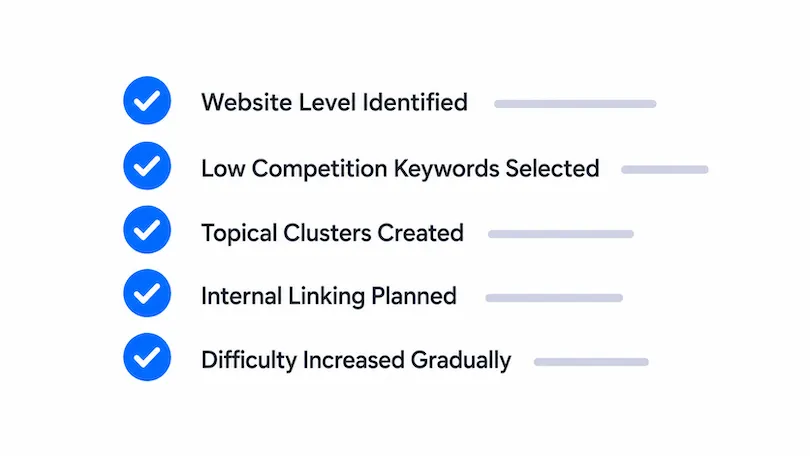
So, before we finish, let me give you a small SEO Avalanche checklist.
Before getting started, make sure you have completed the following steps:
- you have identified the current level of your website and its real ranking capabilities;
- you have selected low-volume, and especially low-competition, topics and articles for your blog or website;
- you have created topical clusters and already planned your internal linking logic, and your articles are not isolated from one another;
- you regularly analyze results and gradually increase the difficulty of your target keywords.
Combine the Avalanche SEO technique with topical clusters to maximize the impact of creating low-level pages, so you don’t have to leave them isolated. Group your Level 0 and Level 1 articles into structured topical clusters that link to broader central Level 3–4 pages (pillar pages). As your low-volume articles gain traction, they will pass their internal authority upward to your main page and your primary competitive target page.
Follow these principles, and you will be able to create a sustainable content-building system that delivers organic growth and a large amount of traffic that will continue increasing month after month as your website grows.
That is all from me. Thank you for reading this article. I hope it was useful, interesting, and easy to understand.