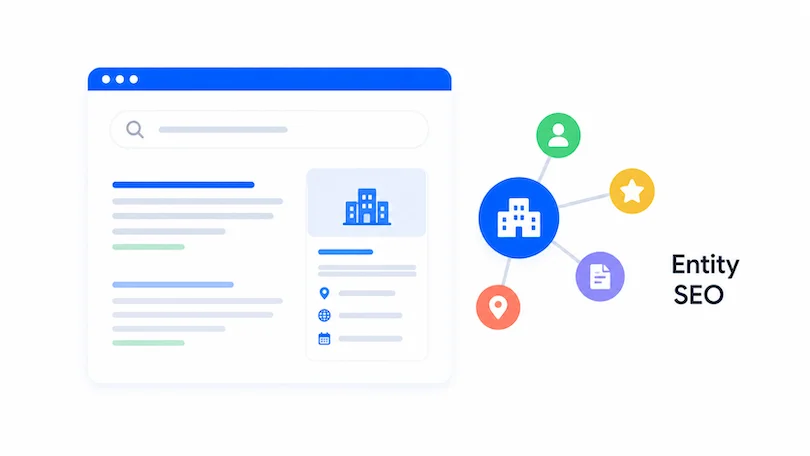
Entity SEO is the optimization of content around specific recognizable concepts, entities, places, and people rather than simply exact keyword matches.
This semantic approach helps search engines and AI models better understand the meaning and context of your content while improving its authority and visibility in search engines powered by AI-driven search.

Why Doesn’t Google Think in Keywords Anymore?
I started working in SEO in 2010, back then there were various keyword research tools.
I remember my first job, where I was told that I should not miss a single keyword in the semantic core.
And we checked to make sure that every keyword was represented, and failing to include a keyword in the semantic core was considered a serious mistake.
Then we placed those keywords on the page and in this way gained traffic and rankings in search engines.
Even back then I wondered: what difference does it make which keywords I use if I write useful content and properly describe the page?
But at that time not all specialists understood this. And how good it is that this situation has changed.
That approach no longer works.
Search engines have learned to understand the meaning of queries much more deeply than just a collection of keywords.
Google analyzes not only individual words but also entities, relationships between them, and user intent.
Therefore, your page can rank highly or even appear in AI Overviews without the exact keyword phrase if it covers the topic thoroughly and expertly.
After all, beyond keywords there are synonyms, slang terms, and niche terminology that experts use within their field.
This is where the concept of Entity SEO appeared.
Entity SEO in 2026 is the main ticket into AI Overviews. AI does not read individual keywords; it builds answers based on facts and entities. If your website is not part of Google’s Knowledge Graph, AI may simply not notice you.
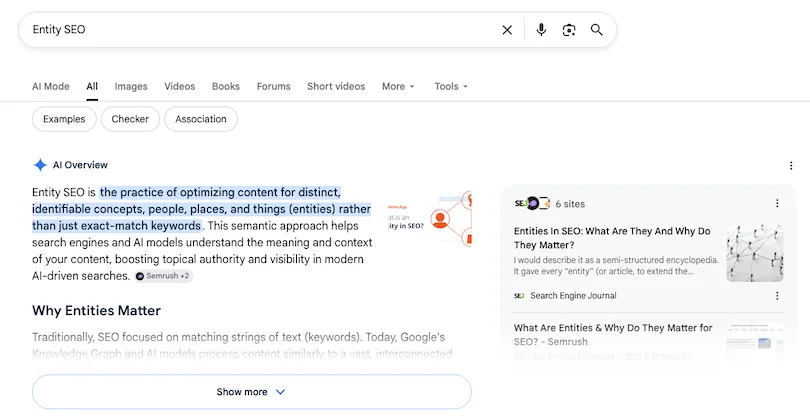
Entity SEO is an approach to content optimization based not on keywords but on entities and the relationships between them.
What Is an Entity?
It is any object that a search engine can uniquely identify.
This can be:
- a person;
- a company;
- a brand;
- an organization;
- a place;
- a product;
- an event;
- a concept.
For example, Apple.
For Google, this is a specific company with its own relationships:
- Apple;
- Steve Jobs;
- iPhone;
- iOS;
- Tim Cook.
In the same way, Google understands that Elon Musk is connected to Tesla, Grok, and X.
SEO is connected with:
- keywords;
- search volume;
- keyword difficulty;
- traffic potential;
- global volume;
- commercial value;
- CPC;
- intent;
- trend;
And the KeywordStat service is connected with Maxim Pavlov, SEO and keyword research.
That is why modern SEO depends less and less on exact keyword matching and more and more on how well the search engine understands the topic of a page and its place within the broader knowledge graph.
Entity SEO Architecture
After Google moved from keywords to entities, the search engine needed a way to store and analyze large amounts of knowledge about the real world.
For this purpose, Google began using the Knowledge Graph.
It is a large-scale database that contains entities and the relationships between them.
This graph is the foundation of modern search, AI Overviews, and other content understanding algorithms.
What Is the Knowledge Graph?
It is a huge map of knowledge where, instead of storing individual words, the system stores objects and the relationships between them.
This system knows that Apple was founded by Steve Jobs, that Apple produces the iPhone, that the iPhone runs on iOS, and that Tim Cook is the CEO of Apple.
Thanks to these relationships, Google better understands a page and its place within the overall knowledge system.
You know, I conducted a small experiment and looked at what Google knows about me.
The system very clearly identified all the information about me: that I am a marketer and SEO specialist, it found my courses on Udemy, linked my various projects, discovered publications in various media, conferences where I spoke, and created its own knowledge graph about me.
Try conducting similar research within your own niche.
If you are an expert in content writing, look at how Google interprets information about you and what it actually knows about you.
It will be very interesting.
And yes, write to me later on LinkedIn and tell me your results.
Were you able to find information about yourself or not?
Why Is the Knowledge Graph Important for SEO?
Let’s imagine two articles.
One article repeats several keyword phrases.
For example:
- buy iPhone;
- best iPhone to buy;
- keyword research service;
- keyword research service pricing;
- free keyword research service.
And so on.
The second article covers the topic comprehensively.
It talks about Apple, iOS, Tim Cook, the App Store, Face ID, USB Type-C, and Apple Intelligence.
If the article is about keywords, then the author talks about their experience, keyword research methods, keyword difficulty, search demand, and so on.
And of course, for Google the second article will be significantly more relevant.
The reason is very simple.
It contains an entire network of related entities that helps the search engine better understand the topic of the material.
That is why Entity SEO is built not around repeating keywords but around comprehensive topical coverage.
Using Structured Data
Sometimes an entity can be identified from the context of the content, but it is better when your website communicates directly with the search engine and explicitly tells it what the page is about.
For this purpose, you can use Schema.org, which is a structured data standard.
With structured data, you can specify:
- the article author;
- the company;
- the product;
- the event;
- the location;
- reviews;
- facts;
and so on.
In practice, structured data helps the search engine answer the question: what exactly is on this page?
For example, the article was written by a specific author, the website belongs to a company, and the material is dedicated to a specific product.
And the less ambiguity remains for the search engine, the easier it becomes to connect the content with the appropriate entities.
How to Optimize Content for Entity SEO?
We already understand how entity understanding works, but now the main question for all specialists is: how do we use Entity SEO to improve the visibility of my website?
I have good news for you. You do not need to completely change your content strategy.
You simply need to shift your focus from keywords to entities.
And doing that is not very difficult.
Let me explain step by step how to do it.
Research the Entire Topic
The classic SEO approach usually begins with keyword research.
But even if we take the topic of this article, for example, we would have keywords such as:
- Entity SEO;
- Semantic SEO;
- Knowledge Graph.
But that would not be enough.
You need to understand which entities Google associates with the main topic.
Therefore, you need to write about:
- Google Search;
- Knowledge Graph;
- Schema.org;
- Semantic Search;
- RankBrain;
- Hummingbird;
- Wikidata;
- Topical Authority.
The more relevant entities you cover in the material, the easier it becomes for the search engine to understand the page content, and the better it will rank parts of your content and use them in AI Overview answers.
Topical Clusters
A single article rarely allows you to fully cover a large topic because it will either become too large to read or too shallow, meaning you will talk a little bit about everything.
Neither option works for us.
That is exactly why Google AI Overview gathers information from many different materials in its answers.
Therefore, modern websites use the topical cluster model.
For example, an article about Entity SEO may contain sections about:
- Knowledge Graph;
- Semantic Search;
- Schema.org;
- Topical Authority;
- LSI Keywords;
- Google RankBrain.
And all of these articles will be connected to each other.
This approach helps build the topical authority of a website and strengthens search engine understanding of entities.
Information Gain
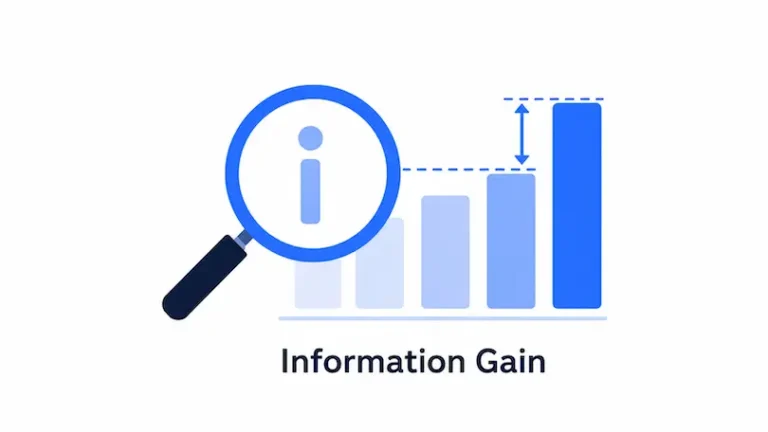
Implement the Information Gain concept. Because Google now tends to demote websites that simply rewrite other people’s articles, even if they have a perfect entity cloud.
Entity SEO requires adding new relationships, personal experience, unique data, or expert opinions that do not yet exist in the Knowledge Graph for that topic.
Related Entities in the Text
One common mistake is focusing only on the main keyword.
Search engines want to see other related objects connected to the main entity.
For example, if an article is about Tesla, you cannot avoid talking about Elon Musk, electric vehicles, batteries, or even mentioning Grok and the X social network.
Such mentions help the search engine confirm the topic of the page.
At the same time, you should not add entities artificially. They should be used only when they genuinely help explain the topic.
I have the same problem when writing articles.
I often go very deep into details and sometimes move away from the main entity because I want to tell more of the story on the page.
And this does not look like entity stuffing, it simply means that I am slightly diluting those entities.
You still should not go beyond the boundaries of the topic you have defined.
You cannot talk about absolutely anything in an article because it is not a podcast.
Implement Structured Data
I already mentioned that structured data helps search engines accurately identify entities.
Therefore, let’s focus on the most impactful markup types for modern semantic graphs: Article, Organization, Person, Product, Dataset, and BreadcrumbList.
The SameAs type deserves special attention.
It allows you to connect an entity on your website with external sources such as Wikipedia, Wikidata, and official company social media profiles.
This also helps the search engine identify the entity more accurately.
Directly connect structured data with the E-E-A-T factor. The author of an article is also a type of entity.
Therefore, through the SameAs tag in the Person schema, you should connect the author’s profile on the website with their profiles on LinkedIn, Wikipedia, or academic databases.
Google should clearly understand: “This article on this topic was written by a real expert who is recognized by other entities.”
Internal Linking
Internal linking has always been important.
Throughout the history of SEO, it has been our free way to strengthen pages through anchor text.
And when I started working in SEO, we built internal links quite aggressively.
Today, that is no longer necessary.
It is no longer primarily about passing page authority but about helping search engines build their own knowledge graph within your website.
For example, an article about Entity SEO can link to articles about Knowledge Graph, Semantic Search, Schema.org, and Topical Authority.
Such a structure creates logical relationships between entities and helps Google better understand the topic of the website.
Topical Authority
Yes, I have talked about this a lot already and I will say it again.
Entity SEO is closely connected to the concept of topical authority because Google trusts websites that cover a topic comprehensively more than resources with only one or two articles.
Therefore, if I have a website about keywords and I write about content marketing, keywords, semantic cores, keyword clustering, AI SEO, and Entity SEO, then the search engine will perceive it more strongly as an expert source in search marketing.
That is why today it is not individual pages that win but content ecosystems built into a website.
Therefore, think more broadly than just keywords, pages, and traffic.
Think in terms of ecosystems.
Write for Meaning, Not for Keyword Density
Yes, we always analyze competitors, look at how many keywords they use, and want to write 10–20 percent more than their article or whatever is recommended.
Forget about that completely.
Write to the point.
Although we marketers are always tempted to inflate the word count to outshine the competition (let’s be honest, I always do it too 😔), you need to keep a cool head and focus on the effectiveness of the text.
There’s no need to write huge 5,000-word texts just to squeeze in more keywords when the topic can be fully covered in 1,500 words.
Optimize your text, eliminate unnecessary words, and ensure high information density. Ensure each paragraph contains new connections between entities without adding unnecessary information.
If you can fully explain the topic in a relatively small number of words, that is great.
But do not rely on repetition. Focus on the quality of topic coverage.
Tools for Working With Entity SEO
When working with Entity SEO, you do not need to rely solely on intuition because today there are already many tools that can help determine which objects search engines associate with your topic and how completely the entities are covered.
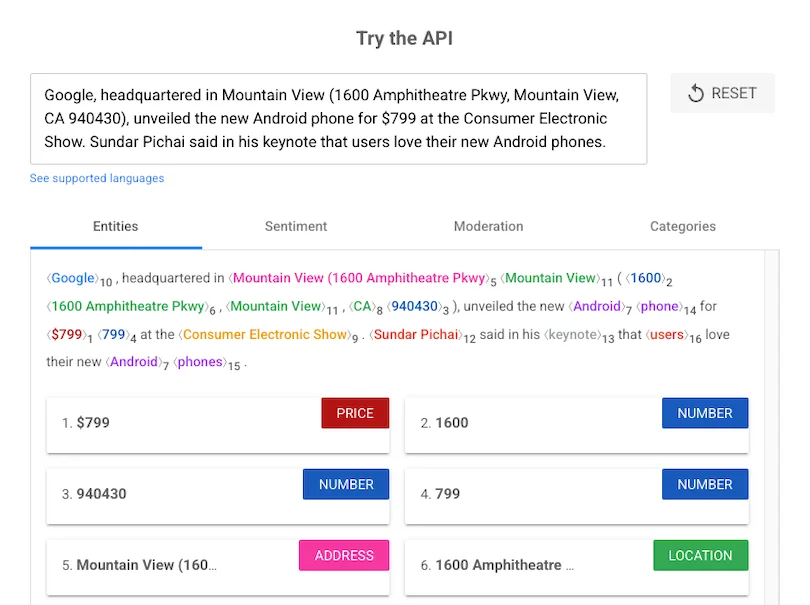
Google Natural Language API
If you want to understand how Google perceives text, this will be one of the most useful tools for you.
Google Natural Language API analyzes content and shows detected entities, their types, meanings, significance levels, and relationships within the text.
Therefore, after analyzing an article about Entity SEO, such a service may identify entities such as:
- Google;
- Knowledge Graph;
- RankBrain;
- Semantic Search.
This allows you to understand how correctly the search engine interprets the material.
Wikidata
This is one of the largest knowledge bases on the internet.
Here, each entity has a separate identifier and a set of properties.
Therefore, Wikidata helps you understand how search engines structure databases.
For example, for the company Apple, Wikidata contains:
- founding date;
- founders;
- headquarters;
- subsidiary products;
- related organizations.
For SEO, this is an excellent source of related entities and topical relationships.
Wikipedia
It still remains one of the most important data sources for search engines.
Despite the fact that it is written by people and information can be added by almost anyone.
But every major entity has its own article that contains a description of the subject, related concepts, categories, and internal links.
And you can analyze not only the article itself but also the related pages because they form the semantic environment of the entity.
InLinks
This is a very well-known set of tools focused specifically on Entity SEO.
This service helps you identify entities, build topical graphs, analyze content, discover gaps in topical coverage, and improve internal linking.
Unlike traditional SEO platforms, InLinks focuses specifically on semantic relationships between objects.
Surfer SEO
Yes, this tool is known as a content optimization service, but it also helps identify related terms and topical entities.
When analyzing competitors, the service can show frequently occurring terms, topical marker words, and additional subtopics.
This helps you expand content and improve topical coverage.
KeywordStat
Our service can also help you identify not only keywords but also related concepts when analyzing search queries.
You will see different query types and related searches.
And these relationships can help you build content that is focused not on individual queries but on comprehensive topic coverage.
Conclusion
In conclusion, let’s once again emphasize that Entity SEO is not just another SEO trend or some new optimization technique.
It is a reflection of how search engines understand information and move from keywords to understanding real-world objects, the relationships between them, and user intent.
That is why simply adding keywords is giving way to a deeper approach based on context, knowledge, and your experience.
My main takeaway from this article is: do not optimize pages for keywords, optimize them for topics, entities, and user intent.
This approach will allow you to create content that remains relevant regardless of algorithm updates or changes in search results.
Thank you for reading this article. Share it with your friends and read other articles on my website.