Keyword mapping is the process of matching keywords to specific pages on a website.
Instead of placing keywords into articles randomly, you create a structured roadmap to ensure that each page has a clearly defined purpose and is targeted at a consistent set of search queries.
What Is Keyword Mapping?
Imagine a situation where you have collected a Keyword list for a new project and ended up with a very large number of keywords. What should you do next?
For many SEO specialists, chaos begins at this stage. Some start writing articles randomly for the highest-volume keywords, others create dozens of similar pages, causing keyword cannibalization. A third group simply hands the keyword list over to copywriters and hopes that the site structure will somehow form on its own.
Don’t worry, I went through these mistakes too. Unfortunately, they cost me a lot of money. 😊
Keyword mapping is the process of distributing keywords across specific pages of a website, where we show in the site map which query is being targeted on which URL, which keywords belong to each page, which pages we still need to create, and what the final structure of the website should look like.
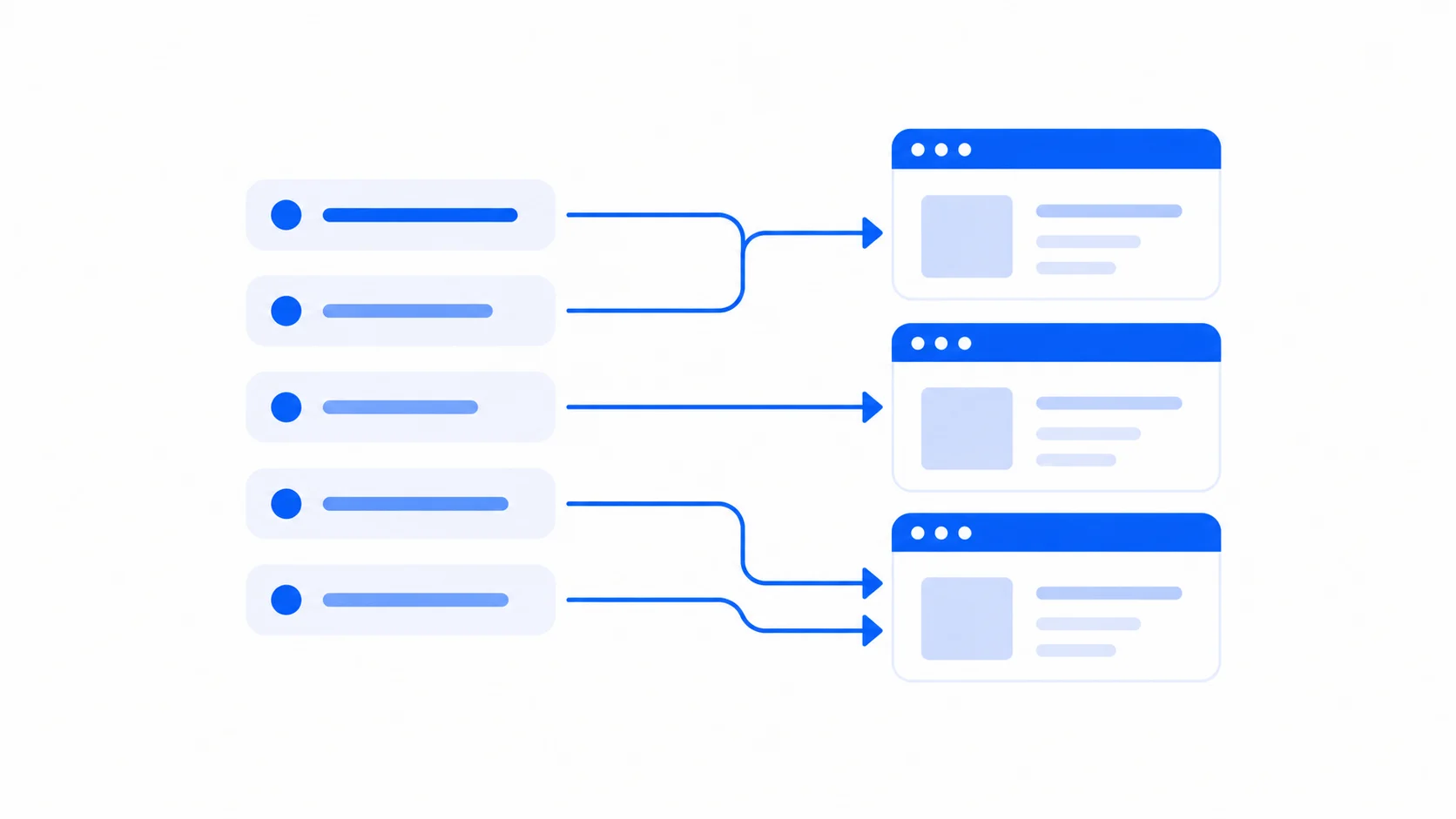
As a result, instead of chaotic content, you get a clear website development plan.
Why Is This Important Today?
Because modern search engines no longer evaluate individual pages alone, they evaluate the structure of a website as a whole.
Google is getting better at understanding search intent, topical clusters, relationships between pages, and query context.
Therefore, a properly created keyword mapping strategy will help you avoid cannibalization, significantly simplify the work of search engines, and increase the likelihood of appearing in AI Overview answers and other intelligent algorithms.
That is why a keyword map becomes the foundation of your SEO strategy.
Building the Right Website Structure
A properly created keyword map will help you avoid technical and content mistakes before they start affecting your website’s rankings.
Keyword Cannibalization
This is the biggest pain point for SEO specialists — cannibalization.
We want to create as many pages as possible to rank for more keywords, but pages end up trying to rank for the same queries and create problems out of nowhere.
For example, which page should be created?
- SEO Tools;
- SEO Tool;
- Best SEO Tools;
- Top SEO Tools;
- SEO Tool Comparison.
Should this be one page or multiple pages?
All of these pages may satisfy the same user intent.
And Google does not understand which page should appear in search results, which one is the primary page, and how link equity should be distributed.
Instead of strengthening the website, these pages begin competing against each other.
Finding Content Gaps
When we create a keyword map, we understand which topics are not yet covered by content.
For example, after mapping, we may discover that there are pages about Keyword Research, Keyword Clustering, and Search Intent, but there is no dedicated page about Keyword Mapping.
That happened to me, which is why I wrote this article. These issues help identify Content Gaps.
These pages often become a source of new SEO traffic.
And the earlier you identify missing topics, the faster you can cover them with content.
Internal Linking
Once the keyword map is ready, it becomes easier to build internal links.
An article about Keyword Research can link to Keyword Clustering.
An article about Keyword Clustering can link to Keyword Mapping.
And an article about Keyword Mapping can link to Search Intent.
In this way, you create topical clusters that help Google better understand the relationships between pages.
AI Search
Modern search is focused on understanding topics, entities, and intent.
AI Overview, Gemini, and other systems analyze not individual pages but the structure of the website as a whole.
If every query is mapped to a specific page, then each page performs a specific task.
And it becomes easier for the search engine to determine the main topic of the page, its role within the website, and its relationship with other content.
Therefore, Keyword Mapping is not only classic SEO but also optimization for modern AI systems.
Basic Principles of Keyword Mapping
Let’s start by saying that you should not distribute queries based on similar words.
Modern search engines work a little differently.
Google analyzes not matching wording but user intent.
Therefore, good mapping is built around intent rather than individual keywords.
Let’s look at several queries:
- keyword research tool;
- keyword finder tool;
- keyword research software;
- keyword research platform;
- best keyword research tool.
You would probably agree that these phrases are different, but the user’s goal is almost the same — to find a keyword research service.
That is why such queries should lead to a single commercial page.
Now let’s look at another group of queries:
- what is keyword research;
- how to find keywords;
- how to build a semantic core;
- keyword research guide.
So, has the intent changed here or not?
I believe it has.
The user is no longer choosing a tool or buying a service.
They want to understand the topic and get instructions.
Therefore, such queries should lead to a separate informational article.
Why Is This Important?
Because if you mix intents on a single page, it becomes difficult for the search engine to determine its purpose.
Let’s imagine a page that is trying to rank for different queries:
- keyword research software;
- best keyword research tool;
- what is keyword research;
- how to do keyword research.
For the user, these are different tasks.
Some are looking for a tool, while others want to learn the process.
Therefore, Google shows different types of pages for these queries.
And if all of them are combined into a single URL, the page may lose rankings for several competitive query groups at once.
Let’s create an example intent-based mapping table.
| Keyword | URL |
|---|---|
| keyword mapping | /keyword-mapping/ |
| keyword mapping guide | /keyword-mapping/ |
| what is keyword mapping | /keyword-mapping/ |
| keyword clustering | /keyword-clustering/ |
| search intent | /search-intent/ |
How to Create a Keyword Map?
After you have collected your keywords and understood the basic principles of mapping, we can move on to creating a keyword map.
This process consists of several stages.
Keyword Collection and Cleanup
Like any SEO process, mapping begins with keyword collection.
For this, you can use various tools:
- KeywordStat;
- Ahrefs;
- SEMrush;
- Google Keyword Planner;
- Serpstat;
- SE Ranking;
- Mangools;
and others.
At this stage, it is important to collect the broadest possible list of queries related to your website’s topic or niche.
For example, for the topic of Keyword Research, these may include the following keywords:
- Keyword Research;
- Keyword Research Tool;
- Keyword Clustering;
- Search Intent;
- Keyword Mapping;
- Content Gap;
- Keyword Difficulty.
Next, we need to remove junk queries.
These may include:
- irrelevant topics;
- duplicates;
- queries with spelling mistakes;
- competitor brand queries.
As a result, we should obtain a clean topical keyword set.
Query Clustering
This is the stage where queries are grouped into separate clusters.
The goal of clustering is to determine which queries should be targeted on the same page.
For example:
Cluster 1:
- Keyword Mapping;
- What Is Keyword Mapping;
- Keyword Mapping Guide.
Cluster 2:
- Keyword Clustering;
- Keyword Clustering Tool;
- Keyword Clustering Software.
Cluster 3:
- Search Intent;
- Search Intent SEO;
- Types of Search Intent.
For this, you can use search result analysis or keyword clustering tools.
There are two main types of clustering:
- soft clustering;
- hard clustering.
Soft Clustering
In the Soft Clustering method, the tool identifies a primary query with a high search volume and groups it with secondary keywords. These keywords have a minimum number of matching URLs (e.g., 3 or more). However, these secondary keywords may not have URL intersections with each other.
This results in broader, larger content groups and a smaller overall page count.
Hard Clustering
In the Hard Clustering method, keywords are grouped together only if they have URL intersections with all other keywords within that cluster.
This more rigorous method creates narrow, highly precise query groups.
This means you’ll need to match them to specific, isolated URLs to avoid intent conflicts.
Defining Website Structure and URLs
After clustering, it becomes clear which pages should exist on the website.
A Simple Example of Intent-Based Mapping
| Intent | Example Queries | Page Type |
|---|---|---|
| Informational | what is keyword research, how to find keywords | Guide / article |
| Commercial | best keyword research tools, keyword research software | Service comparison |
| Transactional | buy keyword research tool, pricing keyword tool | Product page |
| Navigational | keywordstat login, ahrefs keyword explorer | Specific website page |
Intent should be what determines your website structure and the distribution of keywords across your site’s pages.
This table will become a working document for SEO specialists, editors, and copywriters.
Setting Priorities
Yes, not all pages will be equally important to you, and therefore after completing the audit, it will be useful to prioritize content based on business value, content creation difficulty, ranking difficulty, search volume, and commercial potential.
Result
After completing all of these stages, you will no longer have just a list of keywords. Instead, you will have a complete SEO map of your website, showing which pages already exist, which pages need to be created, which queries will be targeted on each URL, and what the overall architecture of your project will look like.
Content Prioritization After Keyword Mapping
After creating a keyword map, you may ask yourself: which pages should be created first?
If you have dozens or hundreds of clusters, you need to prioritize them based on business value.
For this, you can use a simple prioritization formula:
- business importance;
- search demand;
- commercial interest;
- ranking difficulty.
Using the ICE Framework
To structure the evaluation process, you can use the ICE model, where each cluster receives a score from 1 to 10 across different criteria.
- Impact — potential impact on the business;
- Confidence — confidence in the forecast;
- Ease — ease of implementation.
After that, the final score is calculated, allowing you to determine which pages will deliver the greatest results with the lowest resource investment.
This approach is especially useful when you have limited resources for content creation and need to choose between several promising topics.
Formula:
ICE Score = (Impact × Confidence × Ease)
Example table:
| Cluster | Impact | Confidence | Ease | ICE Score |
|---|---|---|---|---|
| keyword research tool | 10 | 9 | 8 | 720 |
| keyword clustering | 8 | 8 | 7 | 448 |
| history of seo | 4 | 7 | 8 | 224 |
The higher the final score, the sooner you should create or optimize the page.
Using the RICE Framework
For larger projects, you need a more detailed approach, and therefore I suggest using the RICE model, which takes into account Reach, potential audience size, Impact, business impact, Confidence, confidence in the estimate, and Effort, resource requirements.
RICE Score = (Reach × Impact × Confidence) ÷ Effort
This approach is especially useful when planning large content programs and allocating resources across teams.
Practical Rule
If you do not have time for calculations, use a simple logic:
High demand + high commercial intent = maximum priority.
Creating a Keyword Map
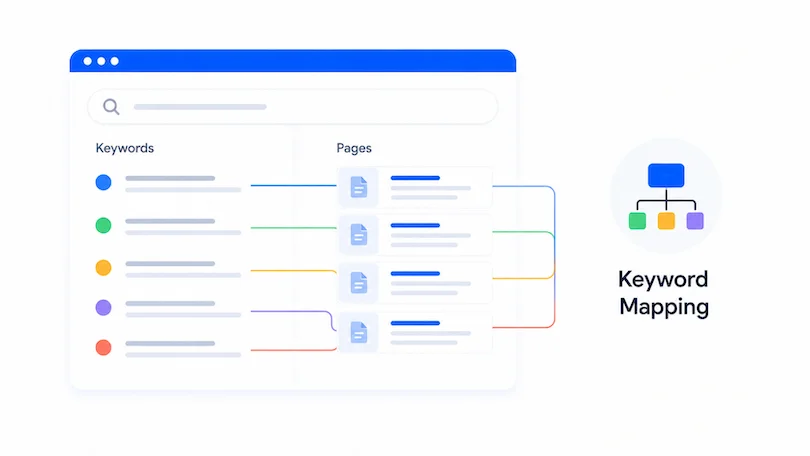
Now that you have keyword clusters, they need to be assigned to specific pages.
And a simple version of a keyword map may look like this.
For example:
| Cluster | URL |
|---|---|
| Keyword Research | /keyword-research/ |
| Keyword Mapping | /keyword-mapping/ |
| Keyword Clustering | /keyword-clustering/ |
| Search Intent | /search-intent/ |
At this stage, it is important to maintain a logical structure.
The user should understand where each topic is located and how it is connected to other sections of the website.
Automation Tools
Of course, a keyword map can be created manually.
But if you work with a large number of queries, it is better to use specialized tools, otherwise the process becomes too time-consuming.
Many processes can be easily automated with simple tools such as Google Sheets and Excel.
Despite the large number of available services, most keyword maps still remain spreadsheets.
And as someone who grew up using spreadsheets, I also use spreadsheets.
After all, Microsoft once made Excel the standard of the corporate world.
As a result, we developed what could be called spreadsheet thinking.
People use spreadsheets for everything:
- task planners;
- text editors;
- CRM systems;
- website mapping.
And so our brains became accustomed to structuring chaotic information into rows and columns because it was the most accessible way to digitize business processes.
Google did not try to break this habit either.
Google Sheets works according to the same principle.
The grid of cells has always seemed incredibly flexible.
It is not just a calculator, it is a visual builder that gives users freedom.
You can add rows, columns, and build complex models.
And people developed a habit: whenever they face an unclear situation, they open a spreadsheet and create structure.
Mind Maps
Many people find it easier to visualize a structure in the form of mind maps.
I will say right away that I am not one of those people, but when I worked at one company, we had a rule that all structures had to be created only in mind maps.
I never liked it because it took more time than creating a map in a simple Excel spreadsheet, but such a structure always looked more professional, was visually clearer, and many people found these maps easier to understand.
Clustering Tools
This is one of the most time-consuming stages of keyword mapping.
Instead of grouping queries manually, you can use specialized services such as:
- Serpstat;
- SE Ranking;
- KeywordStat;
and others.
These tools analyze search results and compare which queries belong to the same page.
This allows you to significantly speed up the process of building a keyword map.
Using AI Assistants for Keyword Mapping
Modern LLM systems can significantly speed up the initial keyword mapping process.
I use tools such as GPT and Claude. They are excellent for preliminary query sorting, so you can use the following prompt.
Analyze the list of keywords. For each query, determine the search intent and use the categories informational, commercial, transactional, and navigational. Then group the queries by the proposed website pages.
After using this prompt, AI can determine intent, identify potential duplicates, suggest a website structure, and uncover content gaps.
Therefore, use AI as an assistant, not as a source of truth.
And remember that ChatGPT and Claude do not see real Google search results, so you should always make decisions based on SERP analysis and always review the actual search results.
When Do You Need Automation?
If your project contains up to 100 queries, you can easily process them manually.
For 100 to 1,000 queries, you can already start using clustering.
For more than 1,000 queries, automation becomes almost mandatory.
Therefore, on large projects, manual mapping not only takes more time but also increases the risk of errors and cannibalization.
That is why modern SEO teams very often use the following combination:
- keyword research tools for semantic collection;
- clustering services;
- spreadsheets for final keyword mapping;
- visual maps for project presentations.
The simplest version of a map looks like this:
| URL | Main Keyword | Secondary Keywords | Intent | Status |
|---|---|---|---|---|
| /keyword-mapping/ | keyword mapping | keyword mapping guide, what is keyword mapping | Informational | Published |
| /keyword-clustering/ | keyword clustering | keyword clustering tools, clustering keywords | Informational | Published |
| /search-intent/ | search intent | search intent seo, user intent | Informational | Draft |
Checklist: How to Validate Your Keyword Mapping
Even if your keyword map looks complete, that does not mean it has been created correctly.
Because in practice, most problems arise during the planning and mapping stage.
Therefore, before launching your content plan, go through the following checklist that I prepared for you.
Pages With the Same Intent
Make sure you do not have pages created for the same intent.
If multiple pages answer the same query, Google will have difficulty determining the primary page.
Check that each intent has a primary URL.
Each page should solve a unique task.
Mixed Intents on One URL
An equally dangerous mistake is trying to combine multiple intents on a single page.
For example:
- what is keyword research;
- best keyword research tool;
- keyword research software.
These are three different types of queries:
- informational;
- commercial;
- transactional.
And they should not be targeted on the same page.
Therefore, your ranking performance will decrease.
Check the following rule: One URL — One Primary Intent.
Pages Without Target Keywords
Sometimes websites contain content that is not connected to any cluster.
For example, an article may be written on the author’s initiative, the topic may be chosen randomly, or the content may not be connected to the semantic core.
Such pages rarely receive stable search traffic because they are not optimized for specific keywords.
Therefore, check the following:
Every page should have a primary keyword cluster.
Clusters Without Pages
This is the opposite situation, and it is also quite common.
A promising cluster already exists in your keyword set, but there is no dedicated URL for it.
In this case, you lose the opportunity to receive traffic from an entire group of queries.
Therefore, make sure that every important cluster has a corresponding landing page.
Example:
| Cluster | URL |
|---|---|
| Keyword Research | Available |
| Search Intent | Available |
| Keyword Mapping | Available |
| Keyword Cannibalization | Not Available |
Yes, this is exactly what a classic Content Gap is.
Therefore, make sure that every important cluster has its own dedicated page.
Logical URL Structure
The structure of a good website should reflect the logic of topical relationships.
Good example:
/seo/
/seo/keyword-research/
/seo/keyword-clustering/
/seo/keyword-mapping/
Bad example:
/seo-guide/
/mapping-seo/
/research-keywords/
/cluster-keywords-guide/
Internal Linking Logic
After completing the mapping process, it will already be clear how the pages are connected to each other.
Therefore, you can easily build internal links between them.
For example, you would link the Keyword Research page to:
- Keyword Clustering;
- Keyword Mapping;
- Search Intent;
- Topical Authority.
And if such internal linking exists, it becomes easier for search engines to understand the topical relationships within the website.
Therefore, check that:
- every page receives internal links;
- related clusters are connected to each other.
Alignment of the Map With Current Google Search Results
Unfortunately, keyword mapping is not something you can do once and forget forever.
Because search results are constantly changing.
Sometimes queries that previously required separate pages start ranking on a single URL.
And the opposite situation can also happen.
Therefore, periodically review your clusters and compare your map with current search results.
Keyword Mapping for an Existing Website
In most SEO guides, keyword mapping is created when you are building a website from scratch.
But what should you do when you already have an existing website and need to implement keyword mapping on top of dozens or hundreds of published pages?
In this case, the process begins with an SEO audit.
Export the existing website URLs and create a table containing:
- URL;
- current cluster;
- new cluster.
At this stage, you will discover pages that may be competing with each other for the same queries.
Search Normalization
If multiple URLs are targeting the same intent, you need to determine the primary page.
Go to Google Search Console and review the reach and number of clicks for each page, then choose the more promising page.
Migration Map
After implementing the new structure, you need to create a separate migration table.
| Old URL | New URL |
|---|---|
| page-1 | page-2 |
Then implement a 301 redirect and move from the old address to the new one.
Final Check
Before publishing content, make sure that:
- each URL has a primary cluster;
- each cluster has its own URL;
- informational and commercial intents are not mixed on the website;
- there is no cannibalization between pages;
- the website structure is clear and logical;
- internal linking supports the main topical relationships.
If all of these points are completed, then your keyword map is ready to use and can already serve as the foundation of your SEO strategy and content plan execution.
Conclusion
Even the most complete list of keywords will not bring you results if the queries are distributed incorrectly across your pages.
That is why a keyword map transforms a collection of queries into a clear website structure, helps prevent cannibalization, identifies content gaps, and provides direction for the long-term development of your project.
Do not forget that keyword mapping is not a one-time task.
As your website grows, new topics will appear, search demand will change, search results in Google and other search engines will evolve, and new user intents will emerge.
Therefore, your keyword map should be reviewed, updated, and your content strategy adjusted on a regular basis.
That is all from me, thank you for reading this article, if you enjoyed it, share it with your colleagues or friends.
And also read other articles on my website and use our service for keyword research and analysis.