Answer Engine Optimization (AEO) is the process of optimizing content for Google and other search engines, as well as AI assistants, when they no longer simply display a list of links but instead generate a complete answer directly in response to a user’s query.
This is very different from the traditional SEO we’ve become accustomed to over the years, where the primary goal was to achieve the highest possible position in the search results. The key objective was to get into the top 10 or the top 3, or ideally reach the number one position and drive traffic to the website.
- Answer Engine Optimization: How it works
- Why Is AEO More Important Than Traditional SEO?
- Why Is SEO Alone No Longer Enough?
- Combining SEO and AEO into a Single Strategy
- How Do Answer Engines Work?
- Stage Three: Evaluating Content Quality
- Stage Four: Answer Generation
- Stage Five: Selecting Sources for Citation
- Optimizing Content for Answer Engine Optimization
- Using Schema.org
- Which Types of Schema Markup Are Most Useful for AI?
- AI Visibility
- The Impact of Information Gain
- Brands Matter More Than Individual Pages
- What Should You Do Today?
- Conclusion
Answer Engine Optimization: How it works
AEO is focused on an entirely different objective. The main goal is to make your content become the source of answers for artificial intelligence. Users are already accustomed to receiving information directly within the search interface without visiting websites. This includes Google AI Overview, SearchGPT, Perplexity AI, and Gemini.
These systems are capable of analyzing a large number of documents, selecting the most relevant fragments from different websites, and combining them into a single, comprehensive answer within seconds.
As a result, the competition is no longer about ranking first in search results. Instead, it’s about earning the right to become the information source that artificial intelligence considers the most accurate, useful, and trustworthy.

Why Is AEO More Important Than Traditional SEO?
Because user behavior has changed significantly since artificial intelligence became part of our everyday lives. And that has fundamentally changed the way people search for information.
Today, almost nobody wants to type a query and browse through multiple websites. People want an answer. If traditional SEO was focused on answering the question, “How do I get more organic traffic?”, today that question is gradually evolving into something different: “How do I make sure my content is used by artificial intelligence when generating answers?”
This is exactly the problem that Answer Engine Optimization (AEO) solves. Modern search strategies are gradually combining both approaches. Traditional SEO continues to generate organic traffic, meaning people still click through to websites from search results. That traffic still exists, but it’s becoming much smaller.
AEO, on the other hand, helps your content gain visibility in AI-powered search engines and generative answers.
| SEO | AEO |
|---|---|
| The primary goal is to drive traffic to the website. | The primary goal is to become a source of answers for AI. |
| Optimization for search engines. | Optimization for AI-powered search engines and language models. |
| Focus on rankings in the SERP. | Focus on the quality and completeness of the answer. |
| The main metric is organic traffic. | The main metrics are AI Visibility and the number of citations. |
| The primary optimization target is keywords. | The primary optimization target is questions, entities, and user intent. |
| Title, Meta Description, and CTR are critical. | Clear answers, content structure, and semantic organization are critical. |
| The user clicks through to the website. | The user may receive the answer without visiting the website. |
| The competition is for rankings in search results. | The competition is to be selected by AI as a trusted information source. |
Why Is SEO Alone No Longer Enough?
Let’s imagine we have two articles covering the same topic.
For example, the first article contains a large number of keywords, a lengthy introduction, and a complex explanation. However, the actual answer doesn’t appear until several screens later.
The second article, on the other hand, answers the user’s question immediately. For example, it provides the answer right away in a featured quote, uses clear subheadings, tables, lists, and a logical structure.
For traditional SEO, both pages may perform quite well. But AI will almost always prefer the second article because it’s much easier to extract a ready-made answer from it.
That’s why modern algorithms evaluate more than just a page’s relevance. They also assess how easily and effectively the content on that page can be used to generate an answer.
Combining SEO and AEO into a Single Strategy
Today, we can confidently say that an effective strategy is no longer about choosing between SEO and AEO optimization. Instead, we need to combine both approaches.
That means our strategy looks like this. As before, we begin with keyword research, identify the user’s search intent, and cluster our keywords accordingly.
Next, we create expert-level content that fully covers the topic and organize it into logical, meaningful sections.
We should include direct answers to the most common search queries. We should use lists and tables to make it easier for LLM-based systems to extract information from our websites. We should also implement structured data using Schema.org and regularly update the content with new facts to maintain its freshness and authority.
This approach allows us to generate organic traffic from search engines while also earning referral traffic and citations in Google AI Overview, ChatGPT, Gemini, Perplexity, and other AI-powered systems.
If SEO helps users find our page, AEO helps artificial intelligence choose our page as the source for its answers.
How Do Answer Engines Work?
To effectively optimize content for AI search, we need to understand how modern Answer Engines work and how they decide which information to present when generating a response.
You shouldn’t think of this process as a magical neural network that knows the answer to every question. In practice, things work very differently. Most modern AI systems go through several stages of information processing.
The first stage is understanding the user’s intent. The system begins by processing and analyzing the question itself. Unlike traditional search engines, which were primarily optimized around keywords and searched for keyword occurrences on web pages, language models try to determine the user’s intent, also known as search intent.
For example, consider the query: “How to optimize content for AI search?” This can mean different things. The user may want to learn the fundamentals of AEO, need a practical optimization checklist, be comparing AEO with traditional SEO, or be looking for optimization tools.
That’s why the system first identifies the context and intent behind the query in order to provide the most relevant information.
The second stage is finding relevant sources. Once the system has identified the user’s intent, it searches for documents that may contain the answer.
These sources may include website articles, documentation, news, knowledge bases, forums, official guides, and previously indexed pages.
This is the stage where traditional SEO factors still matter: domain authority, content quality, content freshness, topical relevance, and many other ranking signals.
It is precisely at this stage that traditional SEO remains a very important part of the overall strategy.
Stage Three: Evaluating Content Quality
After several potential sources have been identified, the AI system begins analyzing their content. It evaluates not only the topic of the article and the information it contains, but also how easy that content is to use when generating an answer.
Most of the articles retrieved are unlikely to contain conflicting information because their content is effectively validated against Google’s Knowledge Base. If the information significantly contradicts that knowledge base, the page is unlikely to rank in the first place.
However, another important factor is how convenient the content is for generating an answer.
Articles that provide a clear definition of a term have a much higher chance of being included in an AI-generated response. For example:
Answer Engine Optimization is the process of optimizing content for AI-powered search engines that generate complete answers instead of displaying a list of links.
This is my own definition of AEO. I believe LLM-based systems can use a paragraph like this much more easily than a lengthy introduction filled with unnecessary text.
Logical structure is another important factor. Artificial intelligence can analyze pages much more effectively when they have a clear structure. For example, an H1 heading followed by H2s, H3s, lists, additional H3s, tables, more H3s, an FAQ section, and so on.
The simpler and more organized the document structure is, the easier it is for the model to determine which section answers a specific question.
Answer completeness also plays a major role. AI systems prefer content that covers a topic comprehensively. For example, if an article is about AEO, it should explain what AEO is, why it matters, how it differs from SEO, how Answer Engines work, how to optimize content, and what the most common mistakes are.
If an article answers only one of these questions while ignoring the others, that will usually not be enough, and its chances of being used in AI-generated answers decrease.
Facts and evidence are equally important. Content that includes research, statistics, practical examples, references to official documentation, and actionable recommendations inspires greater trust from both AI algorithms and human readers than content based solely on general opinions or broad discussions.
Stage Four: Answer Generation
Once the sources have been analyzed, AI systems do not simply copy an entire article. Instead, they combine information from multiple sources, eliminate repetition, select the clearest explanations, generate a unified answer, and, when appropriate, include links to the sources they used.
That’s why it’s not enough to simply have a well-written article. It’s important that individual sections of your content can be used during answer generation and that they provide complete, self-contained answers to specific questions.
Stage Five: Selecting Sources for Citation
This is the most important stage from an AI perspective. Even if an AI system uses information from dozens of websites, only a small number of them will actually receive citations.
When selecting which sources to cite, AI systems consider factors such as the expertise of the content, the completeness of topic coverage, the authority of the website, the originality of the information, the freshness of the data, the quality of the content structure, the presence of clear answers, and how well the content matches the user’s search intent.
Today, it’s no longer enough to publish long articles filled with thousands of words. The goal is to create content that is easy for AI systems to analyze, interpret, and cite.
Optimizing Content for Answer Engine Optimization
Now that we understand how AI search works, we’ve completed only the first step. The next step is learning how to create content that artificial intelligence will actually use when generating answers.
Let’s build a simple, practical step-by-step framework.
1. Start Every Section with a Direct Answer
In the past, it was common practice to write a long introduction before providing the actual answer. Authors would tell a story, explain the context—especially in blog articles—and only get to the point several paragraphs later.
For AI systems—and, honestly, for people as well—this approach isn’t very convenient.
If you have a heading, provide a short answer immediately underneath it. I also like to format these answers as blockquotes. I’ve noticed that Google really likes answers presented this way and will often pull those quotes directly into Featured Snippets, AI Overview, and other search features.
2. Use Questions as Headings
Answer Engines analyze not only the page’s content but also its structure. When a heading matches the user’s question, the likelihood of that section being used increases significantly.
For example:
- What is Answer Engine Optimization?
- How does AEO work?
- Why is AEO important?
- How to optimize content for AI search?
Headings like these help AI systems quickly identify which section of an article answers a particular query.
Of course, you can—and should—include your target keywords in these headings. As you already know, all of your primary keywords and semantic phrases should appear in your H1, H2, and H3 headings. That’s a fundamental SEO principle.
3. Provide a Short Answer Immediately After the Heading
Place a concise answer of approximately 40–60 words directly below every H2 or H3 heading. After that, you can expand with a more detailed explanation if necessary and fully explore the topic.
4. Use Lists and Tables
AI systems extract information from lists and tables much more easily than from long blocks of text.
So make things easier for AI systems—and for your readers as well. When people visit a page, they rarely read every word. Instead, they scan the content, and their eyes naturally focus on lists and tables.
We’ve become accustomed to consuming information in tables over the years. They’re convenient for users, and they’re equally useful for generative AI systems because tables are often used when creating comparison-based answers.
For effective AEO optimization, I recommend using both bulleted and numbered lists, keeping the items concise, and presenting clear, direct answers whenever possible.
5. Use Simple Language
Most AI systems—and people, for that matter—prefer clear and unambiguous language.
Overly long and complicated sentences, excessive slang, industry jargon, and too many introductory phrases all make content more difficult to understand.
Instead of writing:
“Within the context of generating modern AI responses, there is an increasing relevance of structuring and organizing information and entities.”
It’s much better to write something like:
“AI systems can use information more effectively when it has a clear structure, concise answers, and easy-to-understand headings.”
As you can see, the second version is much easier to understand for both people and AI systems. It also increases the likelihood that your content will be used directly, without modifications.
6. Add Original Expert Information
I just said that content should be simplified—but not to the point where it becomes generic. The reality is that most articles on the internet simply repeat information that already exists. That’s no longer enough.
We need to continuously add something valuable to every article. We need to apply the concept of Information Gain by contributing genuinely useful information.
Your own research, proprietary methodologies, real-world case studies, uncommon scenarios, and practical checklists are exactly what make content more valuable and help it stand out from competing articles.
That’s why effective AI optimization doesn’t begin with technical settings. It begins with the content itself.
Ask yourself what additional value you can provide beyond what’s already been published. Think about how you can organize that information on the page, simplify its presentation, cover the topic more comprehensively, and whether you have original expert knowledge to contribute.
If you do, the likelihood that modern Answer Engines will use your content increases significantly.
Using Schema.org
Should you use Schema.org and structured data for Answer Engine Optimization?
My short answer is yes. But not in the way most people are used to thinking about it.
In the past, most SEO specialists implemented Schema.org primarily to earn rich snippets and improve the appearance of search results. Today, however, its role has changed somewhat.
Schema Markup does not automatically improve your visibility in AI-generated search results. Instead, it acts more like an entry ticket or a relevance filter.
If your content is similar to a competitor’s, but your page includes well-implemented FAQPage or Product Schema, AI systems are more likely to use your content.
Why Is Schema.org Important in the AI Era?
Modern language models can understand plain text much better than they could just a few years ago. However, even the most advanced models perform better when they receive structured information.
For example, a human reader can easily understand that Maxim Pavlov is the author of an article and KeywordStat is the name of a service. For search engines, however, these relationships are not always obvious.
Schema.org allows you to explicitly specify who the author is, which organization published the article, what product is being discussed, and many other important relationships.
The fewer ambiguities you leave when describing a page, the easier it is for search engines to correctly understand its content and use relevant sections when generating AI-powered answers.
Google has officially stopped displaying FAQ Rich Results—the expanded question-and-answer blocks that previously appeared in search results.
This change took effect on May 7, 2026, when Google removed this visual search enhancement for all websites without exception. The company has also been gradually removing FAQ-related reports from Google Search Console and the Rich Results Test.
However, the FAQPage markup itself remains valid in the page’s code. Google does not penalize websites for using it, and AI systems—including Google AI Overview and other services powered by ChatGPT—continue to actively read this markup when generating AI-powered answers.
Which Types of Schema Markup Are Most Useful for AI?
FAQPage is ideal for pages that include a question-and-answer section. This structure helps AI systems understand which parts of the page contain user questions and where the corresponding answers are located.
HowTo is designed for step-by-step guides. If your article describes a sequence of actions, HowTo markup helps clearly define each step of the process.
Article and BlogPosting markup are suitable for most published content. They allow you to specify the author, publication date, last updated date, featured image, and other important information about the article.
Person and Organization help connect your content to a specific author and company. This is becoming increasingly important because AI systems place greater emphasis on expertise, authorship, and the trustworthiness of information.
AI Visibility
Many SEO specialists—including myself, after working in this industry for many years—have traditionally measured website performance using metrics such as search rankings, CTR, organic traffic, and the number of website visits.
Today, in the era of AI Search, those metrics are no longer sufficient. A new metric has emerged: AI Visibility.
AI Visibility answers a simple question: How often is your brand, website, or content used by Answer Engines when generating responses?
SEO platforms have already begun tracking not only traditional search rankings but also brand mentions in AI-generated answers, and many have added these metrics to their premium plans.
As a result, the winners won’t necessarily be the largest websites. Instead, they’ll be the ones that publish genuinely original research, develop unique methodologies, and become trusted sources for AI-generated answers.
The Impact of Information Gain
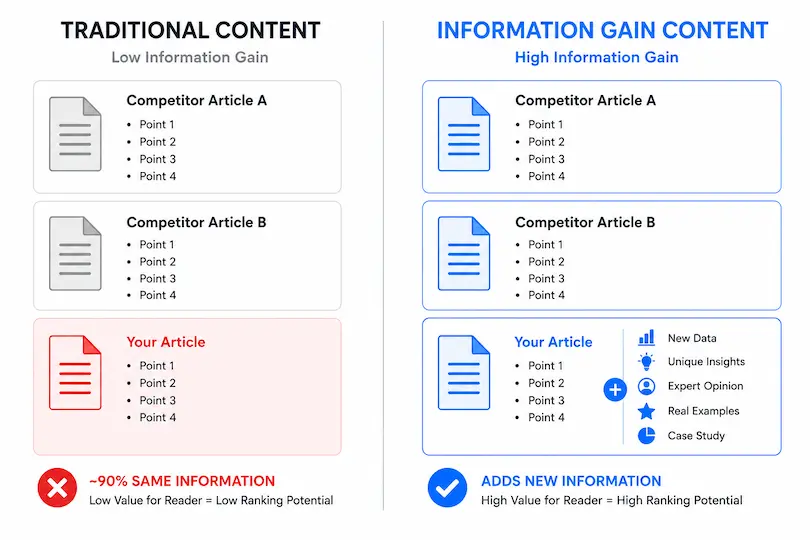
Today, Information Gain is becoming one of the most important factors in modern optimization because the internet’s biggest problem is the overwhelming amount of repetitive content.
I remember when our goal was simply to scan textbooks and publish them online. At that time, the objective was to fill the internet with as much information as possible.
Today, the problem is no longer a lack of information. Millions of articles simply repeat what has already been written without contributing anything new.
As a result, many of these articles differ only in their design, layout, or images.
That’s why Information Gain has become so valuable. It represents additional information that users cannot find on other websites or in other publications.

How Is Information Gain Applied?
Information Gain can take many different forms. It may include original research, experimental results, proprietary methodologies, unique statistics, real-world case studies, experimental conclusions, or original frameworks and models.
The more original information your content contains, the greater the likelihood that AI systems will choose it as a source when generating answers.
Brands Matter More Than Individual Pages
Another important trend has emerged—the growing importance of strong brands.
In the past, you could create a page targeting a branded search query, and if the brand itself didn’t have a dedicated page, you could rank above it in search results.
Today, that situation has become extremely rare. Yes, it still exists in a few niches, especially in more competitive gray areas—I know that firsthand. But in general, modern search systems evaluate the reputation of an entire website rather than individual articles. As a result, it’s much harder for a single page to achieve strong visibility on its own.
A website needs to consistently publish high-quality content within its niche. The stronger the site’s overall reputation becomes, the more likely its new content is to be cited by AI systems.
That’s why, if you’re building a website today, you should focus on creating a complete content ecosystem. Build topical clusters, strengthen your Topical Authority, maintain consistent quality standards, regularly update existing content, publish original research and analytical reports, and continuously strengthen your brand recognition.
What Should You Do Today?
AI Search technologies continue to evolve rapidly, but the fundamental rules of the game have already been established.
If you want to prepare your website for the future of search, focus on the following priorities:
- Create content that fully answers the user’s question.
- Publish original research and real-world case studies.
- Structure your content using clear headings, lists, and tables.
- Implement proper Schema.org markup.
- Regularly update existing articles.
- Invest in expertise rather than simply publishing more pages and articles.
Conclusion
We’re living through a fascinating period where search is evolving faster than ever before.
In the past, the primary objective of SEO was to rank a page at the top of the search results. Today, that alone is no longer enough.
We still need to rank websites at the top of search results, but we also need to become trusted information sources for Answer Engines.
Answer Engine Optimization is not a replacement for traditional SEO—it’s an extension of it.
Technical SEO, topical relevance, and website authority remain just as important as ever. However, they must now be combined with additional requirements: well-structured content, direct answers to user questions, demonstrated expertise, original data, and high informational value.
Websites that adapt to these changes are already gaining a competitive advantage today.