Transactional keywords are search queries that indicate a user’s intention to complete a transaction, that is, purchase a product, subscribe to a service, or perform another conversion action.
These queries are located at the very bottom of the classic marketing funnel. The so-called hot customer is already ready to complete a conversion action. Therefore, these keywords provide a higher conversion rate and higher revenue.

- What Are Transactional Keywords?
- Informational, Commercial, and Transactional Queries: What Is the Difference Between Them?
- Why Are Transactional Keywords So Important for SEO?
- What Does a Transactional Query Look Like?
- Competition for Transactional Queries
- Checklist for an Effective Transactional Page
- Conclusion
What Are Transactional Keywords?
These are search queries that we need to take into account when collecting our semantic core, when our potential customer is already ready to make a decision about purchasing a product or service.
A conversion is not necessarily the purchase of a product. It can be signing up for a subscription, downloading a program, selecting a particular offer from several options, and so on.
But we always assume that the potential customer is ready to buy something that we are offering, and is simply phrasing these queries in different ways.
Marketing Funnel
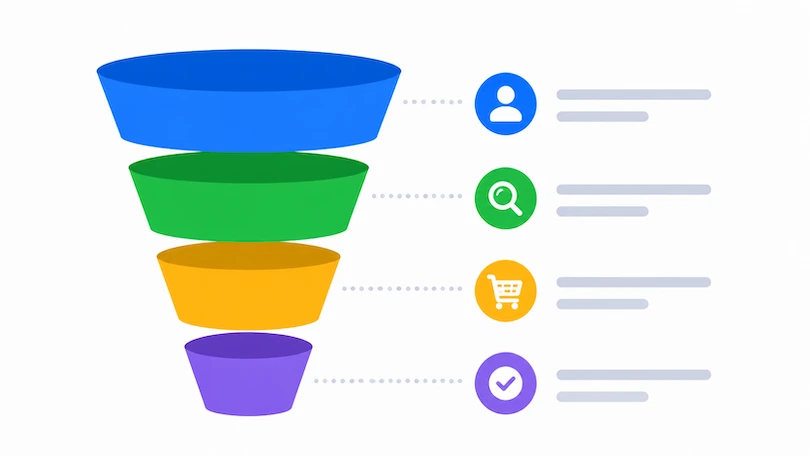
In classic SEO, such queries will have a much lower search volume than informational keywords. But this is logical. A person first searches for what, where, and how, and only then. In other words, they search more often for what it is and how it works than only when they are ready to buy.
They take a long time to mature, and only then enter a specific query and purchase a product or service.
The main value of such keywords, transactional keywords, lies in the high conversion rate because the user has already gone through the stage of researching the product or service and is as close to a purchase as possible.
Informational, Commercial, and Transactional Queries: What Is the Difference Between Them?
When you build your SEO strategy, you need to understand the difference between informational, transactional, and commercial intents.
Below, I will provide a table to clearly show how they differ.
| Criteria | Informational Queries | Commercial Queries | Transactional Queries |
|---|---|---|---|
| User Goal | Get information | Research options before buying | Complete a conversion action |
| Example Query | How to choose wireless headphones | Best wireless headphones | Buy wireless headphones |
| Sales Funnel Stage | Awareness | Consideration | Decision |
| Traffic | High | Medium | Low or medium |
| Conversion Rate | Low | Medium | High |
| Competition | Medium | High | Very high |
| Content Type | Guides, tutorials, articles | Reviews, rankings, comparisons | Categories, product pages, landing pages |
| Business Value | Indirect | High | Maximum |
| Typical Query Modifiers | How, why, what is | Best, reviews, comparison, alternatives | Buy, price, order, discount, plans |
| Purchase Probability | Low | Medium | High |
Beginner SEO specialists always make the same mistake. They focus only on keyword volume and completely ignore intent.
That is why a query with 50,000 searches per month may look impressive, but if visitors do not generate any conversion actions on the website, then why do we need that traffic?
That is why we must guide the user through the funnel. We use informational queries, we move informational content into commercial content, and commercial content into transactional content.
And even a keyword with a few hundred searches per month will bring us much more profit than high-volume informational traffic.
Why Are Transactional Keywords So Important for SEO?
Search intent directly affects the commercial results of our website.
You can compare two queries:
- How do wireless headphones work.
- Buy wireless headphones online.
In the first case, the user is looking for information about how they work, they are still very cold.
In the second case, they are already deciding where to buy and are looking for the best purchasing options, delivery, price, and so on.
What Does a Transactional Query Look Like?
Most search phrases are formulated very quickly and often on the fly, without following grammar rules, and using the minimum number of words.
I remember when we first started doing SEO in 2010, we literally added keyword phrases to the page in their exact match form. If we take the same niche, it would be “buy headphones online”. We literally wrote phrases like that.
Today, there is no need to do that. A product page already has a “buy”, “order”, or “add to cart” button, and the search engine already understands that this is, in principle, a commercial page.
And therefore, you do not need to write such a direct commercial query on the page, but we have certain markers that allow us to understand that a query is commercial.
These are words such as:
- buy;
- order;
- subscribe;
- download;
- add to cart;
- and so on.
Examples:
- buy wireless headphones;
- order flower delivery;
- subscribe to a service;
- download an app.
Price and Plan Markers
These queries are related to researching the cost of an offer. These queries are often mixed. Some people classify them as commercial queries, while others classify them as transactional.
These are words such as:
- price;
- cost;
- plan;
- discount;
- coupon;
- promo code.
Examples:
- price of a service for a law firm;
- discount on gaming laptops;
- coupon for domains or hosting.
Comparison and Selection Markers
The user has already decided on the product category and is choosing the best solution for themselves.
And here we will see words such as:
- best;
- comparison;
- reviews;
- alternatives;
- versus.
For example:
- best CRM for small business;
- HubSpot vs Salesforce;
- VPN service reviews.
It is important to understand that the strength of transactional intent usually increases along with the specificity of the query.
For example, a keyword such as CRM system may attract users at different stages of the funnel: informational and even transactional.
But the query “CRM system for a law firm” already shows that the person has solved their problem and is refining the query. They know the type of product they need and are already a little closer to making a purchase than in the previous queries.
These queries are called long-tail keywords, and they often convert better than general high-volume keywords.
Yes, they have much less traffic than high-volume keywords, but usually this traffic is of higher quality and more commercially oriented.
AI Assistants
Actively use AI assistants. They have large databases, including keyword databases.
You can use Google AI Mode, Gemini, ChatGPT, Grok, Claude, and other systems.
Simply use a prompt like this:
“Give me a list of commercial keywords that customers may use to search for my service or product.”
And you will also get a large number of insights.
You can also ask them to group these keywords or to suggest additional LSI Keywords to diversify your content.
I wrote an article on this website about what LSI Keywords mean in the modern understanding.
Filter Queries by Intent
You need to separate informational queries from commercial ones, and commercial queries from transactional ones.
You can do this using certain tools. KeywordStat can do this as well.
But here is a small piece of advice from me: collect your semantic core already clustered from the beginning.
Collect transactional keywords separately, commercial keywords separately, and informational keywords separately.
In our KeywordStat service, as well as in similar services such as Ahrefs, SEMrush, SE Ranking, and Serpstat, each keyword is assigned an intent.
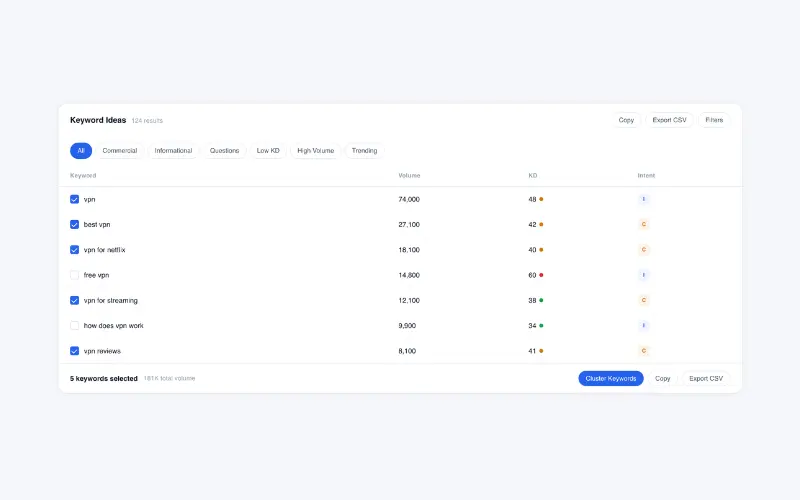
Therefore, to save time later, I recommend clustering your semantic core by intent right from the start.
Choose Long-Tail Keywords
If you have a young website that is just getting started, it is more logical to get traffic from low-volume keywords.
While your website is new, Google will not always be ready to send you traffic because you simply do not have enough authority yet.
For this, you can use the Avalanche SEO technique.
I also wrote an article about it on this website. You can read what it is.
Competition for Transactional Queries
Naturally, when we talk about money, competition increases, including in the search results.
If with informational keywords you compete with blogs, news websites, and niche resources, then with transactional keywords you will already be competing against large companies, marketplaces, major brands, as well as advertising in the search results.
Therefore, you should be prepared for this.
To rank for commercial queries, it is not enough to simply create a product page or a service landing page and add texts with keywords.
Google ranks these pages a little differently.
There will most likely be no problems with content relevance, neither for you nor for your competitors. But how well the page helps the user make a decision, how authoritative the website is, and how it has already proven itself — these factors will have separate importance.
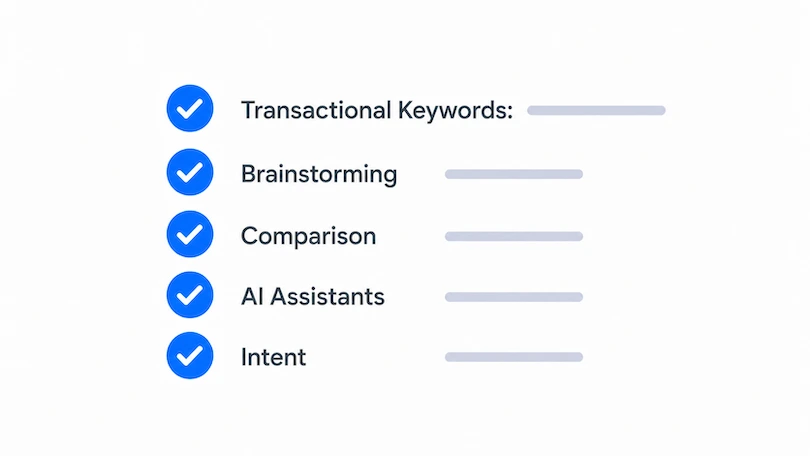
Checklist for an Effective Transactional Page
If you want to receive high-quality commercial traffic, then your product page or service landing page should contain certain elements.
Offer and Call to Action
Your user should clearly understand what exactly you are offering, how much it costs, what additional costs may be involved, what delivery options are available for the product, and what else needs to be ordered if you are offering a service.
The following buttons should be clearly visible on the page:
- Order;
- Buy;
- Get a Consultation;
- Start for Free;
- Log In;
- Get Access;
- and so on.
Transparent Pricing Information
Today, even supermarkets, when they play around with pricing, still display the cost per kilogram, per liter, and so on at the bottom.
If your pricing structure is not transparent, it may become one of the reasons why a user leaves the page because there is no clear information about the cost, and this makes the user uncomfortable.
Display pricing, plans, possible discounts, available service packages, payment terms, and delivery conditions.
Because sometimes delivery is included in the price, and sometimes it is not.
FAQ for Landing Pages
It should be noted that an FAQ is not just a place where you can add keywords that did not fit on your landing page.
An FAQ should be used correctly.
An FAQ is the place where many users want to clarify details before making a purchase, and it is good if you do not write meaningless information there, but actually answer your users’ typical questions.
For example:
- Is there a free trial period?
- How can I cancel my subscription?
- What payment methods are available?
- How long does delivery usually take?
- Is there a warranty for the product?
- Is it possible to return the product if it did not fit or if I did not like it?
And so on.
Reviews and Social Proof
If we are talking about an online store, there are always reviews.
Go to Amazon and look at the number of reviews on the most popular products. There are simply thousands.
Moreover, these reviews are real. I have personally bought products on Amazon and know that if you want to leave a review there, you need to attach a photo, provide proof of purchase, and so on.
In other words, faking these reviews is practically impossible.
If you have an online service, publish customer reviews.
Do not create fake reviews and do not generate images.
I understand that not all clients are comfortable with having their photos displayed on your website.
First, you can incentivize a client by offering them a backlink. I know many SEO agency owners who would do a lot for a backlink to their website. That’s a joke.
Record a video testimonial.
Very few people trust plain text reviews anymore, so video testimonials can work much better.
You can publish:
- customer reviews;
- ratings from popular services such as Trustpilot or similar platforms;
- product or service use cases;
- statistics;
- logos of well-known clients, if you have them.
I have another SaaS service, and I noticed that many customers register using their work email addresses, and some of them were from fairly large companies.
I contacted them by email and asked whether I could use their company logo since they were my customers.
They agreed and said, “Yes, of course, go ahead.”
And that is how I added logos of well-known companies to my website.
Convenient Navigation and Internal Links
If you have a large product page, you can create tabs and move between sections, switch to specifications, reviews, additional tabs, and product descriptions.
If you have a service, make it easy to find pricing plans, pricing comparisons, user guides, and so on.
The fewer obstacles users encounter on their path to conversion, the better it will be for you, and the greater the likelihood that this user will eventually become your customer.
Conclusion
I have explained in detail what transactional keywords are and why they are one of the most valuable types of queries in SEO.
Although they attract less traffic, they bring users, buyers, customers, and so on.
Therefore, your SEO strategy should not be built only around high-volume keywords.
Most likely, it is important to understand user intent and combine different types of keywords, guide the customer through the funnel, publish informational articles to attract informational traffic and educate cold users about your products and services, warm up the user, bring them to landing pages that are commercial and transactional, and ultimately sell them your products or services.
Do not forget to analyze search intent.
Start with long-tail queries that have strong commercial intent and gradually move toward shorter queries with higher keyword difficulty and higher search volume.
Create different types of pages that help users make decisions quickly so they can complete the desired action on your website.
Therefore, use the right approach when choosing your semantic core, evaluating intent, and directing your SEO budgets to where they will generate the maximum return for your business.
That is all from me. Thank you for reading this article. Read other articles on my website.