Short tail keywords are broad search terms, usually one or two words long, that attract massive traffic but also brutal competition.
They sit at the top of the SEO funnel and shape how search engines understand your website’s topic authority.

- What are short-tail keywords?
- Why do we need short-tail keywords then?
- Short Tail vs. Long Tail
- The Problem with Short-Tail Keywords
- The Product Range Problem
- Why can a high-volume keyword disappoint you?
- How GEO is destroying classic short-tail traffic
- How to Win in Short-Tail SEO
- Content Optimization for AI Answers
- Using KeywordStat
- Conclusion
What are short-tail keywords?
Various blogs and forums will tell you that short-tail queries are short keywords of one or two words, for example: laptop, fitness app, CRM, SEO.
But in today’s reality, this definition sounds very outdated, because the length of a query in words is only an indirect indicator.
Yes, short-tail keywords are high-frequency search queries with extremely vague, broad user intent and extremely high competition.
When a user types “laptop” into the search bar, their motive is completely unclear even to search engines. They’re looking for reviews of new products, or are looking for laptop wallpaper, or the location of a service center, or are ready to buy a laptop right now.
Because of this uncertainty, search results for short-tail queries will vary greatly because the search engine needs to satisfy the entire intent.
It seems like a very logical strategy to choose long-tail keywords. There’s less competition, and the commercial intent is higher. It seems obvious.
Why do we need short-tail keywords then?
Relying solely on long-tail keywords is also a dead end.
Your structure will become fragmented, and you’ll rank for a large number of microphrases, but your site won’t have sufficient topical authority, and Google’s algorithms simply won’t understand your core expertise.
That’s why I believe an effective SEO strategy is synergy. General hub pages optimized for short-tail keywords build Topical Authority and overall site visibility in the niche. At the same time, narrow, long-tail spoke pages generate targeted traffic, leads, and provide the business with stable sales.
Short Tail vs. Long Tail
Most specialists focus solely on search volume when choosing keywords and completely ignore the context of these keywords.
That’s why large brands invest millions in maintaining positions for general keywords. But does this mean you should do the same?
Let’s take a look at how different types of keywords behave using a real-world e-commerce example.
I have prepared a comparison table for you where I clearly show how it works.
| Query Type | Example Search Query | Search Intent | Conversion Probability | SERP Competition |
|---|---|---|---|---|
| Short Tail (Head) | “CRM system” | Market research, gathering information | Low | Extreme |
| Middle Tail (Body) | “CRM for small business” | Comparing options, narrowing down the choice | Medium | High |
| Long Tail | “best CRM for small law firms” | Ready to buy a solution for a specific niche | High | Low |
The Problem with Short-Tail Keywords
When I worked at a digital marketing agency, clients would come to us with requests like, “I want to rank first for ‘insurance,'” “I want to rank first for ‘hosting,'” and so on.
This is a classic SEO ego trap, because businesses want to see themselves at the top for the most lucrative keyword in their niche because, firstly, it looks serious. We rank high for such-and-such a keyword.
But then the harsh reality sets in, and it turns out that the top sites are those with large budgets, long-standing domains, a huge number of backlinks, and editorial departments that produce content on an industrial scale.
And so, promoting short-tail keywords is quite expensive, painful, and time-consuming.
I’ve also seen stories where we were working to rank a very powerful keyword, and after we’d achieved it, these queries would drop after a Google update, and clients would be very nervous about it.
Therefore, I believe that focusing only on the position of your largest keyword in the search results is also wrong.
The Product Range Problem
Another reason why you can’t always use short-tail keywords is when you don’t have enough product range.
I once worked for an automotive e-commerce site that sold motor oils. The goal was to rank highly in Google for the query “buy motor oil.” And my team and I accomplished this fairly quickly.
But what was our problem?
We were a distributor for the Shell brand, and we had a couple of other brands. But our selection wasn’t that wide.
And when users came to the site, they mostly saw only Shell products. But when someone searched for “buy motor oil,” we didn’t know which brand they were referring to. And perhaps he was looking for a brand we didn’t have.
So we started to sag, and the main goal I set for the purchasing department was to add as many different products as possible to our product portfolio.
That’s how we acquired Mobil, Castrol, and other well-known brands.
Even though our margins on them were very small, we had to do it because people wanted to see a display case with motor oils.
And until we did this, our SEO situation was quite challenging.
Conclusion: Short-tail queries require your site to have maximum listing depth. If you can’t offer users a wide selection, Google will always prioritize marketplaces and large aggregators that offer this selection by default.
Why can a high-volume keyword disappoint you?
Search volume itself is a good metric, but a rather dangerous one.
I learned this lesson while working on promoting a SaaS product. We found a great short-tail keyword with high search volume and a high cost-per-click in contextual advertising. And the entire marketing team was thrilled.
We focused all our efforts on optimizing this page, reached the top, and failed to generate the desired traffic and, most importantly, sales.
It turned out that this search query was being entered by beginner freelancers and students, while the software was designed for the large B2B segment with high sales.
Thus, we attracted empty traffic while our competitors were attracting customers through narrower, less obvious, low-frequency search queries.
How GEO is destroying classic short-tail traffic
While the battle for short-tail keywords used to be fierce, with competition focused on reaching the top 10 organic results, today the rules have changed.
And, as you know, the biggest tectonic shift is the integration of AI-powered answers directly into search results. Google (with its AI Overviews powered by Gemini models) and Microsoft Bing (with its Copilot integration) are fundamentally changing our user experience.
For example, queries like “email marketing” are inherently ambiguous. Search engines no longer want to send users to third-party sites. They use their generative answers to provide a concise definition of the base term and a ready-made list of recommendations right at the top of the page, at position zero.
For example, you enter the query “email marketing,” and the answer tells you: “email marketing” is these three main steps: source 1, 2, 3.” And then comes the organic results: top 1, top 2, top 3. But the results are pushed far down, to the second screen.
This has led to a significant drop in the CTR of traditional organic links on the first page. There are various studies on this topic.
While we previously had a 15–30% CTR for the top spot for various niches (according to Stackmatix), now it can be 10% or lower, even 8%, and even 5–6% for some niches.
| Niche / Query Type | Real CTR of the #1 Position | What Takes the Clicks? |
|---|---|---|
| Informational (“How to choose…”, “What is…”) | 5% – 10% | AI Overviews, Featured Snippets, Wikipedia. |
| Commercial / E-commerce (“Buy running shoes”, “Price…”) | 8% – 15% | Google Shopping ads, comparison sites, and marketplaces. |
| Local Services (“Car repair near me”, “Electrician”) | 10% – 18% | The Google Local Pack, which can capture up to half of the traffic. |
| Branded Queries (“Official [Brand] website”) | 50% – 70% | CTR remains consistently high because the user is looking for a specific company. |
So what can you do about this?
You need to learn how to optimize pages for generative engines. This process is called GEO—Generative Engine Optimization.
And your task now is not just to write a keyword in the title, but to ensure that the AI algorithm selects your site as the primary source and cites it in its generated response.
How to Win in Short-Tail SEO
We can use the “Hub and Spoke” strategy.
If you simply create one page, stuff it with a bold keyword, and expect miracles, then most likely, nothing will happen.
Especially now that search engines use vector representations, neural mapping, and other approaches. They have long since abandoned keyword density, as it used to work in the early 2000s.
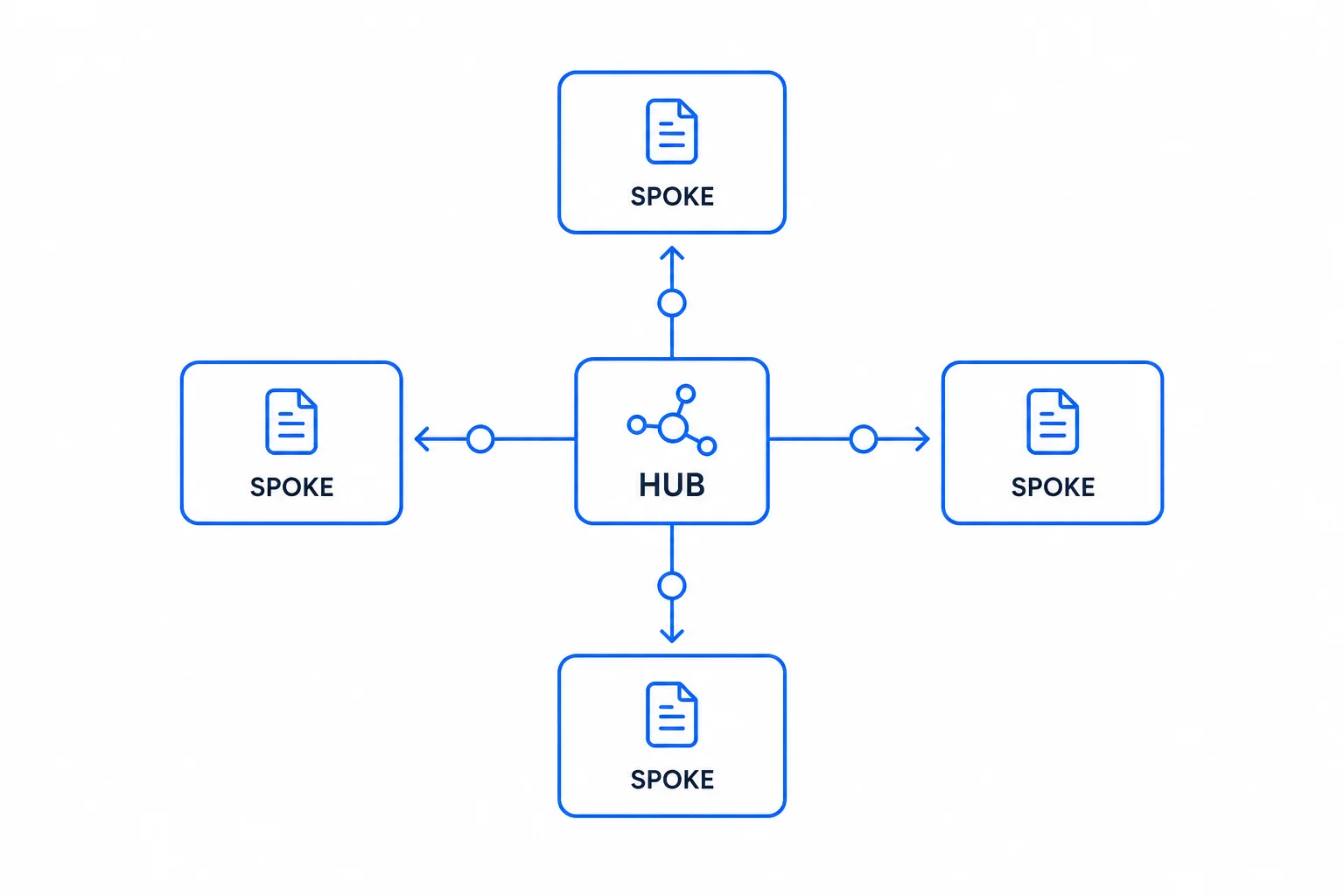
Search engines want to see your topical authority within the entire niche. Therefore, the best way to prove this authority is to use the hub and spoke model.
What does this mean?
You have a Spoke article (Supporting articles), for example, about B2B email. You have a Hub page—email marketing. And you create Spoke articles. These could be about B2B email, how to build a database, database revitalization, the best email services, the anatomy of emails, and so on.
Your hub page is focused on short-tail topics. It provides a comprehensive but high-level overview of the topic.
And your Spoke pages are dozens of narrow blog articles tailored to long-tail keywords.
And you implement internal linking. Each narrow Spoke article should link back to the main hub page using the right anchor text. Here, you can use your keywords, as well as long-tail keywords. Also critical for Short Tail is the external anchor list of the Hub itself, and not just the internal links from Spoke pages.
What’s the logic?
You quickly rank high for long-tail articles. They begin to receive targeted traffic and conversions. Through internal links, this traffic and link juice are redistributed to the main hub page.
And Google, seeing that you have a deep, structured cluster of content on the topic, begins to trust your homepage in the battle for short-tail positions.
But if the Hub page receives “empty” non-converting traffic, this will likely worsen behavioral factors.
Content Optimization for AI Answers
To ensure that generative engines like Google AI Overviews or Perplexity select your site as a source for broad queries, optimize your text according to simple rules.
Direct answers above the fold. AI looks for structures for quick parsing, so use the microdefinition format at the very beginning of a section.
Focus on information gain. Google doesn’t like rewrites. You should add unique data to the page: internal statistics, expert opinions, and so on. And GEO algorithms will be more willing to cite the original sources of unique information.
Structured lists and tables. Tables and numbered lists are a favorite content format for generative models because they find it easier to extract a ready-made table into their answer than to format a massive amount of your text.
Using KeywordStat
How KeywordStat Can Help You Work with Short-Tail Keywords
When I was working as an SEO, my main problem was sorting through all those keywords in Excel. It was a ton of phrases, and they weren’t organized.
And it was when we developed KeywordStat that we implemented this algorithm and applied a completely different approach. We made it possible to get keywords in just a few clicks.
What do you do?
You simply enter a keyword and get all the keyword ideas. You can also upload additional keywords, and they will be displayed in descending order. This means your main keywords will be at the top.
You can also select any keywords you need, update metrics for them, copy, export, save the project, or cluster them.
And, in my opinion, this is very convenient.
Conclusion
Don’t be afraid of short-tail keywords. They are essential for your brand’s authority and reach.
Approach them wisely, build dense content clusters, optimize pages for AI requirements, and carefully filter semantics to avoid wasting your energy and budget on empty keywords.
And, ultimately, search engine rankings don’t pay your business’s bills—they do.
So, use your brain, use long-tail keywords, but aim for short-tail keywords, and profit from your business.