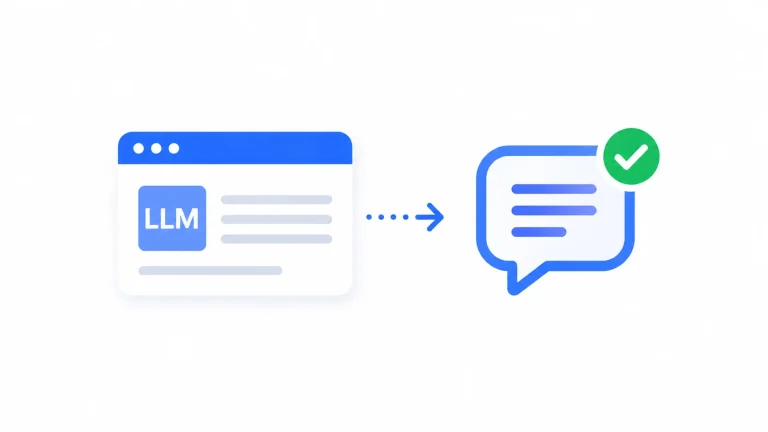
Passage Ranking is an intelligent algorithm designed to analyze individual sections or fragments of a page in order to evaluate their relevance to a search query.
This is how Google ranks individual fragments within a page, not just the page as a whole.
The algorithm analyzes the meaning of a specific paragraph or section and can display it in search results even if the main topic of the page is much broader.
- How Does Google Find an Answer in the Middle of a Huge Article?
- How Does Passage Ranking Work?
- Example of How Passage Ranking Works
- Debunking Popular Myths
- How to Optimize Content?
- The Concept of Semantic Chunking
- Contextual Sandwich for Copywriters
- Jump Links
- The Logic of Working with Long-Tail Keywords
- How to Check Whether a Text Is Optimized for Passage Ranking?
- Conclusion
How Does Google Find an Answer in the Middle of a Huge Article?
Imagine a situation where a user enters a very specific query into Google. Let’s take my niche as an example. How can you determine whether a particular keyword will rank? As you understand, this keyword has a low keyword difficulty.
In the past, the search engine would simply show pages that explained what keyword difficulty is and so on. Now Google is capable of finding an exact answer even inside a detailed guide, a PDF article, and so on.

That is why a technology called Passage Ranking was created.
The technology was created quite a long time ago. You know, I could literally feel it at my fingertips, that it was possible… I used to call this technology “content islands” and created additional content islands to make this information easier to find.
And now the importance of Passage Ranking is only increasing because modern search is becoming more and more integrated with LLM models, AI Overviews, RAG systems, AI assistants, and so on.
They all work according to the same principle. They find the necessary information on a page. They no longer rank the entire page.
Therefore, if your content consists of structured and high-quality semantic blocks, you gain an additional advantage not only in classic search but also in being cited by artificial intelligence.
How Does Passage Ranking Work?
Let’s look at a bit of theory. Google does not create a separate page for every paragraph and does not index every fragment on a page as a separate document. The page is analyzed as a whole, and Google simply finds a specific section on the page that answers a narrow question.
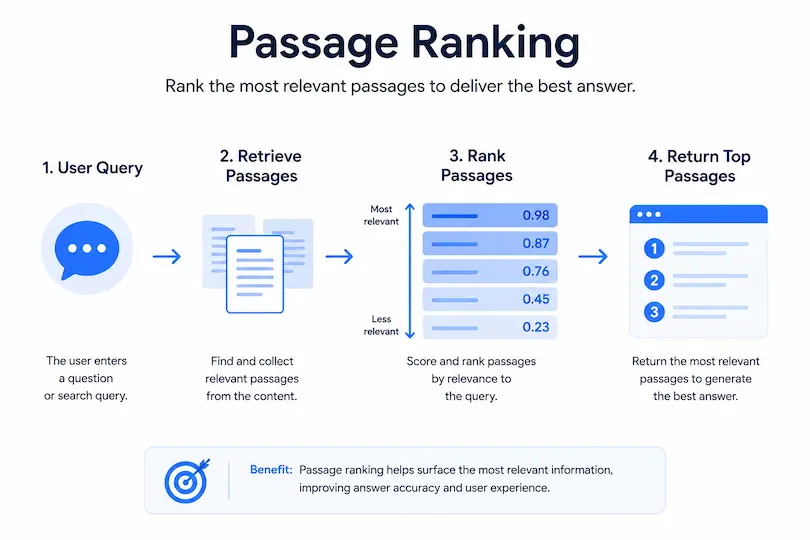
I noticed an interesting workflow improvement here: using explicit named anchors in H2 and H3 tags significantly helps Google process the document structure. This allows the search engine to generate direct “jump” links directly in search results, directing users directly to the relevant semantic block without having to manually scroll through a huge article.
Google has moved from traditional ranking to the analysis of semantic blocks because, in the past, search engines evaluated a document as a whole. They evaluated domain authority, backlink profile, page optimization according to keywords, user signals, text volume, spam score, content fluff, and so on.
The main problem was that high-quality expert materials contained important information, but that information was hidden somewhere deep within the content. Users did not search for such queries and, accordingly, never saw those answers.
Passage Ranking made it possible to solve this problem, and Google no longer sees a page only as a single document. It is capable of analyzing individual semantic blocks within it.
Advances in natural language processing became the foundation for the creation of Passage Ranking.
First, BERT, MUM, and other Google language models were introduced. As a result, the search engine learned to understand not only keywords but also the entire meaning of the text being analyzed.
Therefore, the algorithms began to analyze the context of the query, user intent, relationships between concepts, and the semantic similarity between a question and an answer within the text.
If we simplify it, Google learned to answer one simple question:
“Which fragment of text best solves the user’s problem right now?”
If that answer is found within an article, then that section may gain an advantage in search results and become a candidate for receiving search traffic.
Example of How Passage Ranking Works
Let’s imagine that we want to write an article. I want to write an article called “The Complete Guide to Keyword Research.” By the way, I already have such an article on my website, so you can read it.
And the total length of the article is very large. I even checked it — it is more than 7,000 words. Agree, that is quite a large article.
And inside the article there are many sections, for example:
- Why Is Keyword Research So Important
- Keyword Research and Its Impact on SEO
- Planning Website Structure
- Finding Keyword Growth Opportunities
- Main Types of Keywords
- Informational, Commercial, Transactional, Navigational Keywords
- Keywords by Search Volume
- Local and Global Keywords
- Keywords by Relevance Over Time
- Short-Tail Keywords
- Long-Tail Keywords
- Branded and Non-Branded Keywords
- Search Intent
- How to Determine Search Intent
- Intent Identification Checker
And so on.
In other words, it is a very large article with a large number of headings and semantic blocks.
And then a user enters a specific query: what are non-branded keywords, or how to conduct keyword research.
Previously, it was necessary to write a highly specialized article on that topic, but now you can write one large article, and certain fragments of that article will provide the answer to the user’s question.
Debunking Popular Myths
Let’s start with the fact that Google Passage Ranking is not a separate index. Google does not store each paragraph as a separate page. The document is still indexed as a whole, but during the analysis and ranking stage of search results, Passage Ranking uses its algorithm to find the most valuable element within it.
Passage Ranking is not the same thing as a Featured Snippet. These are completely different things. Passage Ranking evaluates the relevance of a fragment, while a Featured Snippet is simply the way that result is displayed in search.
That fragment may participate in Passage Ranking without appearing in a Featured Snippet. And vice versa.
Therefore, it should be said that one mechanism is responsible for understanding content, while the other mechanism is responsible for how that content is shown to users in search results.
Long-Form Content Does Not Work
This is another popular myth. And, you know, it is partly true.
We noticed on some websites that reducing the number of words helped us rank better. But this did not happen because of the reduction in word count itself. We simply removed unnecessary fluff and stopped cluttering the page with useless material.
We squeezed the water out of the sponge and kept only the most important things.
But if you want to fully cover a guide, a high-quality long-form article will receive traffic from a huge number of low-frequency and medium-frequency keywords.
Therefore, the most important thing when creating a long-form article is a good structure, while the number of words no longer matters.
How to Optimize Content?
Let’s try to create a universal guide that will work for most niches.
Use H2 and H3 Headings
This is still a good way not only to include keywords but also to use them as semantic markers, because each subtopic should have its own heading.
Your structure will be very poor if you have a huge 2,000-word text with no headings at all while moving from one topic to another throughout the article.
Paragraphs Should Be Self-Contained
Make sure Google can understand the meaning of a block without reading the entire article. Do not leave a thought unfinished; logically complete the paragraph.
One Paragraph — One Idea
Sometimes, when we write, we start discussing one thing, then remember additional details, dive deeper into them, and eventually lose the main point.
Therefore, follow the principle of “one question — one answer,” and make sure the key idea is contained within the paragraph.
This will make the text easier to understand not only for algorithms but also for users.
Use Lists
Yes, yes, I know that we have all become afraid of lists after AI detectors started identifying our lists as content that was not written by a human.
But I am also a human, and I also like lists. And I like it when an article is structured with lists.
Therefore, instead of using long enumerations within text, you can use:
- Bulleted lists
- Numbered lists
- Sequential lists when describing stages or steps in a process
You can also use checklists.
This makes information on a page easier to consume.
Elements such as lists and tables also very often appear in enhanced search result features.
Creating Tables
Yes, and here we are again talking about the fear of AI detectors, because just like with lists, they also react to a large number of tables.
But tables help us present data in a compact format: “before and after,” key advantages, and so on.
Therefore, tables are still well received by both users and algorithms.
Perhaps you should not create too many of them, and you should not make them with a large number of columns, so that they remain easy to consume.
Questions and Answers
Use a Questions and Answers section. This is an opportunity to answer questions that users may have after reading the article.
The Importance of Information Gain
I have a separate article about Information Gain. You can read it, but we definitely need to acknowledge that another very important trend has emerged.
We can no longer simply rewrite articles.
If all websites provide the same answer, then Google is forced to find the content that delivers more additional value.
Therefore, if your material includes research, examples, case studies, statistics, or your unique experience, then add those materials to the article.
Because Passage Ranking helps find the answer, while Information Gain helps find the best answer.
The Concept of Semantic Chunking
I believe it’s important to understand how search crawlers and systems such as Passage Ranking and AI Overviews technically process passages.
This is how it works. Algorithms split long documents into so-called chunks. These are semantic blocks of a certain size, usually between 200 and 500 words.
If a paragraph is too short—less than 50 words—the crawler may not have enough context to answer a specific query. On the other hand, if a section consists of more than 600 words without subheadings or structure, its semantic weight may become diluted, and the Passage Ranking algorithm may not be able to extract the exact idea from that text.
Contextual Sandwich for Copywriters
We’ve already discussed how to optimize paragraphs, but we also need a clear and simple writing guideline for copywriters.
We can use the Contextual Sandwich principle. The first sentence of a paragraph should provide a direct, clear, and simple answer. You can look at how Wikipedia does this. They present the answer immediately in the first sentence.
I also often format this block as a quotation to provide structured content for search crawlers.
In the first sentence, we give a direct and very clear answer to the question. The following two or three sentences develop the idea and provide the main evidence. They include numbers, facts, and examples.
The final sentence of the paragraph should contain a clear conclusion.
As a result, content written in this structure is more likely to be extracted by Passage Ranking and AI Overviews, because these systems understand its meaning more easily.
Jump Links
It’s also worth mentioning that named anchors in H2 and H3 headings help Google significantly.
Most articles, for example in WordPress, can use automatic plugins. However, these plugins sometimes generate chaotic heading anchors that aren’t ideal.
It’s much better when the Table of Contents is generated using anchors that match the heading names and have clean, manually written, human-readable IDs that accurately reflect the search intent.
For example, instead of id=”98234″ it is better to do this: id=”keyword-difficulty-calculation”
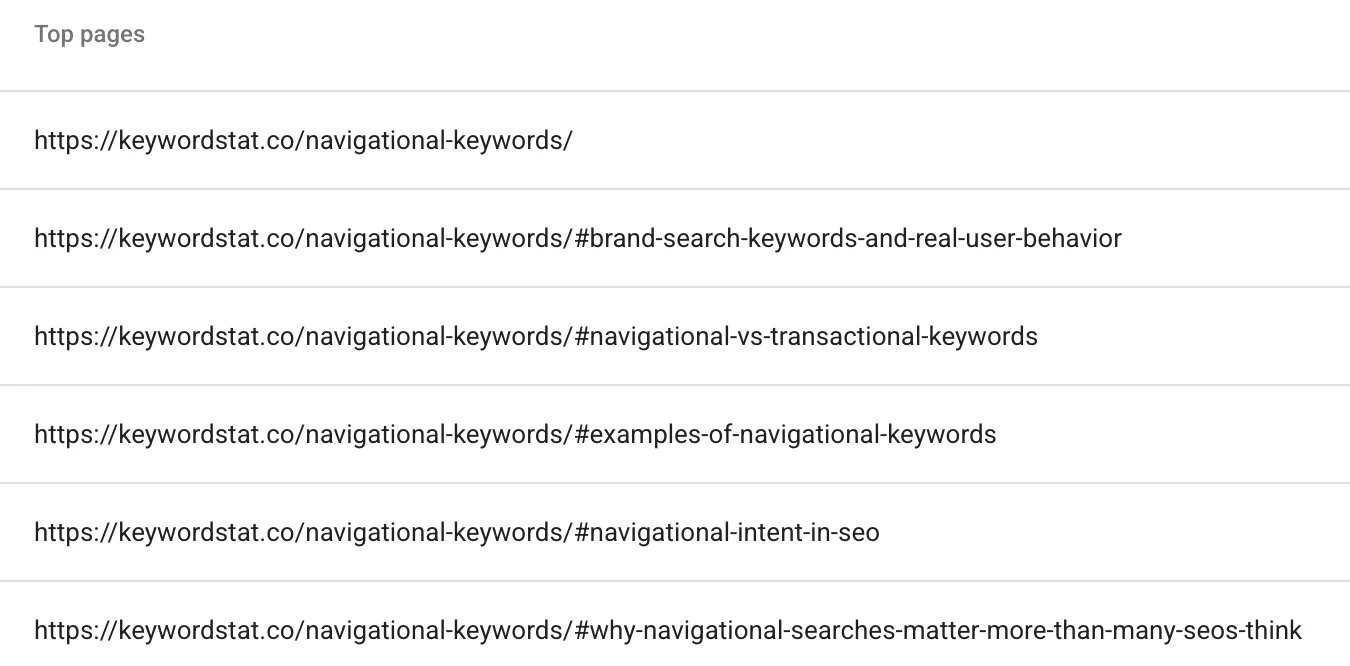
This helps Google display jump links directly in search results. We can track this behavior in Google Search Console (by filtering performance reports by URLs containing the “#” symbol).
I’ll show you an example using one of my articles as an example:
The Logic of Working with Long-Tail Keywords
Thanks to Passage Ranking, we no longer need to create dozens of small articles targeting every micro-query.
Instead, it’s enough to publish one well-structured, comprehensive guide—a solid long-form article.
The algorithm will identify the relevant passages within it, match them to long-tail search queries, and allow that hub article to attract a large amount of targeted traffic from a single page.
How to Check Whether a Text Is Optimized for Passage Ranking?
I will give you a short checklist so that you can evaluate your content. Ask yourself these five simple questions.
Passage Ranking Checklist
- Do your H2 or H3 headings contain search queries?
- Is the paragraph a complete answer?
- Does the paragraph contain specifics: numbers, examples, facts, instructions, or tables?
- Are you using unnecessary words?
Remove all constructions that add unnecessary words. Ruthlessly remove them from the text.
Is the current section understandable without reading the previous paragraphs?
If a person lands on a specific block and finds the information there, it means they can understand the meaning without reading the entire article.
Conclusion
Passage Ranking has changed the entire approach to content creation because today Google no longer evaluates a page as a whole and has learned to read the semantic blocks within a page.
If you want to create content that will win in search results, do not just use the right words, provide answers to specific questions.
Everything has long since moved from document optimization to knowledge optimization, and every section of an article becomes a potential entry point from search.
Therefore, the more structured and useful your content and semantic blocks are, the greater the probability of receiving organic traffic.
And in the modern era of AI Overviews, RAG systems, and artificial assistants, this approach has already become the norm, and you should not fall behind these trends.
The content of the future is no longer content written around keywords and a certain word count, but a collection of clear expert answers and recommendations combined into a logical structure.
I’d like to conclude by saying that in the era of vertical search and large-scale document indexing, knowledge optimization has replaced document optimization.
Today, what matters isn’t how much you’ve written on a page, but what you’ve actually said. The more logically your content is structured, the greater your chances of being cited in search results.
That is all from me. Thank you for reading the article. Read other articles on my website.